A business expense receipt is the document that turns spending into a deduction — and the tax system is specific about what it must show and how long it must be kept. For a business owner it substantiates the write-off; for an employee it’s the ticket to a tax-free reimbursement under an accountable plan. This page explains what a business expense receipt needs to contain, why a card statement alone isn’t enough, and how retention and digitization actually work.
Business Expense Receipt
Add custom logo
Edit line items
Choose payment method
Add/remove elements
Customize business information
Choose font
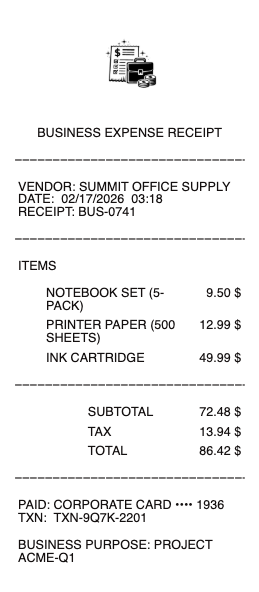
What’s on a Business Expense Receipt
The vendor — who was paid
The date of the expense
The amount, itemized where possible
What was purchased — the goods or service, line by line
The business purpose — noted on or with the receipt
The payment method, tying it to a bank or card record
The expense category it will be filed under — travel, meals, supplies, software
Substantiation — What the IRS Actually Wants
A deductible business expense must be ordinary and necessary for the business, and the receipt is how you substantiate it: who was paid, when, how much, and — the piece people forget — the business purpose. The purpose rarely appears on the receipt itself, so the working habit is to write it on or attach it at the time (“client lunch — Q3 renewal, J. Alvarez”), because reconstructing purposes at year-end is guesswork an auditor can smell. Certain categories carry extra rules: meals (generally 50% deductible) and travel demand the who/where/why detail, and the receipt-plus-note is what satisfies it. And a warning about shortcuts: a card statement alone is usually not enough — it proves a payment happened but not what was bought. The statement corroborates; the itemized receipt substantiates. Keeping both, with the purpose noted, is the whole discipline in one sentence.
Accountable Plans — Tax-Free Reimbursement Done Right
For employees and the businesses reimbursing them, the receipt powers something valuable: the accountable plan. Under IRS rules, an employer’s reimbursement is tax-free to the employee and deductible to the business when three tests are met: the expense has a business connection, it’s substantiated to the employer within a reasonable time (that’s the receipt and purpose), and any excess advance is returned. Fail those tests — no receipts, vague purposes, kept excess — and the arrangement becomes a non-accountable plan, where reimbursements are treated as taxable wages, with payroll tax for everyone. This is why company expense policies nag for itemized receipts within 30 or 60 days: the paperwork isn’t bureaucracy, it’s what keeps the money untaxed. Per-diem rates offer a receipt-light alternative for travel meals and lodging, but the underlying trade is the same — documentation in exchange for tax-free treatment.
Retention, Digitization, and Building an Audit-Proof File
Two practical questions finish the picture. How long to keep receipts: the IRS can generally examine returns for three years, stretching to six where income is substantially understated — so three years is the floor and six is the safe habit for business records (longer for assets you depreciate, where the receipt matters until the asset is disposed of plus the limitation period). Paper or digital: scanned and photographed receipts are accepted — the IRS has long allowed electronic storage of records, which is why expense apps that photograph receipts at purchase are the modern best practice; thermal paper fades, but a legible scan doesn’t. The audit-proof pattern is boring and effective: capture the receipt at the moment of spending, note the purpose, file it by category and month, and let the bank statement corroborate the trail. An expense that takes ten seconds to document at purchase can take an hour to defend without it.
Related business receipts: see also our Freelance receipt guide and our Professional Services receipt guide.
Create a Business Expense Receipt
Our generator produces a clean business expense receipt — vendor, date, itemized amount, and a purpose line — as a PDF for an expense report, an accountable-plan reimbursement, or your deduction file when a faded or lost original needs a legible stand-in.
Use it responsibly: recreate only expenses that actually occurred, with true amounts and purposes. Fabricating business expense receipts to claim deductions or reimbursements for spending that never happened is tax fraud — the IRS cross-checks receipts against bank records, and employers verify against card feeds. This tool is for legitimate record-keeping only.
Frequently asked questions
Everything you need to know about the product and billing.
What does a business expense receipt need to show?
The vendor, the date, the itemized amount, what was purchased, and — noted on or with it — the business purpose, plus the payment method tying it to a bank or card record. Purpose is the piece people forget, and the one auditors ask about.
Is a credit card statement enough proof of a business expense?
Usually not on its own — a statement proves a payment happened but not what was bought. The itemized receipt substantiates the expense; the statement corroborates it. Keeping both, with the business purpose noted, is the reliable pattern.
What is an accountable plan?
The IRS arrangement that makes employer reimbursements tax-free: the expense must have a business connection, be substantiated with receipts within a reasonable time, and any excess advance returned. Fail those tests and reimbursements become taxable wages — which is why expense policies demand itemized receipts.
How long should I keep business expense receipts?
Three years is the floor — the IRS’s general examination window — and six years is the safe habit, since substantial understatements extend the period. Keep receipts for depreciated assets even longer: until disposal plus the limitation period.
Are scanned or photographed receipts accepted?
Yes — the IRS accepts electronically stored records, so a legible scan or photo stands in for the paper. That’s the practical answer to fading thermal receipts: capture them at purchase with an expense app and let the digital copy be the durable record.
Why note the business purpose on the receipt?
Because the receipt shows what was bought but not why it was business. A one-line note at the time — client, project, reason — satisfies the substantiation rules for meals and travel and beats reconstructing purposes months later, which audits treat with suspicion.