A professional services receipt documents payment to a licensed expert — a lawyer, accountant, consultant, engineer, or architect — and it carries details ordinary service receipts don’t: itemized time entries, a retainer that may be held in trust, and a split between fees and pass-through expenses. Because these professions are regulated, how they bill (and receipt) follows rules. This page explains what the receipt shows and why the retainer line is unlike any other.
Professional Services Receipt
Add custom logo
Edit line items
Choose payment method
Add/remove elements
Customize business information
Choose font
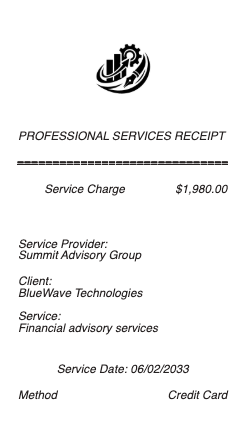
What’s on a Professional Services Receipt
The firm/professional and client, with an engagement or matter reference
Itemized time — task, date, hours, and hourly rate — or a flat/project fee
A retainer applied, and the balance remaining
Fees vs disbursements — the professional’s charges separate from costs paid on your behalf
The billing period or matter phase covered
Tax where applicable, amount paid, and method
Trust-account handling, where an advance was held in trust
Hourly Billing and Itemized Time Entries
Professional work is often billed by the hour against itemized time entries, and the receipt or invoice reflects it line by line: the date, a description of the task, the time spent, and the rate. Lawyers and many consultants bill in tenth-of-an-hour (6-minute) increments, so a detailed statement can list many small entries that sum to the total. This granularity is the point — it lets the client see what was actually done for the fee, which regulated professions are expected to provide. Different people at a firm bill at different rates (a partner versus an associate versus a paralegal), so the same matter can carry several rates on one statement. Reading the time entries is how you verify the charge against the work, rather than accepting a lump sum — and it’s the record you’d rely on if a fee were ever questioned.
Retainers Held in Trust — the Distinctive Part
The feature that sets professional-services billing apart is the retainer held in trust. When you pay an advance to a lawyer (and some other professionals), that money often goes into a client trust account — for attorneys, an IOLTA account — and it remains your money until it’s earned. The professional draws against it as work is performed, and each statement shows the retainer drawn down and the remaining trust balance. This matters ethically and practically: unearned retainer must be refundable, and trust funds can’t be mixed with the firm’s operating money. So a professional-services receipt may show not just what you paid but what remains held on your behalf — a line no ordinary receipt has. If your matter ends with a trust balance, you’re owed it back. Understanding the retainer-and-trust mechanics is what makes these statements legible.
Fees vs Disbursements, Deductions, and Records
Professional bills separate fees (the professional’s own charges) from disbursements — costs paid on your behalf and passed through, like court filing fees, expert witnesses, travel, or government charges. Keeping them distinct matters because disbursements aren’t the professional’s income and may be treated differently for tax. Speaking of which: professional fees for a business are generally deductible (legal and accounting fees tied to the business, for instance), so the itemized receipt is the substantiation, and the fees/disbursements split helps classify each. The engagement letter that started the relationship defines the rate, scope, and retainer terms, so pairing it with the receipts documents what was agreed and billed. For the professional, these are income records under regulatory record-keeping duties. Keep the itemized statements — the summary “paid in full” version won’t show the time, the trust movement, or the fee/disbursement split a business or an audit needs.
Related professional service receipts: see also our Service receipt guide and our Monthly Service receipt guide.
Create a Professional Services Receipt
Our generator produces a clean professional services receipt — firm and client, itemized time or flat fee, retainer applied, fees and disbursements, and total — as a PDF you can issue a client or keep for your records and bookkeeping.
Use it responsibly: recreate only real work and payments, with their true time and amounts. Fabricating professional-services receipts to misstate income, inflate a business deduction, or misrepresent trust funds is fraud — and for regulated professionals, billing and trust-accounting records are subject to oversight and can be audited. The firm’s own itemized statement is the authoritative document; this tool is for legitimate record-keeping only.
Frequently asked questions
Everything you need to know about the product and billing.
What does a professional services receipt show?
The firm or professional and client with a matter reference, itemized time (task, hours, rate) or a flat fee, any retainer applied and the balance, a split between fees and disbursements, the period or phase covered, tax where applicable, and — where used — trust-account handling of an advance.
Why are professional services billed in tenth-of-an-hour increments?
Lawyers and many consultants bill in 0.1-hour (6-minute) units, so a statement lists many small time entries that sum to the total. The granularity lets the client see exactly what was done for the fee, which regulated professions are expected to document.
What is a retainer held in trust?
An advance you pay that goes into a client trust account (an IOLTA account for attorneys) and remains your money until earned. The professional draws against it as work is done, and the statement shows the amount drawn and the remaining trust balance. Unearned retainer is refundable.
What’s the difference between fees and disbursements?
Fees are the professional’s own charges for their work. Disbursements are costs paid on your behalf and passed through — court filing fees, experts, travel, government charges. They’re kept separate because disbursements aren’t the professional’s income and may be treated differently for tax.
Are professional service fees tax-deductible?
Professional fees tied to a business — legal and accounting fees, for instance — are generally deductible, and the itemized receipt is the substantiation. The fees-versus-disbursements split on the statement helps your accountant classify each correctly.
Why should I keep the itemized professional statement?
Because a summary “paid in full” version won’t show the time entries, the trust-account movement, or the fee/disbursement split that a business deduction, a fee dispute, or an audit needs. The itemized statement, paired with the engagement letter, documents what was agreed and billed.