A catering receipt documents an event food order, and it behaves less like a restaurant slip than like a small contract: booked ahead with a deposit, priced per guest, settled with a balance, and layered with service, delivery, and gratuity fees. Because catering is so often a business or event expense, the receipt is the record everyone from a bride to a corporate admin relies on.
Catering Receipt
Add custom logo
Edit line items
Choose payment method
Add/remove elements
Customize business information
Choose font
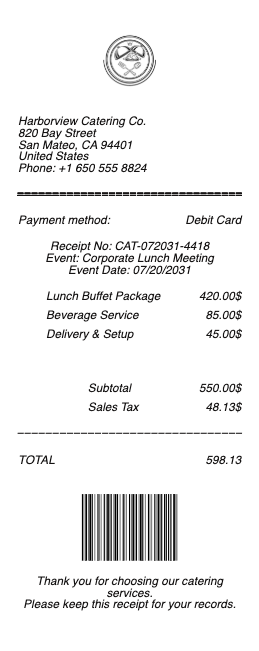
What’s on a Catering Receipt
Caterer name and contact, event date, and delivery/service location
Guest count — the number the whole order is priced against
The menu — packages or per-item, often quoted per person
Deposit paid and balance due, with the balance date
Service and delivery/setup fees, and gratuity — frequently a set percentage
Rentals and staffing lines, when servers or equipment are included
Tax, total, and payment method
Deposits, Guest Counts, and the Balance
Catering runs on commitments, and the receipt records them. Most events are booked with a deposit — commonly non-refundable, since the caterer reserves the date and buys ahead — followed by a final balance due before or at the event. The pricing hinges on the guaranteed guest count: you confirm a headcount by a deadline, the order is priced on it, and going below it usually still charges the guaranteed number while going above adds per-head. The receipt captures the deposit, the balance, and the count it was based on, which is exactly what a dispute over a changed headcount or a missed deadline is resolved against. Confirm those figures when you book, not on event day.
Service Fees vs. Gratuity — a Critical Distinction
Catering receipts carry a stack of fees that confuse people and inflate the total well beyond the food. The two most misread: the service or administrative fee is not the tip — it covers the caterer’s coordination and overhead and often does not go to staff — while gratuity is the tip and may be added as a set percentage on top. Add a delivery/setup fee and rentals and the itemized total can run far above the per-person menu price. For budgeting and for expenses, read each line: knowing whether gratuity is already included prevents both over-tipping and an under-budgeted event. This fee structure is the single biggest difference between a catering receipt and a restaurant bill.
Business Expenses, Invoicing, and Getting a Copy
Catering is overwhelmingly an expense — corporate events, weddings, office functions — so the receipt is often really an invoice: itemized, with terms, and sometimes issued to an organization that is tax-exempt, which changes the tax line. For reimbursement or accounting, the itemized catering receipt/invoice is essential, since the total spans food, staffing, fees, and tax that a card statement’s single line cannot break out. Caterers keep the full order record and can reissue the receipt or a paid invoice on request — useful because catering documentation is frequently needed weeks after the event for final accounting. Keep the deposit receipt and the final paid invoice together as the complete record.
Related dining receipts: see also our Bar receipt guide and our Food Truck receipt guide.
Create a Catering-Style Receipt
Our generator rebuilds a catering receipt or invoice — caterer and event details, guest count, per-person or package pricing, deposit and balance, service and delivery fees, gratuity, tax, and total — as a clean PDF for your event and accounting records.
Use it responsibly: recreate only real orders at their true amounts. Fabricating catering receipts for reimbursement, deposit disputes, or tax purposes is fraud — the caterer’s own order record and invoice are the authoritative documents.
Frequently asked questions
Everything you need to know about the product and billing.
What should a catering receipt include?
The caterer and event details, the guest count the order is priced on, the menu (per person or package), the deposit and balance due, service and delivery fees, gratuity, rentals or staffing, tax, and the total.
Are catering deposits refundable?
Usually not — the deposit reserves the date and covers advance purchasing. The receipt records the deposit and terms, so confirm the cancellation and refund policy when you book.
What is the difference between a service fee and gratuity on a catering receipt?
The service or administrative fee covers the caterer’s coordination and overhead and often does not go to staff. Gratuity is the tip, sometimes added as a set percentage. They are separate lines — read both before adding more.
How does guest count affect a catering receipt?
Pricing is based on a guaranteed count confirmed by a deadline. Going below it usually still charges the guaranteed number; going above adds per-head. The receipt records the count the order was priced on.
Is a catering receipt the same as an invoice?
Often yes — catering documentation is typically an itemized invoice with terms, sometimes issued to a tax-exempt organization. For accounting or reimbursement, that itemized invoice is the record you need.
Can I get a copy of a catering receipt after the event?
Yes — caterers keep the full order record and can reissue the receipt or paid invoice, which is common since final accounting often happens weeks later. Keep the deposit receipt and final invoice together.