A food truck receipt comes from a business that moves — parked at an office park today, a festival tomorrow — so the one thing it often lacks is a fixed address, and the one thing it almost always has is a mobile point-of-sale. That combination shapes the slip and makes the digital text-or-email receipt more useful than the paper one. This page covers what it shows and how mobile POS, cash, and events affect it.
Food Truck Receipt
Add custom logo
Edit line items
Choose payment method
Add/remove elements
Customize business information
Choose font
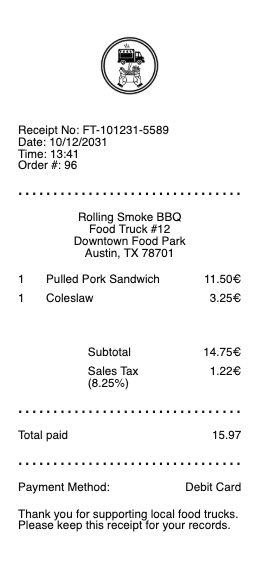
What’s on a Food Truck Receipt
Truck or business name — often more prominent than an address, which changes daily
Date, time, and the location or event, when noted
Each item from a focused menu, with any add-ons
Subtotal, tax, and a tip added on the card reader
Total and payment method — card or cash
A mobile POS reference (Square, Toast, Clover) and the option for a texted or emailed receipt
Mobile POS and the Text/Email Receipt
Food trucks were early adopters of tablet-based mobile POS — Square especially — and it defines the receipt experience. At the window you are usually offered a receipt by text or email instead of paper, which is the better copy to take because it lands as a clean digital record you can forward to an expense tool. The same systems place a tip prompt on the reader, so the tip appears as its own line on the receipt. If you skipped the digital receipt and need proof later, a truck running Square or similar can often re-send a recent transaction — worth asking, since food trucks rarely reprint from a stationary register the way a restaurant would.
Cash, Events, and No Fixed Address
Two realities make food truck receipts different from restaurant slips. First, many trucks still take cash, and a cash sale may produce only a brief printed slip or a verbal total with no automatic digital copy — so if you need documentation, pay by card for the emailed receipt or ask specifically for one. Second, the location is the event, not a street address: a receipt from a festival, market, brewery lot, or corporate pop-up may name the event rather than a fixed address, which matters when an expense reviewer expects a merchant location. Noting where and why (the conference, the client site) alongside the receipt fills that gap.
Expenses, Catering Gigs, and Getting a Copy
Food truck spend lands on expense reports through two doors: individual meals at a work event, and booking a truck to cater a company function — the latter closer to a catering invoice, with a deposit and per-head or flat-event pricing. For an individual meal, the emailed itemized receipt is the reimbursement document; for a catering booking, ask for a full invoice. For a lost receipt, the truck’s POS is the fallback if you paid by card; a cash purchase leaves only what you kept, so photograph any printed slip on the spot. Because trucks move, chasing a receipt days later is harder than with a fixed restaurant — capture it at the window.
Related dining receipts: see also our Catering receipt guide and our Street Food receipt guide.
Create a Food Truck-Style Receipt
Our generator rebuilds a food truck receipt — truck name and event/location, itemized menu items, tax, tip, and total — as a clean PDF when the texted or paper original is gone and your expense file needs it.
Use it responsibly: recreate only purchases you actually made, at their real amounts. Fabricating receipts for reimbursement is expense fraud — a truck’s mobile POS keeps the genuine transaction available to re-send.
Frequently asked questions
Everything you need to know about the product and billing.
How do I get a receipt from a food truck?
Most trucks run a mobile POS (often Square) that offers a texted or emailed receipt at the window — the best copy to take for expenses. If you missed it, a truck on Square can often re-send a recent card transaction.
Do food truck receipts show an address?
Often not a fixed one — trucks move daily, so a receipt may name the event or location (a festival, market, or corporate lot) rather than a street address. Note where and why alongside it for expense purposes.
What if the food truck only takes cash?
A cash sale may produce only a brief slip or a verbal total with no digital copy. If you need documentation, pay by card for the emailed receipt or ask specifically for a printed one, and photograph it.
Does the tip show on a food truck receipt?
Yes — the mobile POS tip prompt on the card reader adds the tip as its own line on the receipt, separate from the food total.
How do I expense a food truck meal?
Use the emailed itemized receipt, not the card statement line, and note the event and business purpose. If you booked the truck to cater an event, ask for a full invoice instead.
Can a food truck reprint a lost receipt?
If you paid by card, its POS can often re-send the transaction. Because trucks move and cash sales leave little trail, capture the receipt at the window rather than chasing it later.