A Chase Bank transfer receipt shows proof of a completed transfer made through a Chase checking or business account. It is commonly used for rent payments, reimbursements, and business accounting.
Chase Bank Transfer Receipt
Add custom logo
Edit line items
Choose payment method
Add/remove elements
Customize business information
Choose font
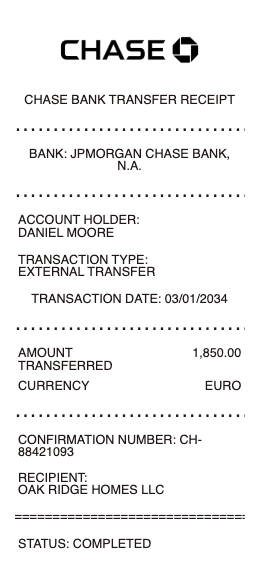
What's on a Chase Bank Transfer Receipt
A Chase bank transfer receipt is proof that money moved to or from a Chase account — most often a Chase wire transfer, but also an external ACH transfer or a Chase QuickPay/Zelle payment. Because wires are the high-value, same-day option, the receipt is built around traceable bank data. A complete Chase transfer confirmation includes:
Confirmation number and, for a wire, the IMAD/OMAD reference
Date and time the transfer was submitted and sent
Sender account (masked) with JPMorgan Chase as the sending bank
Beneficiary name, account, and bank
Chase wire routing number (021000021) or, for international wires, the SWIFT/BIC code CHASUS33
Amount and currency, plus the wire fee
Transfer type (domestic wire, international wire, or ACH) and status
An optional memo or reference — an invoice, escrow, or account number
Chase Wire Transfer Fees
Fees are the detail people most often look up, and they belong on the receipt. A Chase domestic wire transfer fee is typically around $35 when a banker sends it, or about $25 online; an incoming domestic wire is usually $15. A Chase international wire transfer fee runs about $50 in person (roughly $40 online), and Chase often charges no fee for an international wire sent in the local foreign currency through chase.com or the app. Incoming international wires are commonly $15. Because the fee changes the amount that actually leaves or lands in the account, showing it as its own line keeps a Chase wire transfer receipt accurate.
Chase Wire Routing Number, SWIFT Code, and Limits
A wire needs the right identifiers. The Chase wire transfer routing number is 021000021 — used for domestic wires and different from the ACH routing number on your checks, which varies by the state where you opened the account. For an international wire into Chase, the SWIFT/BIC code is CHASUS33. Chase also applies a wire transfer limit that depends on your account type and whether the wire is sent online or with a banker, so a large transfer may need to be split or sent in a branch. Including the correct routing number or SWIFT code on a Chase wire receipt is what lets the receiving bank match and post the payment.
Domestic vs International Chase Wire Transfers
A domestic Chase wire needs the beneficiary's account and their bank's routing number and usually settles the same business day when sent before the cutoff. A Chase international wire transfer adds the beneficiary bank's SWIFT/BIC code, the recipient's IBAN where required, the currency and exchange rate, and sometimes a correspondent bank — and typically takes one to five business days. Because a correspondent bank can deduct its own fee, the amount received abroad can be a little less than the amount sent, so an international Chase wire receipt should show both figures. Match the receipt to the wire type so the fields line up with how the money actually moved.
Related money transfer receipts: see also our Bank of America wire transfer receipt guide and our bank transfer receipt guide.
Generate a Chase Bank Transfer Receipt — Free, No Login
Our Chase transfer receipt generator builds a clean wire or transfer confirmation with every field in place: confirmation and IMAD reference, date and time, sender account, beneficiary name and bank, routing number (021000021) or SWIFT code (CHASUS33), amount, currency, fee, and status. Choose domestic wire, international wire, or ACH, edit each field, and download a formatted file in PDF, PNG, or JPG in under a minute — no account required. It's ideal for reconstructing a confirmation you couldn't export cleanly, giving a landlord, title company, or vendor clear proof of payment, or keeping an accurate bookkeeping record.
Legal note: Any Receipt Generator is not affiliated with, endorsed by, or associated with JPMorgan Chase, and does not process payments or validate the authenticity of any generated document. This tool is strictly for legitimate record-keeping, reimbursement, and bookkeeping purposes. Creating a receipt for a transfer that did not occur, altering an amount, or using a document to commit fraud is prohibited; users assume full responsibility for the accuracy and intended use of the files they generate.
Frequently asked questions
Everything you need to know about the product and billing.
What is a Chase bank transfer receipt?
It's proof that money moved to or from a Chase account — most often a Chase wire transfer, but also an ACH transfer or Zelle payment — showing the confirmation number, date, sender and beneficiary, routing or SWIFT code, amount, fee, and status.
How much is a Chase wire transfer fee?
A Chase domestic wire is typically about $35 (or $25 online) to send and $15 to receive. An international wire is around $50 (about $40 online), often free when sent in the local foreign currency online, with incoming international wires commonly $15.
What is the Chase wire transfer routing number and SWIFT code?
The Chase wire routing number is 021000021 (different from the ACH routing number on your checks), and the SWIFT/BIC code for international wires into Chase is CHASUS33.
What is the Chase wire transfer limit?
Chase applies a wire limit that depends on your account type and whether the wire is sent online or with a banker. Large transfers may need to be sent in a branch or split, so check your account's limit before sending.
How long does a Chase wire transfer take?
A domestic Chase wire usually settles the same business day when sent before the cutoff; an international wire typically takes one to five business days.
What formats can I download, and is it free?
You can export Chase transfer receipts as PDF, PNG, or JPG for free, with no login. Watermark-free downloads are available with a paid upgrade.