A consulting fee receipt documents professional advice billed by retainer, project, or hour. This guide explains how retainers actually work, scope changes, and why consultants issue invoices first and receipts second.
Consulting Fee Receipt
Add custom logo
Edit line items
Choose payment method
Add/remove elements
Customize business information
Choose font
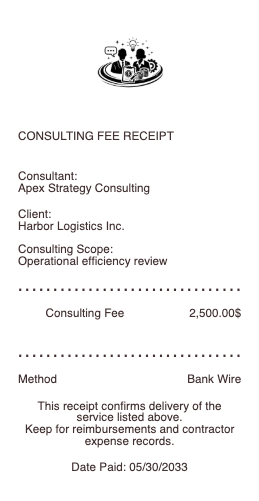
Three fee models, three different documents
Consulting bills in three shapes, and the paperwork follows the shape:
Hourly — time records are the backbone; the invoice itemises hours by task, and the receipt confirms payment of it.
Project or fixed fee — the statement of work defines the deliverable; payments track milestones.
Retainer — the client pays for availability or a block of capacity, in advance, on a cycle.
The retainer is the one that confuses accounting. A replenishing retainer (pay down, top up) behaves like a deposit account: the receipt for the top-up is not the record of services — the periodic statement showing draw-down against the balance is. A flat monthly retainer behaves like a subscription for capacity: paid whether fully used or not, which is precisely its point and precisely what clients later question. The receipt trail should make the model unmistakable.
Scope creep and the change-order paper trail
The classic consulting dispute is not about the fee — it is about work that was outside the original scope. The protection, for both sides, is the change order: a short written record that new work was requested, what it costs, and that the client approved before it began.
Receipts inherit this structure: payments against the original scope reference the statement of work; payments for additions reference their change orders. A consultant whose invoices map cleanly onto scope documents gets paid without argument; a client holding that same mapping can audit exactly what was bought. The absence of change-order paper is how a $20,000 project becomes a $35,000 dispute.
Invoice first, receipt second
Professional services run on the invoice-then-payment cycle: the consultant issues a numbered invoice on terms (net 15, net 30), the client pays, and the receipt — or the invoice marked paid — closes the loop. Both documents matter to both sides:
For the client, the invoice supports the expense and its tax treatment; the receipt proves settlement.
For the consultant, the invoice sequence is the revenue record, and unpaid invoices are the receivables ledger.
For US clients paying unincorporated consultants $600 or more in a year, the paper trail also feeds 1099-NEC reporting — one more reason the payments should be cleanly documented against a named consultant with a tax ID on file.
What a consulting receipt should show
The engagement — client, consultant, and the SOW or agreement referenced.
The fee model and period — which retainer month, which milestone, which hours.
Scope references — original scope or the change order number.
Expenses passed through, separately from fees, with their own receipts behind them.
Amount, tax treatment, and payment method.
Two engagement-ending lines complete the picture. A kill fee — the agreed charge when a client terminates mid-engagement — should trace back to the clause that created it, quoted on the final invoice. And the closing invoice should state that it is final: an engagement whose last invoice says so has an end date the file can prove, which matters when retainers auto-renew and when non-solicitation or warranty windows run from completion.
Keeping engagement records
Both sides keep the same file: agreement, SOWs, change orders, invoices, receipts — for the life of the engagement plus the tax retention period. Consultants add time records; clients add the deliverables the payments bought, because a challenged deduction is answered by showing what the fee purchased.
If a record is missing while the payment genuinely happened, the counterparty holds the mirror-image document (their invoice, your receipt) and can reissue — the recovery route. Your bank statement establishes the payment, and a clear reconstructed record documents that real payment for your files, matching it exactly, with the engagement references restored from the agreement rather than memory.
Consultants working through an entity add one nuance: the receipt should name the entity that contracted, not the person who delivered — payments to a consultant's LLC belong on paper under the LLC, because mismatched names between agreement, invoice, and payment are the kind of small inconsistency audits enjoy pulling on.
Frequently asked questions
Everything you need to know about the product and billing.
How does a consulting retainer work?
Two models: a replenishing retainer is a deposit account — payments top it up and work draws it down, with the periodic statement as the real record; a flat monthly retainer buys capacity whether fully used or not. The receipts should make unmistakable which model applies.
What is a change order?
A short written record that out-of-scope work was requested, priced, and approved before starting. Payments for additions should reference their change orders — the missing change-order paper is how projects become disputes. Its sibling is the kill fee — the agreed charge for terminating mid-engagement, which should trace to its contract clause on the final invoice.
Why do consultants invoice rather than just take payment?
Professional services run invoice-then-payment: the numbered invoice on terms supports the client's expense treatment and forms the consultant's revenue ledger. The receipt then proves settlement.
What is the 1099 connection?
US clients paying unincorporated consultants $600 or more in a year report it on Form 1099-NEC — which requires clean payment records against a named consultant with a tax ID on file.
What should a consulting receipt show?
The engagement and agreement referenced, the fee model and period (which month, milestone, or hours), scope or change-order references, pass-through expenses separated from fees, and the amount with tax treatment. The paying and named parties should match the agreement — a consultant contracting through an LLC should be paid and receipted as the LLC, not the individual.
How are pass-through expenses handled?
Billed separately from fees, each backed by its own receipt. Mixing expenses into fee lines breaks both the client's expense categorisation and the consultant's markup transparency.