A courier receipt documents a delivery handled by a courier service — often same-day or local, and frequently carrying something time-sensitive or important: legal documents, medical samples, urgent parcels. Its defining feature isn’t the postage but the proof of delivery, because a courier’s whole value is getting something to a specific person and confirming it arrived. This page explains what a courier receipt shows and why the delivery confirmation matters most.
Courier Receipt
Add custom logo
Edit line items
Choose payment method
Add/remove elements
Customize business information
Choose font
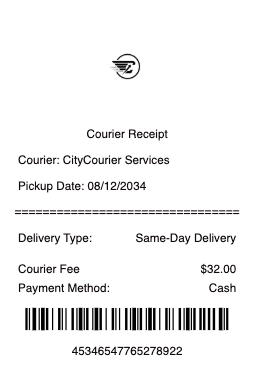
What’s on a Courier Receipt
The courier company and a job/consignment number
Sender and recipient, with pickup and delivery addresses
The service level — same-day, express, or scheduled
The item — parcel, envelope, or documents — and any weight/size
The charge, often based on distance, urgency, and size
Pickup and delivery times
Proof of delivery — a signature or confirmation on delivery
Couriers vs Standard Shipping — Speed and the Personal Handoff
A courier differs from ordinary mail or parcel shipping in speed and directness. Where a standard carrier moves parcels through a network over days, a courier typically provides same-day or point-to-point delivery — often a single driver taking an item straight from pickup to destination, sometimes within hours. This is why couriers are used for documents that must arrive today, legal filings, medical specimens, sensitive items, or urgent business parcels. On-demand and app-based courier services book by phone or app and price by distance, urgency, and size rather than flat postage. The receipt reflects that model: it names the specific pickup and delivery, the service window, and the time-critical nature of the job. Understanding that you’re paying for speed and a direct handoff — not bulk shipping — explains both the cost and why the delivery confirmation is the receipt’s most important element.
Proof of Delivery — the Signature That Matters
For a courier, proof of delivery (POD) is the whole point. Because couriers carry important, often irreplaceable items, the receipt or its companion POD records who received it, when, and their signature (or a photo, or a delivery code). For legal documents — a contract, a court filing, a served notice — that signed proof of delivery can carry real weight, sometimes evidentiary; for medical or business deliveries it confirms chain of custody. This is what separates a courier receipt from a simple postage stamp: it doesn’t just prove you sent something, it proves it was received by the right person at a specific time. Keeping the POD is therefore essential whenever the delivery itself needs to be provable — a dispute over whether a document arrived is settled by the signature on the courier’s proof of delivery, which is why senders of anything important request and retain it.
Business Use, Records, and Getting a Copy
Couriers are heavily used by businesses — law firms, clinics and labs, e-commerce sellers offering local same-day delivery, and offices sending urgent documents — so courier costs are a common deductible business expense, and the itemized receipt is the record for accounting and client re-billing (law firms often pass courier costs to clients as a disbursement). For proof and disputes, the receipt and POD together show what was sent, when, where, and that it arrived. Most courier services keep a record of each job and provide receipts and delivery confirmations by email or through an online account, so a copy is retrievable by the job or consignment number. Whether you need an expense record, a client re-bill, or evidence that an important item was delivered, the courier receipt — paired with its proof of delivery — is the document to keep. The consignment number is the reference that ties it all together.
Related shipping & courier receipts: see also our shipping receipt guide and our delivery receipt guide.
Related shipping and courier receipts: see also our shipping receipt guide and our delivery receipt guide.
Create a Courier Receipt
Our generator produces a clean courier receipt — courier and job number, sender and recipient, service level, item, charge, and delivery confirmation — as a PDF when you need a legible copy for a business expense, a client re-bill, or your own records.
Use it responsibly: recreate only real deliveries that actually occurred, with their true details. Fabricating a courier receipt or proof of delivery to falsely claim something was sent or received, support a false expense or legal claim, or mislead a client is fraud — and forging proof that a legal document was delivered can carry serious consequences. The courier’s own job records and delivery confirmation are the authoritative source; this tool is for legitimate record-keeping only.
Frequently asked questions
Everything you need to know about the product and billing.
What does a courier receipt show?
The courier company and a job/consignment number, the sender and recipient with pickup and delivery addresses, the service level (same-day, express, scheduled), the item and any weight or size, the charge (often by distance, urgency, and size), pickup and delivery times, and proof of delivery.
How is a courier different from standard shipping?
A courier provides speed and directness — typically same-day or point-to-point delivery, often a single driver taking an item straight from pickup to destination in hours, rather than moving parcels through a network over days. It’s used for time-critical documents and urgent parcels.
What is proof of delivery on a courier receipt?
A record of who received the item, when, and their signature (or a photo or delivery code). For couriers carrying important items it’s the key element — it proves the item was received by the right person at a specific time, not just that it was sent.
Why does proof of delivery matter for legal documents?
For a contract, court filing, or served notice, a signed proof of delivery can carry real, sometimes evidentiary weight — a dispute over whether a document arrived is settled by the courier’s signed POD. That’s why senders of anything important request and keep it.
Can I use a courier receipt as a business expense?
Yes — courier costs are a common deductible business expense for law firms, clinics, labs, and e-commerce sellers, and the itemized receipt is the record for accounting. Law firms often re-bill courier costs to clients as a disbursement, using the receipt as backup.
How do I get a copy of a courier receipt?
Most courier services keep a record of each job and provide receipts and delivery confirmations by email or through an online account, retrievable by the job or consignment number. Keep the receipt with its proof of delivery whenever the delivery itself needs to be provable.