A shipping receipt is proof that a package entered a carrier's network — showing the tracking number, service, addresses, and cost. Whether you shipped with UPS, FedEx, or USPS, or dropped off a marketplace return, the shipping receipt is what protects you until delivery is confirmed. This guide explains what a shipping receipt is, how to read the tracking number by carrier, and why sellers should keep every drop-off slip.
Shipping Receipt
Add custom logo
Edit line items
Choose payment method
Add/remove elements
Customize business information
Choose font
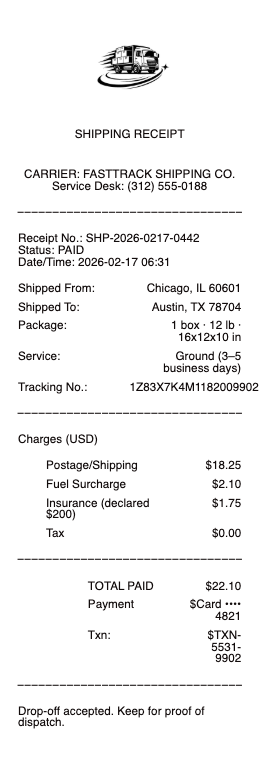
What is a shipping receipt — and what's on it
A shipping receipt is the carrier's record that it accepted your package — proof of shipment, distinct from proof of delivery. It includes:
Tracking number — the identifier for tracing the shipment, near a barcode.
Carrier & service — UPS, FedEx, or USPS, and the speed (ground, express, priority).
Sender & recipient addresses — where it's from and going.
Weight & dimensions — what the price was based on.
Postage & fees — the cost, including insurance or extras.
Date & location — when and where the carrier took possession.
One line on the counter receipt punches above its weight: the declared value. Carrier liability for a lost or damaged package is capped at the declared (or default) value, not at what the contents actually cost — a laptop shipped at the default declaration is insured as if it were socks. The receipt records the declaration you made, which is the ceiling of any claim you will file.
Reading the tracking number by carrier
Each carrier formats tracking numbers differently, and the receipt is where you find yours. UPS numbers start with "1Z" followed by 16 characters. FedEx uses numeric strings, typically 12 digits (Express) or 15 digits (Ground). USPS tracking numbers run 20–22 digits, often starting 9400 or 9205. On any receipt, look for the long string labeled "Tracking," "Trk#," or "USPS TRACKING #" beside the barcode, and enter it on the carrier's site or app to follow the package door to door.
Why marketplace sellers should keep every shipping receipt
If you sell on eBay, Etsy, Poshmark, Mercari, or handle returns for an online store, the drop-off receipt is your defense in an "item not received" dispute — it proves the package was handed to the carrier, with a timestamp and tracking number. The same applies to returns you drop off: keep the receipt until the refund posts, because if a return goes missing in transit, that slip is your evidence. Photograph every drop-off receipt immediately; thermal slips fade, and disputes can arrive weeks later.
International shipments add the customs layer to the same slip: the receipt sits alongside the customs declaration (CN22/CN23 or commercial invoice), and the values on the two must agree — a package declared low for duty and claimed high for loss is a contradiction carriers notice. Consistent declarations are boring precisely because they work.
Shipping receipts as business records
For a business, shipping costs are a deductible expense, and the receipts document postage spend by order, customer, or period. If you ship through an online platform (a carrier account, Click-N-Ship, or a marketplace's label service), your account keeps digital receipts for every label — easier than saving paper. For occasional counter shipments, the printed receipt is the only record, so file it (or photograph it) with the order it belongs to. Clean shipping records also make carrier refund claims — for late or lost shipments — far easier to file.
Related shipping & courier receipts: see also our courier receipt guide and our delivery receipt guide.
Related shipping and courier receipts: see also our courier receipt guide and our delivery receipt guide.
Create a shipping receipt
Our shipping receipt template and generator reproduces a clean carrier-style record — tracking number, service, addresses, weight, cost, and date — in a printable format, so you can rebuild a legible copy of a shipment you actually sent for your records or an expense claim.
For legitimate record-keeping only. A shipping receipt should reflect a real shipment; creating one for a package that was never sent, or to fake proof of shipment in a dispute, is fraud. Use this only to reproduce or organize your own genuine shipping records.
Frequently asked questions
Everything you need to know about the product and billing.
What is a shipping receipt?
It's the carrier's record that it accepted your package — proof of shipment. It shows the tracking number, carrier and service, addresses, weight, cost, and the date and location where the carrier took possession. It's distinct from proof of delivery.
How do I read the tracking number on a shipping receipt?
Look for the long string near the barcode. UPS numbers start with "1Z" plus 16 characters, FedEx uses 12 or 15 digits, and USPS runs 20–22 digits often starting 9400. Enter it on the carrier's site or app to track the package.
Why should I keep the receipt when I drop off a return?
It proves the package entered the carrier's network, with a timestamp and tracking number. If the return is lost in transit or the refund is disputed, that receipt is your evidence — keep it until the refund posts.
Is a shipping receipt proof of delivery?
No — it's proof of shipment (acceptance). Proof of delivery comes from the carrier's tracking status or a signature service. Together they document the package's full journey. Check the declared value line too — carrier liability caps at the declaration, not at what the contents cost, so it is the ceiling of any claim.
Are shipping costs tax deductible?
For a business, generally yes — postage and shipping are deductible expenses, documented by the receipts. Platform and carrier accounts keep digital receipts for every label, which simplifies the records.
What if I lost my shipping receipt?
If you shipped from an online account (carrier account, Click-N-Ship, marketplace labels), the receipt is stored digitally. For counter shipments, the tracking number from a photo, label copy, or card statement lets you trace the shipment even without the slip. For international shipments the customs declaration duplicates part of the record — its values should match the receipt's, since claims and duty both read them.