A cryptocurrency transaction receipt is the record of moving crypto — and the most important thing to understand is that the real receipt lives on the blockchain, not in a PDF. Whatever coin or chain, every on-chain transaction shares the same anatomy: addresses, an amount, a fee, and a hash anyone can verify. This page explains that universal structure, the difference between on-chain and exchange transfers, and why crypto payments can’t be undone.
Cryptocurrency Transaction Receipt
Add custom logo
Edit line items
Choose payment method
Add/remove elements
Customize business information
Choose font
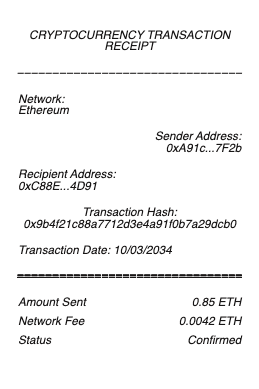
What’s on a Cryptocurrency Transaction Receipt
The transaction hash (TXID) — the unique ID, verifiable on a block explorer
Sender and receiver addresses
The coin and amount transferred
The network fee paid to process it
Confirmations — how many blocks have validated it
Timestamp and block number
Status — pending, confirmed, or failed
The Universal Anatomy of a Crypto Transaction
Whatever the coin, an on-chain transaction has the same core parts, and reading them applies across Bitcoin, Ethereum, and beyond. Money moves from one address to another, carries an amount and a network fee, and is stamped with a unique transaction hash — a long string that is the transaction’s fingerprint. Once included in a block, it accrues confirmations: each new block built on top makes it harder to reverse, which is why exchanges wait for several confirmations before crediting a deposit. The fee goes to the validators or miners who process it and rises with network congestion. This shared structure is why, once you can read one blockchain’s receipt, you can read them all — the coin changes, but the hash, addresses, amount, fee, and confirmations don’t. That anatomy is the foundation for verifying and recording any crypto movement.
On-Chain vs Exchange (Off-Chain) Transactions
Not every crypto “transaction” touches the blockchain, and the distinction matters for records. An on-chain transaction is broadcast to the network, mined into a block, and gets a hash you can verify publicly — permanent and irreversible. But moving crypto between two accounts on the same exchange is often off-chain: the exchange just updates its internal ledger, so it’s instant, usually free, and has no blockchain hash at all. That’s why a transfer between two Coinbase users may not appear on a block explorer — it never went on-chain. Understanding which type you had explains why some transfers have a verifiable hash and others only an exchange reference. For proof, an on-chain hash is the strongest evidence; for an off-chain exchange move, the exchange’s transaction record is what documents it. Knowing the difference keeps you from hunting for a hash that doesn’t exist.
Irreversibility, Verification, and Taxes
The defining trait of on-chain crypto is that it’s irreversible. Unlike a card payment you can dispute or a bank transfer that can sometimes be recalled, a confirmed blockchain transaction cannot be undone — send to a wrong or scam address and the funds are gone, with no chargeback. That’s why double-checking the address and network before sending is essential, and why the receipt matters as a record of exactly where funds went. Verification is the flip side of that finality: anyone can look up the hash on a block explorer and confirm the details, permanently and publicly, which makes the on-chain record stronger proof than any document. For taxes, remember crypto is property — disposing of it is a taxable event — so keeping each transaction’s hash, amount, USD value, and date is what lets you substantiate gains and losses. The blockchain is both the receipt and the auditor.
Related crypto receipts: see also our Bitcoin receipt guide and our Ethereum receipt guide.
Create a Cryptocurrency Transaction Receipt
Our generator produces a clean crypto transaction receipt — hash, addresses, coin and amount, network fee, confirmations, and USD value — as a readable PDF for your records or a tax file when you want a legible copy of an on-chain transaction.
Use it responsibly: recreate only real transactions that actually occurred, with their true amounts and hashes. Fabricating a crypto receipt to fake a payment, invent proof of funds, or misstate gains or losses on a tax return is fraud — the blockchain is public and permanent, so any claimed hash can be checked on a block explorer in seconds. The on-chain record is the authoritative source; this tool is for legitimate record-keeping only.
If the transaction started on an exchange, the Binance receipt records the exchange side of it, while this page covers the on-chain transfer.
Frequently asked questions
Everything you need to know about the product and billing.
What does a cryptocurrency transaction receipt show?
The transaction hash (TXID) verifiable on a block explorer, the sender and receiver addresses, the coin and amount, the network fee, the number of confirmations, the timestamp and block number, and the status — pending, confirmed, or failed.
What is a transaction hash (TXID)?
A unique string that acts as a transaction’s fingerprint on the blockchain. Anyone can look it up on a block explorer to see the addresses, amount, fee, and confirmations permanently and publicly, which makes it the strongest proof of a crypto transaction.
What are confirmations on a crypto transaction?
Each block built on top of the one containing your transaction adds a confirmation, making it harder to reverse. Exchanges wait for several confirmations before crediting a deposit, since more confirmations mean the transaction is more final and secure.
Why do some crypto transfers not have a blockchain hash?
Because they’re off-chain. Moving crypto between two accounts on the same exchange just updates the exchange’s internal ledger — it’s instant, usually free, and never goes on the blockchain, so there’s no hash. The exchange’s own record documents it instead.
Can a cryptocurrency transaction be reversed?
No. A confirmed on-chain transaction is irreversible — unlike a card payment or some bank transfers, there’s no chargeback. If you send to a wrong or scam address, the funds are gone, which is why verifying the address and network before sending is essential.
How do I verify a crypto transaction?
Look up its hash on the relevant blockchain’s explorer, which permanently shows the addresses, amount, fee, and confirmations. That public record is stronger proof than any PDF, and it’s also what you keep, with USD values, to substantiate gains and losses for taxes.