An Ethereum receipt is really a transaction record on the Ethereum blockchain — and the true, verifiable receipt is the transaction hash on a block explorer, not a PDF. Whether you sent ETH, moved a token, or swapped on a decentralized exchange, the network records it with a gas fee attached. This page explains what an Ethereum transaction shows, how gas works, and why a token transfer still costs ETH.
Ethereum Receipt
Add custom logo
Edit line items
Choose payment method
Add/remove elements
Customize business information
Choose font
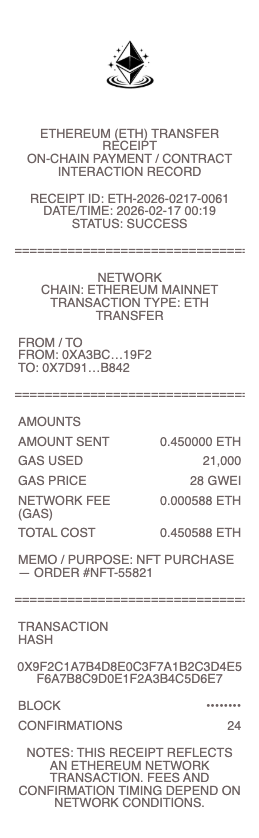
What’s on an Ethereum Transaction Record
The transaction hash — the unique ID, verifiable on Etherscan
From and to wallet addresses (the 0x… addresses)
The amount of ETH or the token and quantity moved
The gas fee paid, shown in gwei and in ETH
Block number and timestamp, and confirmation status
The transaction type — a transfer, a token send, or a contract interaction
USD value at the time, if recorded by your wallet or exchange
Gas, Gwei, and EIP-1559 Fees
Every Ethereum transaction costs gas — the fee paid to validators to process it — and reading it is the key to an ETH receipt. Gas is priced in gwei (one gwei is a billionth of an ETH), and the total fee is the gas used × gas price. Since the EIP-1559 upgrade, that price splits into a base fee (which is burned, removing ETH from supply) and a priority fee or tip to the validator. Fees rise and fall with network congestion, which is why the same transfer can cost a little at a quiet hour and a lot during a busy one. Since the Merge, Ethereum runs on proof-of-stake, so those fees go to stakers rather than miners. The gas line is genuinely useful on a receipt: it’s the real cost of the transaction beyond the amount you sent, and it matters for cost-basis records.
ETH, ERC-20 Tokens, and Smart Contracts
Ethereum isn’t just ETH. Most tokens you hold — stablecoins like USDC and USDT, and thousands of others — are ERC-20 tokens that live on Ethereum, and here’s the catch that surprises people: moving a token still costs ETH gas, because the network charges in its native coin regardless of what you’re transferring. So a receipt for sending USDC shows a USDC amount but an ETH fee. Interacting with a smart contract — a swap on a decentralized exchange, an approval, minting an NFT — is also a transaction with its own gas, and often an approval step precedes a swap, meaning two fees. Each of these appears as a distinct transaction on Etherscan with its own hash. Understanding that tokens and contract actions all settle as gas-paying ETH transactions is what makes an Ethereum history legible.
The Blockchain Is the Receipt — Verification and Taxes
The strongest proof of an Ethereum transaction is the transaction hash on Etherscan: anyone can look it up and see the addresses, amount, gas, and confirmations, permanently and publicly. That makes a self-made PDF weaker than the on-chain record — the hash is the authoritative receipt. For taxes, this matters because crypto is property in the US: disposing of ETH or a token (selling, swapping, spending) is a taxable event with a gain or loss, and gas fees can affect cost basis and proceeds. Exchanges and wallets export transaction histories with USD values for reporting, but the on-chain hash is the granular backup behind each line. Keeping your transaction IDs — or an exported history keyed to them — is how you substantiate a crypto tax position, since every entry can be independently verified on the blockchain.
Related crypto records: the same on-chain principles run across the ecosystem — see our Bitcoin receipt guide for the original blockchain ledger, and the staking reward receipt guide for how proof-of-stake income is taxed.
Create an Ethereum Receipt
Our generator produces a clean Ethereum transaction receipt — hash, from/to addresses, amount, gas fee in gwei and ETH, and USD value — as a readable PDF for your records or a tax file when you want a legible copy of an on-chain transaction.
Use it responsibly: recreate only real transactions that actually occurred, with their true amounts and hashes. Fabricating an Ethereum receipt to fake a payment, invent proof of transfer, or misstate crypto gains or losses on a tax return is fraud — the blockchain is public and permanent, so any claimed transaction hash can be checked on Etherscan in seconds. The on-chain record is the authoritative source; this tool is for legitimate record-keeping only.
Frequently asked questions
Everything you need to know about the product and billing.
What does an Ethereum transaction record show?
The transaction hash (verifiable on Etherscan), the from and to wallet addresses, the amount of ETH or token moved, the gas fee in gwei and ETH, the block number and timestamp, the confirmation status, the transaction type, and often the USD value at the time.
What is gas and why is it measured in gwei?
Gas is the fee paid to validators to process an Ethereum transaction. It’s priced in gwei — a billionth of an ETH — and the total is gas used times gas price. Since EIP-1559, that splits into a burned base fee and a priority tip to the validator.
Why does sending a token like USDC cost ETH?
Because ERC-20 tokens live on Ethereum, and the network charges its gas fee in ETH regardless of what you’re transferring. So a receipt for sending USDC shows a USDC amount but an ETH fee — you need some ETH in the wallet to move any token.
How do I verify an Ethereum transaction?
Look up the transaction hash on Etherscan, a public block explorer. It permanently shows the addresses, amount, gas, block, and confirmations — which makes the on-chain hash a stronger proof than any self-made PDF receipt.
Are Ethereum transactions taxable?
In the US crypto is property, so disposing of ETH or a token — selling, swapping, or spending — is a taxable event with a gain or loss, and gas fees can affect cost basis and proceeds. Wallets and exchanges export histories with USD values for reporting.
Why did one swap create two Ethereum transactions?
Interacting with a smart contract on a decentralized exchange often needs an approval transaction before the swap itself, and each is a separate gas-paying transaction with its own hash. That’s why a single swap can show two fees in your history.