A customs fee receipt usually mixes government duty with carrier charges. This guide separates duty from brokerage, disbursement, and storage fees, and shows how to read a customs charge before paying it.
Customs Fee Receipt
Add custom logo
Edit line items
Choose payment method
Add/remove elements
Customize business information
Choose font
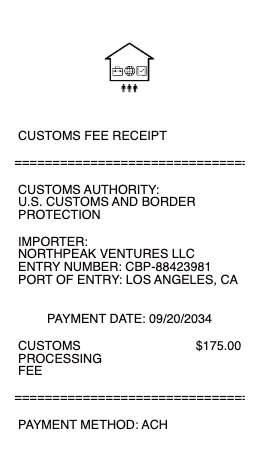
Most of a 'customs fee' is often not customs
The payment demand that arrives before a package is delivered is usually labelled a customs fee — and the label hides a composite. The total typically contains:
Duty and tax — the government's share, calculated on the goods.
Brokerage or clearance fee — the carrier's charge for preparing and filing the customs entry on your behalf.
Disbursement or advancement fee — a charge for the carrier having paid the duty to customs before collecting it from you.
Storage or bonded warehouse fees, when clearance was delayed.
On a low-value shipment, the carrier's fees can exceed the duty itself. That is not a scam — brokerage is real work — but it is the reason two identical parcels can produce very different bills depending on which carrier handled them, and it is why the breakdown matters more than the total.
Reading the demand before you pay it
A customs charge is one of the few bills people pay without looking, because the package is hostage. Look anyway. The demand should show:
What portion is duty and tax, with the value and rate it was computed from.
What portion is the carrier's own fees, each named.
The shipment it relates to, by tracking number.
Errors happen in predictable places: a declared value misread (a $23.00 item entered as $2,300), a wrong classification, or duty charged on goods that qualified for preferential origin treatment. Each is disputable — but only from a breakdown. A demand that shows one unexplained total is worth querying before payment, not after.
The advancement fee, explained
The least understood line is the disbursement or advancement fee — a charge that exists because the carrier paid the government before you paid them. Customs released the goods against the carrier's payment, and the fee (a flat amount or a percentage of the advanced sum) is the price of that float and risk.
It can be avoidable: some carriers waive it if you pay duty directly online before delivery is attempted, and commercial importers avoid it by having their own customs account or broker. For occasional consumer imports it is mostly a cost of convenience — but knowing what it is stops you disputing a legitimate charge or, equally, accepting an inflated one.
What the receipt should show once paid
Duty, tax, and each carrier fee itemised — never a single blended figure.
The entry or clearance reference.
The tracking or waybill number.
Who was paid — the carrier as agent, with the duty forwarded to customs.
Date and payment method.
For a business, the split matters in the books: duty belongs in landed cost of the goods, while brokerage and disbursement fees are import handling expenses. One blended number cannot be allocated correctly.
Keeping and recovering clearance records
Keep the fee receipt with the commercial invoice, the order confirmation, and the tracking history — a clearance dispute, a duty refund claim, or an insurance claim over a damaged shipment will want all of them together.
Carriers keep clearance records against the waybill number and can reissue invoices, which is the recovery route for a missing document. If a record is lost while the payment genuinely happened, your card statement establishes the date, amount, and carrier, and a clear reconstructed record documents that real payment for your files — matching the charge exactly, with the duty-versus-fees split taken from the carrier's reissued invoice rather than estimated.
Frequently asked questions
Everything you need to know about the product and billing.
Why is the customs fee more than the duty?
Because the total usually includes the carrier's own charges — brokerage for filing the entry, a disbursement fee for advancing the duty, sometimes storage. On low-value shipments those fees can exceed the duty itself.
What is a brokerage fee?
The carrier's charge for preparing and filing the customs entry on your behalf. It is real work and a legitimate charge — but it varies by carrier, which is why identical parcels can produce different bills.
What is a disbursement or advancement fee?
A charge for the carrier having paid the duty to customs before collecting from you — the price of their float and risk. Some carriers waive it if you pay duty directly online before delivery.
Can I dispute a customs charge?
Yes, from the breakdown: misread declared values, wrong classifications, and missed preferential-origin treatment are the common errors. A demand showing one unexplained total is worth querying before payment.
How should a business book customs fees?
Split them: duty and tax belong in the landed cost of the goods; brokerage and disbursement fees are import handling expenses. A blended figure cannot be allocated correctly, which is why the itemised receipt matters.
How do I get a copy of a lost clearance invoice?
From the carrier, against the waybill or tracking number — they keep clearance records and can reissue. Your card statement establishes what you paid while their invoice restores the duty-versus-fees split.