A staking reward receipt records crypto earned by staking — locking coins in a proof-of-stake network to help secure it and receiving new coins in return. It’s less a payment record than an income record, because staking rewards are taxed the moment you receive them. This page explains what the receipt should capture, the ways staking is done, and the two-step tax treatment that makes documenting the fair-market value at receipt so important.
Staking Reward Receipt
Add custom logo
Edit line items
Choose payment method
Add/remove elements
Customize business information
Choose font
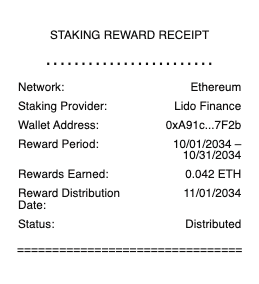
What’s on a Staking Reward Receipt
The asset staked and the reward coin received
The reward amount, and the date/time received
The fair-market USD value at the moment of receipt
The staking method — solo validator, delegation, or an exchange/platform
The reward rate (APR/APY) the amount reflects
The receiving wallet or account
Cumulative rewards, if it’s a periodic payout summary
How Staking Works — Validators, Delegation, and Platforms
Staking secures a proof-of-stake blockchain, and there are several ways to do it, each producing a slightly different record. Running your own validator (Ethereum requires 32 ETH) earns rewards directly but needs technical setup. Delegation or pooled staking lets you stake smaller amounts through a validator or pool. Exchange staking — offered by Coinbase, Kraken, Binance, and others — is the easiest: the platform stakes on your behalf and credits rewards to your account, often with a summary you can export. Liquid staking (Lido, for example) gives you a token like stETH representing your staked position so you stay liquid. Rewards accrue at a quoted APR/APY and arrive periodically. The method matters for records because a validator’s on-chain rewards, an exchange’s credited rewards, and a liquid-staking token each document the same income differently.
The Tax Rule: Income at Receipt, Then Capital Gains
This is why the receipt matters most. Under IRS guidance (Revenue Ruling 2023-14), staking rewards are ordinary income at their fair-market value when you gain dominion and control — essentially when the reward hits your wallet and you can use it. So each reward is an income event valued in USD at that moment, which is exactly what the receipt should capture. Then a second tax event happens later: when you sell or swap those reward coins, you have a capital gain or loss, with the cost basis equal to the value you already reported as income. Miss the receipt-date value and you can end up taxed twice on the same amount or unable to prove your basis. Documenting the FMV at receipt for every reward is the single most important record for staking, because it anchors both tax events.
Records, 1099s, and Getting the Data
Because staking creates ongoing income, keeping a running record is essential. Exchanges that offer staking typically provide a rewards summary and may issue a 1099-MISC for staking income above a threshold, which you reconcile against your own records. For on-chain or validator staking, the rewards are visible on the blockchain, and crypto tax tools import them with historical USD values to build the income and basis figures. Note that some networks have lock-up or unbonding periods before staked assets and rewards can be moved, which affects when you have control. Whether your goal is filing accurately or just tracking yield, the key data points never change: the coin, the amount, the date, and the USD value at receipt. Keeping a per-reward record — or an exported history carrying those values — is what makes staking income defensible at tax time.
Related crypto receipts: see also our mining payout receipt guide and our DeFi yield receipt guide.
Create a Staking Reward Receipt
Our generator produces a clean staking reward record — asset, reward amount, date, fair-market USD value at receipt, method, and rate — as a readable PDF for your income records or a crypto tax file when you want a legible summary of a reward.
Use it responsibly: recreate only real rewards actually received, with their true amounts and values. Fabricating staking receipts to misstate crypto income, invent yield, or manufacture a cost basis is tax fraud — on-chain rewards are publicly verifiable and exchange records are reported to tax authorities. The blockchain and the platform’s own records are the authoritative source; this tool is for legitimate record-keeping only.
Frequently asked questions
Everything you need to know about the product and billing.
What does a staking reward receipt show?
The asset staked and reward coin received, the reward amount and date, the fair-market USD value at receipt, the staking method (solo validator, delegation, or exchange/platform), the reward rate (APR/APY), the receiving wallet or account, and cumulative rewards if it’s a summary.
How are staking rewards taxed?
Under IRS Revenue Ruling 2023-14, they’re ordinary income at their fair-market value when you gain dominion and control — when the reward hits your wallet. Later, selling those coins is a separate capital gain or loss, with basis equal to the value already reported as income.
Why is the value at receipt so important for staking?
Because it anchors both tax events: it’s the income you report when the reward arrives, and it becomes the cost basis when you later sell. Missing that receipt-date value can lead to being taxed twice on the same amount or being unable to prove your basis.
What are the different ways to stake crypto?
Running your own validator (Ethereum needs 32 ETH), delegating or pooling smaller amounts through a validator, exchange staking where a platform like Coinbase or Kraken stakes for you, or liquid staking (like Lido) that gives you a token such as stETH so you stay liquid.
Do I get a 1099 for staking rewards?
Exchanges offering staking often provide a rewards summary and may issue a 1099-MISC for staking income above a threshold, which you reconcile against your own records. For on-chain or validator staking, rewards are visible on the blockchain and imported by crypto tax tools.
Can I move staking rewards immediately?
Not always — some networks have lock-up or unbonding periods before staked assets and rewards can be transferred, which affects when you truly have control. The receipt should note the method, since that determines both liquidity and the timing of your income event.