An exchange receipt documents a swap — one item handed back, another taken in its place — and it’s a different animal from a return receipt, because usually little or no money moves. Its job is to record both halves of the trade and the price difference between them, and afterwards it becomes something people overlook: the new item’s proof of purchase. This page explains what an exchange receipt shows and how even, uneven, and no-receipt exchanges work.
Exchange Receipt
Add custom logo
Edit line items
Choose payment method
Add/remove elements
Customize business information
Choose font
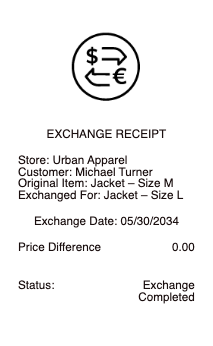
What’s on an Exchange Receipt
The item returned — description and its price/value credited
The item taken in exchange — description and its price
The price difference — collected from you or refunded/credited
A reference to the original receipt or transaction
The store, date, and register/associate
How any difference was settled — card, cash, or store credit
The updated return-policy window, where the store restarts it
Even vs Uneven — How the Math Settles
Exchanges come in two shapes. An even exchange swaps items of the same price — the classic size or color swap — so no money moves at all: the receipt just documents item-out and item-in, and your original payment stands. An uneven exchange trades across prices: swap up and you pay the difference; swap down and the difference comes back — to your original payment method or as store credit, per the store’s policy. One detail that surprises people: the value credited for the returned item is normally what you actually paid, not the current shelf price — exchange a sale-priced item and your credit is the sale price, even if the item now sells for more. That’s why the exchange receipt lists both items with explicit figures: it’s the arithmetic of the trade in writing, and the only record of how the difference was settled.
Exchange vs Return — and the Defective-Item Path
A return unwinds a sale for a refund; an exchange replaces it with another sale. Retailers strongly prefer exchanges — the revenue stays — which is why exchange terms are often more generous than refund terms: many stores allow an exchange or store credit past the refund window, or handle a receiptless swap they’d refuse to refund. A defective item travels a different path entirely: swapping a faulty product for a working one isn’t a change-of-mind exchange but a warranty or consumer-protection remedy, so the usual condition rules (tags on, unworn, within 30 days) don’t apply the same way — proof of purchase and the defect are what matter. Knowing which lane you’re in decides what to ask for at the counter: a courtesy exchange runs on the store’s policy, while a defective swap runs on your rights and the warranty, with the receipt as the anchor for both.
Gift Swaps, No-Receipt Exchanges, and the New Proof of Purchase
Two practical cases round out the picture. Gift exchanges run on the gift receipt: it proves the purchase without revealing the price, and typically yields an even exchange or store credit at the gift’s value. No-receipt exchanges are possible at many chains but tightly managed — expect the item’s lowest recent selling price as your credit, store credit rather than cash, and a request for photo ID, since retailers log receiptless transactions to spot abuse. And one habit worth keeping: after any exchange, keep the exchange receipt as the new item’s proof of purchase. If the replacement later fails, gets returned, or needs a warranty claim, the exchange receipt — tying the new item back through the original transaction — is the document that proves you own it and what its value was. Toss it, and the swap has no paper trail at all.
Related returns and exchanges receipts: see also our Replacement receipt guide and our Voided receipt guide.
If you're returning rather than exchanging, our guides explain how no-receipt returns work at Walmart and Home Depot.
Create an Exchange Receipt
Our generator produces a clean exchange receipt — the item returned, the item taken, the price difference and how it was settled, and the original-transaction reference — as a PDF for your records or as the new item’s proof of purchase.
Use it responsibly: recreate only exchanges that actually happened, with true items and amounts. Fabricating an exchange receipt to obtain merchandise, manufacture store credit, or support a false warranty or return claim is fraud — stores log exchanges against the original transaction and track receiptless swaps by ID, so the paper trail is checkable. This tool is for legitimate record-keeping only.
Frequently asked questions
Everything you need to know about the product and billing.
What does an exchange receipt show?
Both halves of the swap: the item returned with its credited value, the item taken with its price, the price difference and how it was settled (card, cash, or store credit), a reference to the original transaction, the store and date, and any restarted return window.
What’s the difference between an even and uneven exchange?
An even exchange swaps items of the same price — a size or color swap — so no money moves. An uneven exchange crosses prices: you pay the difference to swap up, or receive it back (often as store credit) when swapping down. The receipt records the arithmetic.
If I exchange a sale item, what value do I get?
Normally what you actually paid, not the current shelf price — exchange a sale-priced item and your credit is the sale price, even if it now sells for more. That’s why the exchange receipt lists both items with explicit figures.
Can I exchange something without a receipt?
Often, but on tighter terms: expect the item’s lowest recent selling price as your credit, store credit instead of cash, and a photo-ID request — retailers log receiptless exchanges to spot abuse. A gift receipt avoids all this by proving the purchase without showing the price.
Is exchanging a defective item the same as a normal exchange?
No — a faulty product swap is a warranty or consumer-protection remedy, not a change-of-mind exchange, so the usual condition rules don’t apply the same way. Proof of purchase and the defect are what matter, and the store or manufacturer terms govern the fix.
Why keep the exchange receipt afterwards?
Because it becomes the new item’s proof of purchase. If the replacement later fails, gets returned, or needs a warranty claim, the exchange receipt — tying the new item back to the original transaction — is what proves ownership and value. Without it the swap has no paper trail.