A FedEx receipt is your proof of shipment — it lists the sender and recipient, the service, weight, cost, and most importantly the tracking number you use to follow the package. The most common question is simply where the tracking number is on the receipt. This guide shows exactly where to find it, what every line on a FedEx shipping receipt means, and how to look up or get a copy.
FedEx Receipt
Add custom logo
Edit line items
Choose payment method
Add/remove elements
Customize business information
Choose font
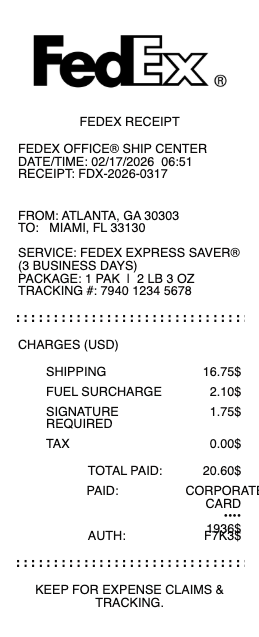
What's on a FedEx shipping receipt
Whether printed at a FedEx Office counter or a drop-off location, a FedEx receipt includes:
Tracking number — the number used to trace the shipment, usually the most prominent figure on the receipt (more on where it is below).
Sender & recipient — the "from" and "to" addresses.
Service type — FedEx Ground, Express (Overnight, 2Day), or Home Delivery, which sets the delivery speed.
Weight & dimensions — the package weight and size used to price the shipment.
Ship date & cost — when it was sent and what you paid, including any packing or extra services.
Barcode — a scannable version of the tracking number.
Where is the tracking number on a FedEx receipt?
On a FedEx receipt, the tracking number is the long number usually labeled "Tracking ID," "TRACKING #," or "Trk#," printed near the top or middle and often shown above or below a barcode. FedEx tracking numbers are typically 12 digits (FedEx Express) or 15 digits (FedEx Ground), though some services use longer numbers. It's the number you enter at fedex.com/track to see the package's status. Don't confuse it with the shorter receipt or transaction number — the tracking number is the long string tied to the barcode.
How to track a package or look up a FedEx receipt
Once you have the tracking number, enter it at fedex.com or in the FedEx Mobile app to follow the shipment door to door. If you shipped from a FedEx account, your online shipment history stores each label and receipt, so you can reprint one. Shipped from a FedEx Office store? Keep the printed receipt — it's your proof of drop-off, and the store can sometimes look up a recent transaction. If you lost the tracking number entirely and shipped as a guest, contact FedEx with the ship date, addresses, and payment details.
Retail drop-offs at third-party locations add one nuance: a package handed to a grocery-store counter or a locker gets a drop-off scan receipt from that location, and until the first FedEx origin scan, that slip is the only evidence the parcel left your hands. For anything valuable, waiting the extra minute for a counter receipt with the tracking number beats the no-receipt drop slot.
Your FedEx receipt as proof of shipment
A FedEx receipt is more than a payment record — it's proof you shipped the item, which matters for returns, marketplace sales, and disputes. When you drop off a return at a FedEx location, the receipt (with its tracking number) is your evidence the package entered FedEx's network, so keep it until the return is confirmed and refunded. For businesses, shipping receipts document postage as a deductible expense, so an itemized copy is worth filing rather than tossing.
Related shipping & courier receipts: see also our UPS receipt guide and our USPS receipt guide.
Related shipping and courier receipts: see also our UPS receipt guide and our USPS receipt guide.
Account shipping changes where the record lives: businesses shipping on a FedEx account get consolidated invoices instead of counter slips, with each shipment a line carrying its tracking number, service, and billed weight. The billed weight is the line to audit — dimensional weight pricing means the invoice can charge for the box's size rather than its heft, and disputes about it run on the invoice detail.
FedEx receipt templates and copies
If a shipping receipt has faded or gone missing, our receipt template and generator can reproduce a clean, itemized copy — sender and recipient, service, weight, tracking number, and cost — for your records or an expense claim.
For legitimate record-keeping only. Recreating a shipping receipt for a package you didn't send, or to misrepresent a shipment or refund, is fraud. Use this only to reproduce or organize your own genuine FedEx shipments.
Related receipts: we also template the UPS receipt, the USPS receipt, and a general shipping receipt.
Frequently asked questions
Everything you need to know about the product and billing.
Where is the tracking number on a FedEx receipt?
It's the long number usually labeled "Tracking ID," "TRACKING #," or "Trk#," printed near the top or middle of the receipt, often next to a barcode. Enter it at fedex.com/track to follow your package.
How many digits is a FedEx tracking number?
FedEx tracking numbers are commonly 12 digits (FedEx Express) or 15 digits (FedEx Ground), though some services use longer numbers. On the receipt it's the long string tied to the barcode, not the shorter transaction number.
How do I get a copy of a FedEx receipt?
If you shipped from a FedEx account, your online shipment history stores each receipt and label to reprint. For FedEx Office drop-offs, keep the printed receipt; the store may be able to look up a recent transaction. Account shippers look in a different place — the consolidated invoice lists every shipment with its tracking number, service, and billed weight.
What's on a FedEx shipping receipt?
The tracking number, sender and recipient addresses, the service type (Ground, Express, Home Delivery), package weight and dimensions, the ship date and cost, and a scannable barcode.
Is a FedEx receipt proof that I shipped a package?
Yes. The receipt with its tracking number is evidence the package entered FedEx's network, which is important for returns, online-marketplace sales, and disputes. Keep it until delivery or a refund is confirmed. For third-party drop-offs, insist on the scan receipt — until the first FedEx origin scan appears, that slip is the only proof the parcel left your hands.
How do I track a package from my receipt?
Find the tracking number on the receipt (near the barcode), then enter it at fedex.com/track or in the FedEx Mobile app to see the shipment's status and delivery progress.