A ferry ticket receipt covers a crossing that can carry far more than a passenger — a car, a caravan, a cabin for an overnight sailing — which makes it one of the more variable travel receipts. Whether you booked as a foot passenger or drove aboard changes what it shows and what a refund is worth. This page covers the anatomy and how vehicle fares, sailings, and refunds work on it.
Ferry Ticket Receipt
Add custom logo
Edit line items
Choose payment method
Add/remove elements
Customize business information
Choose font
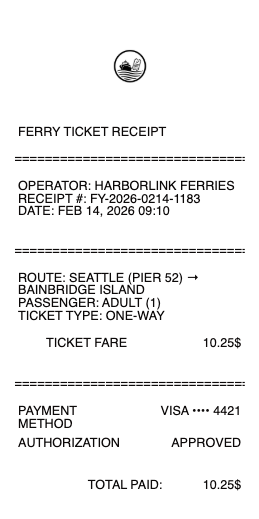
What’s on a Ferry Ticket Receipt
Ferry operator and the booking reference
Route — departure and arrival ports, sailing date and time
Passenger count and any concession fares
Vehicle details — car, van, motorhome, or bicycle, priced by size/length on car ferries
Cabin or seat on longer or overnight crossings
Fare type — fixed sailing or flexible/open return
Total, payment method, and any port or fuel surcharge
Foot Passenger vs. Vehicle Fares
The single biggest variable on a ferry receipt is whether you brought a vehicle. A foot passenger fare is simple — per person, sometimes with a seat. Drive aboard and the receipt adds a vehicle fare priced by the vehicle’s size: a car, a van, a motorhome, and a towed trailer or caravan each fall in different length/height bands, and getting the band wrong at booking is a common source of a corrected charge at the port. On short crossings the vehicle fare often dwarfs the passenger fare. The receipt itemizes both, which matters for a business claim where only your own travel — not a personal vehicle — may be reimbursable, and for confirming you were charged for the right vehicle class.
Sailings, Cabins, and Fare Flexibility
Ferry fares, like rail and air, trade price for flexibility, and the receipt records which you bought. A fixed-sailing fare ties you to a specific departure and is cheaper but hard to change; a flexible or open return costs more and lets you travel on a later sailing. On overnight and long-distance crossings, cabins and reclining seats are booked as add-ons and appear as their own lines — worth keeping for an expense claim, since accommodation at sea can be a reimbursable travel cost. Amending a booking — a later sailing, a different vehicle — is done against the reference on the receipt, and the fare type determines whether it costs anything.
Refunds, Expenses, and Getting a Copy
Refund rules track the fare: flexible tickets refund or amend with little penalty, fixed-sailing fares often do not, and the receipt is what any refund is processed against. For expenses, the itemized ferry receipt showing the route, passengers, and any cabin is the reimbursement document — and if a personal vehicle was carried, separate that line, as policies differ on vehicle transport. To retrieve a lost receipt, the operator’s Manage Booking or account order history holds e-ticket purchases; a ticket bought at the port desk may exist only as the printed slip, so keep it. For island commuters and freight, a season or multi-trip ferry pass has its own receipt worth filing, the same as a rail season ticket.
Related transport receipts: see also our high-speed train receipt guide and our bus ticket receipt guide.
Create a Ferry Ticket-Style Receipt
Our generator rebuilds a ferry receipt — operator and route, sailing date, passengers, any vehicle by class, cabin, fare type, and total — as a clean PDF for a records or expense file when the original is gone.
Use it responsibly: recreate only crossings you actually paid for, at their real fares and vehicle classes. Fabricating ferry receipts for reimbursement or refunds is fraud — the operator’s booking system holds the genuine receipt, which is the correct document for any claim.
Frequently asked questions
Everything you need to know about the product and billing.
What should a ferry ticket receipt include?
The operator and booking reference, the route with ports and sailing time, passenger count, any vehicle priced by size, cabin or seat on longer crossings, the fare type, and the total with any port or fuel surcharge.
How are ferry fares priced for vehicles?
By the vehicle’s size — cars, vans, motorhomes, and towed caravans fall in different length and height bands. On short crossings the vehicle fare often exceeds the passenger fare, and the wrong band at booking causes a corrected charge at the port.
What is the difference between a fixed and flexible ferry fare?
A fixed-sailing fare ties you to a specific departure and is cheaper but hard to change. A flexible or open return costs more and lets you travel on a later sailing. The receipt records which you bought, and it governs refunds.
Can I get a refund on a ferry ticket?
It depends on the fare — flexible tickets refund or amend with little penalty, fixed-sailing fares often do not. The refund is processed against the receipt, so keep it until any change is settled.
How do I get a copy of a ferry receipt?
Use the operator’s Manage Booking or account order history for e-ticket purchases. A ticket bought at the port desk may exist only as the printed slip, so keep it for expenses.
Can I expense a ferry crossing with my car?
Yes, using the itemized receipt — but separate the vehicle-transport line, since travel policies differ on whether carrying a personal vehicle is reimbursable. Cabins on overnight sailings may count as accommodation.