A high-speed train receipt covers services like Eurostar, the TGV, ICE, the Shinkansen, and Amtrak’s Acela — and it carries details a local rail ticket does not: a compulsory seat reservation, premium travel classes, and, on international routes, a check-in and passport process closer to flying. This page covers what it shows and how reservations, classes, and cross-border rules shape it.
High-Speed Train Receipt
Add custom logo
Edit line items
Choose payment method
Add/remove elements
Customize business information
Choose font
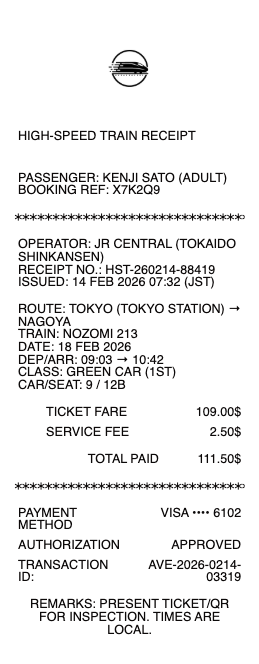
What’s on a High-Speed Train Receipt
Operator and service — Eurostar, TGV, ICE, Shinkansen, Acela and the like
Named passenger and booking reference — high-speed e-tickets are usually name-specific
Route, date, departure time, and the train number
Travel class — standard/second, first, or a business/premier tier with lounge and meal
The mandatory seat, coach, and sometimes seat-facing reservation
Fare type — advance/non-flex vs flexible — and any railcard or corporate rate
Total, payment method, and issue date
Compulsory Reservations and Travel Classes
The first thing that separates a high-speed receipt from a local rail ticket is the mandatory reservation: on most high-speed services you cannot just board with a ticket — a specific train, coach, and seat are assigned, and they appear on the receipt. That is why a high-speed fare is tied to a departure in a way a turn-up-and-go local fare is not. The second is class: beyond standard, high-speed lines sell first and often a business or premier tier bundling lounge access, at-seat meals, and flexible conditions, each priced distinctly and each showing on the receipt. For an expense claim, the class line matters — some travel policies cap rail at standard or first, so a receipt that names the class is what an approver checks.
International High-Speed: Check-In, Passports, and Fares
Cross-border high-speed travel behaves more like air than rail, and the receipt reflects it. Services like Eurostar require check-in ahead of departure and border/passport control, so the ticket is name-specific and the booking carries a check-in deadline rather than open boarding. Fares run on airline-style tiers — cheap non-flexible advance fares tied to one train, up to fully flexible and premier fares — and the receipt records which, which governs whether a change or refund is possible and at what cost. Because these tickets are personal and often expensive, the itemized receipt with the passenger name, class, and fare conditions is the document that matters for both reimbursement and any change.
Refunds, Exchanges, and Getting a Copy
Refund and exchange rights follow the fare tier: flexible and premier fares change or refund with little or no penalty, advance non-flex fares are heavily restricted, and the receipt is what any request is processed against. High-speed operators sell through their own sites and apps and through rail booking platforms, all of which keep the reservation in your account — so a lost receipt is retrievable as a downloadable e-ticket receipt or VAT invoice, the latter useful for business travel tax reclaim across borders. Keep the receipt with the passenger name and class until the trip is complete and any expense is settled; for international services, it is also proof of the booking at check-in if the app or email fails.
Related transport receipts: see also our train ticket receipt guide and our ferry ticket receipt guide.
Create a High-Speed Train-Style Receipt
Our generator rebuilds a high-speed rail receipt — operator and service, passenger and reference, route with train number, travel class, the seat reservation, fare type, and total — as a clean PDF for an expense or records file when the original is gone.
Use it responsibly: recreate only journeys you actually paid for, at their real classes and fares. Fabricating high-speed rail receipts for reimbursement or refunds is fraud — the operator’s account holds the genuine name-specific receipt, which is the correct document for any claim.
Frequently asked questions
Everything you need to know about the product and billing.
How is a high-speed train receipt different from a normal train ticket?
It carries a compulsory seat reservation (specific train, coach, and seat), named passenger details, premium travel classes, and — on international routes — a check-in and passport process closer to flying. A local rail ticket often has none of these.
Do high-speed trains require a seat reservation?
Most do — you are assigned a specific train, coach, and seat, which appear on the receipt. This ties the fare to a departure, unlike turn-up-and-go local services.
What travel classes do high-speed trains have?
Standard/second, first, and often a business or premier tier bundling lounge access, at-seat meals, and flexibility. The class shows on the receipt, which matters where travel policies cap rail at a certain class.
Do I need to check in for international high-speed trains?
For services like Eurostar, yes — there is a check-in deadline and border/passport control before departure, so the ticket is name-specific and the booking carries a check-in time rather than open boarding.
Can I refund or change a high-speed train ticket?
It depends on the fare tier — flexible and premier fares change or refund with little penalty, advance non-flex fares are heavily restricted. The receipt records the tier, and any request is processed against it.
How do I get a copy of a high-speed train receipt?
From the operator’s site or app, or the rail booking platform you used — all keep the reservation in your account as a downloadable e-ticket receipt or VAT invoice, the latter useful for cross-border business tax reclaim.