A fundraising receipt means different things on a personal crowdfunding campaign, a peer-to-peer charity drive, and an organisation's own appeal. This guide explains which gifts are deductible, platform fees, and organiser duties.
Fundraising Receipt
Add custom logo
Edit line items
Choose payment method
Add/remove elements
Customize business information
Choose font
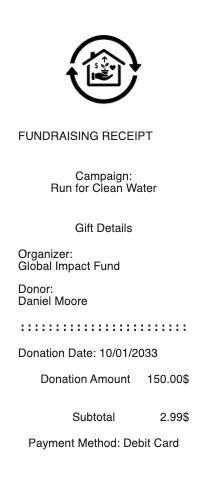
Three kinds of fundraising, three kinds of receipt
"I donated to a fundraiser" describes three legally different acts, and the paperwork diverges accordingly:
A personal crowdfunding campaign — medical bills, disaster recovery, a family in need. The platform receipt documents a gift to an individual.
A peer-to-peer charity fundraiser — a friend's marathon page benefiting a registered charity. The money flows to the charity; the friend is the messenger.
An organisation's own appeal — the charity fundraising directly, issuing its own acknowledgments.
The single most consequential fact: gifts to individuals are not tax-deductible, however compassionate the cause. Only gifts to qualified organisations qualify — so the deductibility of your donation is decided by who legally received it, which the receipt reveals if you read it.
Reading a platform receipt: who got the money?
Crowdfunding receipts name the parties, and the names carry the tax answer. A receipt showing a payment to a named individual's campaign is a gift record — useful as proof of payment, useless for deduction. A receipt from a peer-to-peer platform showing the charity as recipient supports deduction — and for gifts of $250 or more, the charity's own written acknowledgment (which registered-charity platforms typically trigger automatically) is the document the deduction legally requires.
The trap case is the hybrid: a personal campaign that promises to pass funds to a charity. Until the money legally reaches the organisation, it is a personal gift — the organiser's good intentions do not create deductibility, and the receipt naming an individual is the honest record of that.
Platform fees, and what the beneficiary actually receives
Between the donor's charge and the beneficiary's payout sit deductions the receipts quietly document: platform fees where charged, payment-processing percentages, and — on tip-based platforms — the voluntary platform tip added at checkout, which goes to the platform rather than the cause.
Donors should read the checkout line: the tip is adjustable and its default is a choice someone made for you. Organisers should expect the payout statement to show gross contributions minus processing — and communicate netted figures honestly when reporting what a campaign raised, because "we raised $10,000" and "the family received $9,200" are both true statements a transparent organiser reconciles publicly.
Organiser duties: the other side's paperwork
Running a fundraiser creates record-keeping obligations the enthusiasm rarely anticipates:
Personal campaigns — payouts to the organiser or beneficiary are generally gifts rather than income, but the paper trail (campaign record, payout statements, disbursement evidence) is what demonstrates that character if a tax authority or the platform asks. Organisers who are not the beneficiary should move funds transparently and keep the transfers documented.
Charity fundraisers — the receipting duty belongs to the charity: acknowledgments come from the organisation, not the marathon runner. Organisers should route funds through the official channel precisely so donors get valid documents.
Events with goods — auctions and ticketed dinners engage the quid pro quo rules: only the excess over value received is a gift, and the charity's receipt should say so.
Keeping fundraising records
Donors: keep the platform receipt, and for deductible gifts the charity's acknowledgment — the platform record proves payment, the acknowledgment qualifies it. Organisers: keep the campaign, payout, and disbursement records until well after the campaign closes; the questions come later, and they come to whoever's name was on the page.
Platforms retain contribution histories and can reissue receipts, which is the recovery route. If a record is missing while the gift genuinely happened, your card statement establishes the payment to the platform, and a clear reconstructed record documents that real payment for your files, matching the charge exactly — while the charity's acknowledgment, which only the organisation can issue, remains the document a deduction stands on.
Frequently asked questions
Everything you need to know about the product and billing.
Are donations to a GoFundMe-style campaign tax deductible?
Not when the recipient is an individual — gifts to people are not deductible however compassionate the cause. Deduction requires a qualified organisation as the legal recipient, which the receipt reveals.
What about a friend's charity fundraiser page?
Peer-to-peer pages benefiting a registered charity route the money to the organisation — the gift is deductible, and the charity's own acknowledgment (typically automatic on such platforms) is the document that qualifies gifts of $250 or more.
What is the platform tip at checkout?
A voluntary payment to the platform itself, separate from your gift, often preselected at a default percentage. It is adjustable — the default is a choice someone made for you.
Why did the beneficiary receive less than was raised?
Payment processing, platform fees where charged, and tips to the platform sit between gross contributions and the payout. Transparent organisers reconcile the two figures publicly.
Do fundraiser organisers owe taxes on the money?
Payouts on personal campaigns are generally gifts rather than income, but the character depends on the facts — and the campaign, payout, and disbursement records are what demonstrate it if the platform or a tax authority asks.
What records should a donor keep?
The platform receipt as proof of payment, plus — for deductible gifts — the charity's written acknowledgment. One proves you paid; the other qualifies the deduction.