A funeral receipt is the funeral home's written proof of what a family paid: the goods and services chosen, the cash advance items paid to others, the total, and each payment made toward it. A paid-in-full funeral receipt shows a zero balance. This page shows what a complete funeral receipt lists, how it matches the itemized statement funeral homes must give under the FTC Funeral Rule, and when an estate or family needs one.
Funeral Receipt
Add custom logo
Edit line items
Choose payment method
Add/remove elements
Customize business information
Choose font
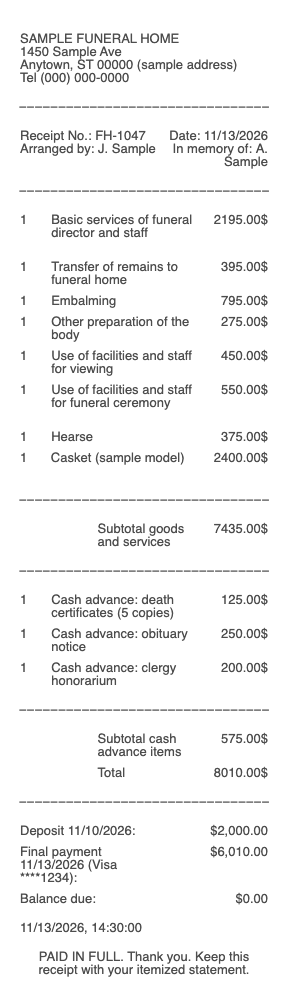
What a funeral receipt lists
Funeral home details — business name, address and phone
Receipt number and date, the name of the person who arranged the funeral, and the name of the person who died
Goods and services selected, each with its own price — for example basic services of the funeral director and staff, transfer of remains, embalming, use of facilities for viewing or a ceremony, the hearse, and the casket or urn
Cash advance items — money the funeral home paid to others for you, such as death certificates, an obituary notice or a clergy honorarium
Total, then every payment with its date and method (deposit, insurance assignment, card, check)
Balance due — and "paid in full" once it reaches zero
A receipt that shows only one lump sum is weak proof. When the family, the estate or an insurer asks what the money paid for, the line items are what answer the question.
The itemized statement behind the receipt
In the United States, the FTC Funeral Rule (16 CFR Part 453, read on eCFR in November 2026) requires a funeral provider to give the person who arranges a funeral an itemized written statement to keep, at the end of the arrangements meeting. It must list:
each funeral good and service selected, with its price;
each cash advance item, itemized;
the total cost.
If some prices are not known yet, the funeral home may give a good-faith estimate, but it must provide a written statement of the actual charges before the final bill is paid. The statement can be part of the contract. Your receipt should match it line for line; if the totals differ, ask why before you pay the balance.
Cash advance items: what they are and how they appear
A cash advance item is something the funeral home buys from a third party and pays for on your behalf. The Funeral Rule lists examples: cemetery or crematory services, pallbearers, public transportation, clergy honoraria, flowers, musicians or singers, nurses, obituary notices, gratuities and death certificates.
These belong in their own section of the statement and the receipt, apart from the funeral home's own goods and services. If the funeral home adds a charge on a cash advance item, or keeps a rebate or commission on it, the rule says the statement must include the sentence "We charge you for our services in obtaining:" followed by those items.
If the funeral home told you a law, cemetery or crematory requires you to buy something, the rule also says that reason must be written on the statement.
When you need a paid-in-full funeral receipt
A paid-in-full receipt is the one that shows every payment and a balance of $0.00. People usually ask for it when someone else needs proof the bill was settled:
The estate — if the estate paid the funeral bill, the executor or administrator keeps the receipt in the estate's records of what was paid out.
Family members who split the cost — a receipt showing who paid what, and when, settles questions later.
An insurer or other payer — when a policy or another party pays part of the bill, the receipt shows that payment and what remained.
Ask the funeral home that handled the arrangements. It keeps the account, so it can issue a final receipt or a statement marked paid in full. Keep it together with the itemized statement from the arrangements meeting.
Make a funeral receipt with our template
Our funeral receipt template lays out the funeral home block, the goods and services selected, a separate cash advance section, the total, each payment and the balance due. Small funeral homes, celebrants and cremation providers can use it to issue clean receipts, and families can use it to rebuild the record of a real payment when the original was lost.
For real funerals and real payments only. Enter the prices actually charged and the amounts actually paid. A funeral receipt for a funeral that did not happen, or one that shows more than was paid, used to claim bereavement leave, insurance money or estate funds, is fraud.
For a deposit taken at the arrangements meeting see the deposit receipt; for a payment made in cash, the cash payment receipt.
Frequently asked questions
Everything you need to know about the product and billing.
What is a funeral receipt?
It is the funeral home's written record of what you paid: the goods and services chosen, cash advance items, the total, each payment and the balance. Once the balance is zero it is a paid-in-full receipt.
What must a funeral home give me in writing?
Under the FTC Funeral Rule, at the end of the arrangements meeting you get an itemized statement to keep. It lists each good and service with its price, each cash advance item, and the total cost.
What are cash advance items on a funeral bill?
Things the funeral home pays others for on your behalf, such as death certificates, obituary notices, clergy honoraria, flowers, or cemetery and crematory services. They are listed separately from the funeral home's own charges.
How do I get a paid-in-full funeral receipt?
Ask the funeral home that handled the arrangements. It should list every payment with its date and show a balance of $0.00. Keep it with the itemized statement.
Why does my receipt not match the estimate?
Some prices may not be known at the arrangements meeting, so the funeral home can give a good-faith estimate. The rule says you must get a written statement of the actual charges before the final bill is paid.
Can I make my own funeral receipt?
Yes, if you run a funeral business or you are rebuilding the record of a real payment, with the real prices and amounts. A receipt for a funeral that did not happen, or for more than was paid, is fraud.