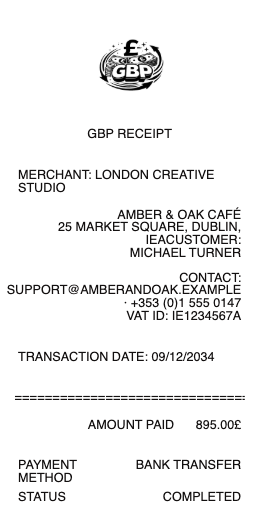
A GBP receipt from a VAT-registered business shows UK VAT at the applicable rate. This guide explains the three UK VAT rates, the registration threshold, and what a valid VAT receipt must contain.
GBP Receipt
Add custom logo
Edit line items
Choose payment method
Add/remove elements
Customize business information
Choose font
Not everything on a UK receipt carries the same VAT
The UK operates three VAT rates, and a single receipt can contain all of them:
Standard rate — 20%. The default: most goods and services.
Reduced rate — 5%. Domestic fuel and power, children's car seats, some energy-saving materials.
Zero rate — 0%. Most food, children's clothing, books and newspapers, and prescription medicines.
Zero-rated is not the same as exempt, and the distinction matters to businesses: zero-rated sales are taxable at 0% and allow the seller to reclaim input VAT, while exempt supplies (insurance, most financial services, postage stamps) do not.
This is why a UK supermarket receipt prints a letter beside each line and a key at the foot — a single shop legitimately contains items taxed at 20%, at 5%, and at nothing at all.
Not every business charges VAT at all
A business must register for VAT once its taxable turnover crosses the registration threshold, and many small traders operate legitimately below it. A sole trader below the threshold charges no VAT and has no VAT number — and their receipt is entirely valid without one.
The consequence for a customer: you cannot reclaim VAT you were never charged. A receipt from a non-registered trader is proof of payment but not a VAT receipt, and a business customer looking to reclaim needs to know the difference rather than assuming a missing VAT line is an oversight.
What makes a valid UK VAT receipt
To reclaim input VAT, the document must carry the supplier's VAT registration number — which, notably, a card machine slip almost never does. A full VAT invoice shows:
The supplier's name, address, and VAT number.
A unique invoice number and the date of supply (the tax point).
The customer's name and address.
A description of the goods or services.
The net amount, the VAT rate, the VAT amount, and the gross total — with each rate shown separately where several apply.
The simplified receipt for smaller purchases
Requiring a full invoice for a £4 sandwich would be absurd, and the rules provide for it. For supplies of £250 or less including VAT, a simplified VAT receipt is sufficient to reclaim input tax, and it needs only:
The supplier's name, address, and VAT number.
The date of supply.
A description of what was bought.
The VAT-inclusive total and the rate charged.
It does not need the customer's details, and it does not need the net and VAT figures separated. This is exactly the format of a typical till receipt from a VAT-registered shop — which is why those small receipts are reclaimable while a bare card slip, carrying no VAT number, is not.
Keeping UK VAT records
VAT records must generally be kept for at least six years. Thermal till receipts do not survive six years — they fade to blank well inside that window — so digitising is not a nicety but the only way to actually comply with the retention requirement using the documents you were given.
Where a VAT receipt is missing for a purchase that genuinely happened, ask the supplier to reissue: a VAT-registered business is obliged to provide one to a VAT-registered customer on request, and most can email a copy. A reconstruction from your bank statement documents your payment for your own files and matches the charge exactly — but it cannot create reclaimable VAT, because only the supplier's VAT number and VAT breakdown can do that.
Frequently asked questions
Everything you need to know about the product and billing.
What are the UK VAT rates?
Three: the standard rate of 20% on most goods and services, a reduced rate of 5% (domestic fuel and power, children's car seats, some energy-saving materials), and a zero rate on most food, children's clothing, books, and prescription medicines.
What is the difference between zero-rated and exempt?
Zero-rated supplies are taxable at 0% and let the seller reclaim input VAT. Exempt supplies — insurance, most financial services, postage stamps — do not carry that right. They look the same on a receipt and are not the same thing.
Why does this receipt have no VAT number?
Possibly because the business is below the VAT registration threshold and is not VAT-registered at all. Their receipt is perfectly valid — but you cannot reclaim VAT you were never charged.
Is a card machine slip a VAT receipt?
Almost never. Card slips typically do not show the supplier's VAT registration number, which is required to reclaim input VAT.
What is a simplified VAT receipt?
For supplies of £250 or less including VAT, a shorter receipt suffices: the supplier's name, address and VAT number, the date of supply, a description, and the VAT-inclusive total with the rate charged. No customer details, no separated net and VAT figures.
How long must UK VAT records be kept?
Generally at least six years. Since thermal till receipts fade well within that period, keeping digital copies is the practical way to actually meet the requirement.