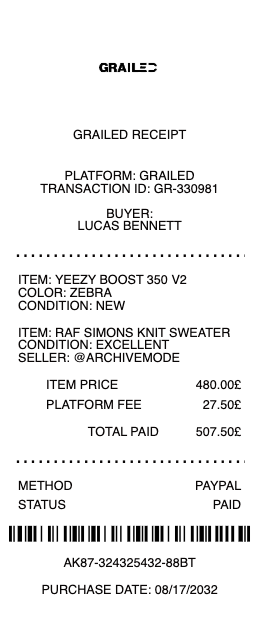
A Grailed receipt is the purchase record behind a marketplace order — the confirmation that names the listing, the seller, the price, shipping, and fees. On a platform built around menswear resale and legit-checking, that document does two jobs at once: it is your proof of purchase, and it is emphatically not proof the item is authentic.
Grailed Receipt
Add custom logo
Edit line items
Choose payment method
Add/remove elements
Customize business information
Choose font
What’s on a Grailed Receipt
Order number and purchase date
The listing — item name as listed, brand, and size
Seller’s username
Item price, shipping charge, and any taxes or buyer fees
Payment method — the card or account charged through checkout
Shipping address and, once sent, the tracking reference
Where to Find Your Grailed Email Receipt and Order History
Grailed sends the receipt as an order confirmation email the moment checkout completes — search your inbox for the order number or the item name if it has buried itself. The same record lives in your account’s purchases section, which is the more durable copy: emails get deleted, but the order history keeps the listing, the amounts, and the tracking together. Sellers get the mirror image — a sale record with the payout after fees — and anyone reconciling a month of flips works from that list, not from memory. For a card dispute or an expense file, a screenshot or PDF of the order page is the document to attach.
The money trail runs one layer deeper than the marketplace: Grailed checkout rides a payment processor, so your bank statement shows the processor-formatted charge while the order details live only in the Grailed receipt. Matching the two — charge amount and date against order confirmation — is the two-document habit that makes any later dispute legible to your bank.
A Receipt Is Not a Legit Check
Receipts circulate on Grailed for a second reason: buyers ask sellers for the original purchase receipt as part of legit-checking sneakers, designer pieces, and grails. Understand what that paper can and cannot do. A receipt proves a purchase happened once — it does not prove the item in the box is the item on the paper, and receipts are among the easiest documents to fake or reuse. That is exactly why fake receipt requests and offers are a known scam pattern on resale platforms. Authenticate the item: materials, stitching, tags, and the platform’s own authentication or purchase protection for high-value orders. Treat any deal that leans on a receipt screenshot instead of the item itself as a red flag.
Refunds, Disputes, and Seller Records
When an order goes wrong — not as described, never shipped — the receipt anchors the case: purchase protection claims and card disputes both start from the order record, its amounts, and its dates. File from the order page rather than the email when possible, since the platform ties the claim to the transaction automatically. Sellers should keep their side just as carefully: sale records with fees and payouts are income documentation, and US marketplace sellers above federal thresholds receive a 1099-K built from exactly these transactions — tidy records mean the form holds no surprises.
Related sneaker resale receipts: see also our StockX receipt guide and our GOAT receipt guide.
Offers and shipping shape the numbers on the receipt in ways screenshots of the listing miss: the accepted offer price replaces the listing price, and shipping is the seller's own line, set per listing. When a buyer disputes value later — for insurance, for customs on an international order — the receipt's accepted-offer figure, not the listing screenshot, is the price that was actually paid.
Rebuild a Marketplace-Style Receipt
Our generator rebuilds a resale-order receipt — order number, item and seller lines, price, shipping, fees, and total — as a clean PDF when you need a legible copy for your records or an expense file and the original email is gone.
Use it responsibly — and read this part twice on a resale platform: recreate only orders you actually placed, with real amounts. Producing receipts to “verify” items you did not buy, pass fakes, or support disputes is fraud, and it is the exact scam pattern buyers here are warned about. A receipt never authenticates an item — the item does.
Trading on other platforms too? See the StockX receipt, GOAT receipt, and eBay receipt examples.
Frequently asked questions
Everything you need to know about the product and billing.
Where do I find my Grailed receipt?
In the order confirmation email sent at checkout and in your account’s purchases section, which keeps the listing, amounts, and tracking together. The order page is the copy to screenshot for disputes or expenses.
What does a Grailed receipt show?
The order number and date, the listing name with brand and size, the seller’s username, the item price with shipping and any fees or taxes, the payment method, and the shipping address with tracking once sent. The accepted offer price, where one was made — which is why the receipt, not a listing screenshot, states what was actually paid.
Does a receipt prove an item on Grailed is authentic?
No. A receipt proves a purchase happened once — not that the item in front of you is that item. Authenticate the piece itself and use the platform’s protection on high-value orders; receipt-screenshot “proof” is a known scam pattern.
How do refunds and disputes work with a Grailed order?
Claims start from the order record — its amounts and dates — under purchase protection, or as a card dispute through your bank. Filing from the order page ties the claim to the transaction automatically.
Do Grailed sellers need to keep sale records?
Yes. Sale records with fees and payouts document income, and US marketplace sellers over federal thresholds receive a 1099-K built from those transactions. Clean records make it match reality.
Can I get a copy of a Grailed receipt if I deleted the email?
Yes — the purchase stays in your account’s order history, where you can view and screenshot the full record at any time. Your bank statement holds the processor's version of the charge — matching its amount and date to the order is how you re-anchor a deleted email trail.