A Lidl receipt comes from a German discounter that shares ALDI’s low-price model but adds two things its rival deliberately skips: a loyalty app and an in-store bakery. Those show up on or around the slip — Lidl Plus coupons applied to your total, fresh-bakery items rung by code — and this page covers what the receipt shows and how the app changes it.
Lidl Receipt
Add custom logo
Edit line items
Choose payment method
Add/remove elements
Customize business information
Choose font
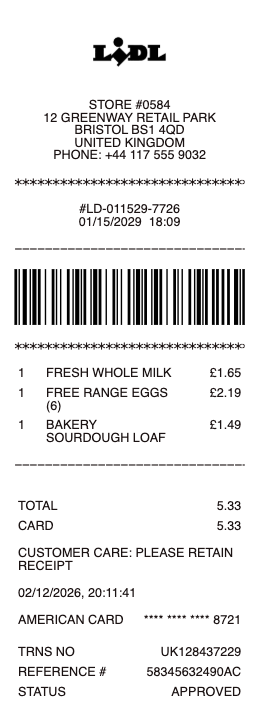
What’s on a Lidl Receipt
Store number and location
Date, time, and transaction number
Each item — mostly Lidl’s own exclusive brands, plus fresh-bakery lines
Lidl Plus discounts — coupons and app offers applied, shown against the regular price
Bag charge, if you bought store bags
Subtotal, tax, and total
Payment method — card, cash, or Lidl Plus-linked payment where offered
Lidl Plus: The App That Changes the Receipt
Unlike ALDI, Lidl runs a loyalty program — Lidl Plus — and scanning its app barcode at checkout is what pulls digital coupons and member offers onto your total. That has two consequences for the receipt: the printed slip shows the discounts applied, and a digital copy of the receipt lands in the Lidl Plus app, giving you an account-linked archive that ALDI and Trader Joe’s simply do not have. If you use the app, a lost paper receipt is not a problem — open Lidl Plus, find the purchase in your history, and the itemized digital receipt is there to view or screenshot for an expense claim. Without the app, the paper slip is your only record.
The app also runs a Coupon Plus spend-tier reward: hit a monthly spend threshold and Lidl Plus issues a voucher, which posts against a future receipt rather than the current one — worth reconciling if a total comes out lower than the shelf prices suggested.
The Bakery and the “Middle of Lidl”
Two Lidl signatures affect what rings up. The in-store bakery — a genuine point of difference from most discounters — sells fresh bread and pastries that are often self-served and entered by item code, so those lines read differently from packaged goods. And the famous “Middle of Lidl” — the center-aisle rotation of limited-time non-grocery specials, from cookware to power tools — rings up like any product but disappears once sold through. As with any limited run, keep the receipt for those middle-aisle buys: they carry the store’s standard return rights, but you cannot simply repurchase one after the week’s stock is gone.
In markets with a deposit return scheme, Lidl slips carry bottle-deposit arithmetic in both directions: a small deposit charged per container on the way in, and a redemption voucher from the reverse-vending machine credited at the till on the way out. The voucher line explains a total that rings up lower than the shelf math — the machine's credit is real money against the basket.
Returns, Expenses, and Getting a Copy
Lidl’s return policy is customer-friendly, and the receipt (paper or the Lidl Plus digital copy) is what makes a refund to the original payment straightforward. For work reimbursements, the itemized receipt is what an approver needs — and here Lidl has an edge over its no-loyalty rivals, since the app receipt can be forwarded without hunting for a faded slip. The exclusive-brand naming quirk still applies: item names are Lidl’s own, appearing only on the receipt and never on the card statement, so the itemized copy is the one that documents what you actually bought.
Related grocery receipts: see also our Aldi receipt guide and our Tesco receipt guide.
Non-food warranty items from the middle aisles get the receipt treatment groceries never need: tools, kitchen appliances, and electronics carry multi-year guarantees serviced against proof of purchase, and the rotating stock means the receipt is the only durable record the item existed at that price. Photograph those slips the day of purchase.
Create a Lidl-Style Receipt
Our generator rebuilds a discount-grocer receipt in the Lidl style — store header, itemized exclusive-brand and bakery lines, any Lidl Plus discount, tax, and total — as a clean PDF for records when the original is gone.
Use it responsibly: recreate only real purchases at their true amounts. Fabricating receipts for returns or reimbursements is fraud — and if you use Lidl Plus, the authoritative copy already lives in your app. Lidl is a trademark of its owner; this tool is not affiliated with the company.
Frequently asked questions
Everything you need to know about the product and billing.
Does Lidl have a loyalty program?
Yes — Lidl Plus. Scanning its app barcode at checkout applies digital coupons and member offers to your total, and a digital copy of the receipt is saved in the app.
How do I get a digital copy of a Lidl receipt?
If you scanned Lidl Plus at checkout, open the app and find the purchase in your history — the itemized digital receipt is there to view or screenshot. Without the app, the paper slip is the only record.
Why do bakery items look different on my Lidl receipt?
Lidl’s in-store bakery items are often self-served and entered by item code, so they ring up differently from packaged, barcoded goods.
What is the “Middle of Lidl”?
The center-aisle rotation of limited-time non-grocery specials — cookware, tools, seasonal goods. They ring up like any item but sell out and cannot be repurchased later, so keep the receipt for returns.
Do Lidl Plus discounts show on the receipt?
Yes — coupons and app offers applied at checkout print as discounts against the regular price, and the same breakdown appears on the digital receipt in the app. Bottle-deposit lines show both ways where deposit return schemes run — charged per container at purchase, credited back when the reverse-vending voucher hits the till.
Can I return to Lidl with the app receipt?
Yes — the Lidl Plus digital receipt serves as proof of purchase for returns and reimbursements, and refunds on a documented purchase go to the original payment method. For middle-aisle non-food with multi-year guarantees, keep the receipt beyond the return window — rotating stock means the slip is the only durable record.