A mining payout receipt records crypto earned by proof-of-work mining — the coins a pool pays you for contributing computing power. Like staking, it’s an income record taxed at receipt, but mining adds its own layer: real hardware and electricity costs that can make it a business. This page explains what a payout record shows, how pool payouts work, and why the hobby-versus-business line changes everything about the tax.
Mining Payout Receipt
Add custom logo
Edit line items
Choose payment method
Add/remove elements
Customize business information
Choose font
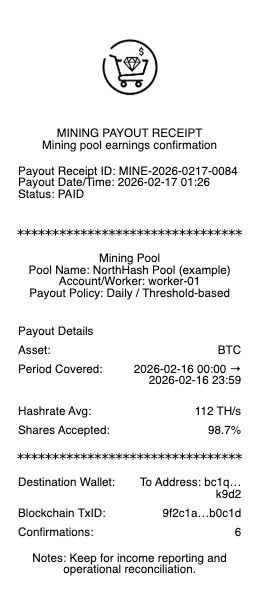
What’s on a Mining Payout Record
The mining pool and your worker/account
The payout amount and coin, with the date/time
The fair-market USD value at receipt
The payout scheme — PPS, PPLNS, or FPPS
Your hashrate contribution and any pool fee deducted
The transaction hash once paid to your wallet
Cumulative earnings, if it’s a period statement
Mining Pools and Payout Schemes
Solo mining is impractical for most coins today, so miners join a pool, contribute hashrate (computing power), and receive a proportional share of what the pool earns. How that share is calculated is the payout scheme, and it shows on your record. PPS (Pay Per Share) pays a fixed amount per share of work regardless of whether the pool finds a block — steady but with a higher pool fee. PPLNS (Pay Per Last N Shares) pays based on the pool’s actual luck over recent shares — more variable, potentially higher. FPPS adds a cut of transaction fees to PPS. Pools also enforce a payout threshold (a minimum balance before they send funds) and deduct a pool fee. Reading the scheme, your hashrate, and the fee explains why a payout is the size it is — and lets you compare pools on real terms rather than headline rates.
Hobby vs Business — the Tax Fork
Mining income is taxed like other crypto rewards — ordinary income at fair-market value when received, then a capital gain or loss when you later sell, with basis equal to that receipt value. But mining has a fork that staking doesn’t: hobby versus business. If you mine as a trade or business, the income is subject to self-employment tax, but you can deduct expenses — the biggest being hardware (ASIC or GPU rigs, via depreciation or Section 179) and electricity, which is often the dominant ongoing cost, plus cooling and hosting. If you mine as a hobby, you still report the income, but deductions are limited or unavailable. That distinction can swing the real return of a mining operation dramatically, so the payout records — paired with electricity bills and hardware receipts — are what substantiate a business classification and its deductions. Keeping them isn’t optional if you mine at any scale.
Records, Verification, and Getting the Data
Mining generates frequent, small payouts, so organized records are essential. Your pool dashboard shows each payout with its amount, scheme, and often a transaction hash, and most pools let you export a history for the period — the practical document for totaling income. Once a payout hits your wallet, it’s verifiable on-chain by its hash like any transaction. For taxes, you need the USD value at each payout’s receipt, which crypto tax tools calculate by importing pool and wallet data against historical prices. Because there’s often no tax form issued for mining, reconstructing income from these records falls to you. Keep the pool exports alongside your hardware and electricity documentation: together they establish both the income side and, for a mining business, the deductible-cost side. The payout record naming the coin, amount, date, and value is the core of it.
Related crypto receipts: see also our staking reward receipt guide and our Bitcoin receipt guide.
Create a Mining Payout Receipt
Our generator produces a clean mining payout record — pool, coin and amount, USD value at receipt, payout scheme, hashrate, and any fee — as a readable PDF for your income records or a crypto tax file when you want a legible summary of a payout.
Use it responsibly: recreate only real payouts actually received, with their true amounts and values. Fabricating mining receipts to misstate crypto income, invent payouts, or inflate business deductions is tax fraud — pool payouts and on-chain transactions are verifiable, and expense claims must be backed by real hardware and electricity records. The pool and blockchain records are authoritative; this tool is for legitimate record-keeping only.
Frequently asked questions
Everything you need to know about the product and billing.
What does a mining payout record show?
The mining pool and your worker account, the payout amount and coin with date, the fair-market USD value at receipt, the payout scheme (PPS, PPLNS, or FPPS), your hashrate contribution and any pool fee, the transaction hash once paid, and cumulative earnings if it’s a statement.
What are PPS, PPLNS, and FPPS payout schemes?
PPS (Pay Per Share) pays a fixed amount per share of work regardless of pool luck — steady, higher fee. PPLNS pays based on the pool’s actual recent luck — more variable. FPPS adds a share of transaction fees to PPS. The scheme, with your hashrate, determines your payout size.
How is crypto mining income taxed?
It’s ordinary income at fair-market value when received, then a capital gain or loss when you later sell (basis = the receipt value). If you mine as a business, income is subject to self-employment tax but expenses are deductible; as a hobby, deductions are limited.
Can I deduct mining hardware and electricity?
If you mine as a trade or business, yes — hardware (ASIC or GPU rigs, via depreciation or Section 179) and electricity, often the dominant cost, plus cooling and hosting. As a hobby, those deductions are limited or unavailable, so the classification matters a lot.
How do I get my mining payout history?
Your pool dashboard shows each payout with amount, scheme, and often a transaction hash, and most pools let you export a history for the period — the practical document for totaling income. Once paid, each payout is also verifiable on-chain by its hash.
Does anyone report my mining income to the IRS?
Often no tax form is issued, so reconstructing income from your pool and wallet records is your responsibility. You need the USD value at each payout’s receipt, which crypto tax tools calculate from historical prices — keep pool exports with your hardware and electricity records.