An Omega receipt is more than proof of a luxury-watch purchase — it’s part of the documentation that keeps the watch under warranty, insurable, and resellable. A Speedmaster or Seamaster is a serial-numbered Swiss timepiece, and its paperwork (receipt, warranty card, serial and reference) travels with it for decades. This page explains what an Omega receipt shows, why the “full set” matters, and how it fits authentication.
Omega Receipt
Add custom logo
Edit line items
Choose payment method
Add/remove elements
Customize business information
Choose font
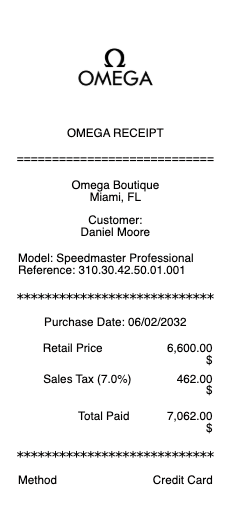
What’s on an Omega Receipt
The boutique or authorized dealer and purchase date
The model — e.g. Speedmaster, Seamaster, Constellation — and collection
The reference number and the watch’s serial number
The price paid, and any tax or VAT
Warranty details — Omega’s extended warranty registration
Payment method and any trade-in applied
Servicing notes, if it’s a service invoice rather than a sale
Serial, Reference, and the Warranty Card
Two numbers identify an Omega, and both connect to the receipt. The reference number specifies the exact model and configuration; the serial number is unique to your individual watch. Modern Omegas come with a warranty card (increasingly digital) that Omega registers to that serial — current pieces carry an extended warranty of up to five years — and the receipt is what activates and dates that coverage. Omega’s technical hallmarks add context to what you bought: the Co-Axial escapement (a movement innovation) and Master Chronometer certification (independently tested by METAS, resistant to magnetism up to 15,000 gauss) are why these are precision instruments, not just accessories. Keeping the receipt with the warranty card links your specific serial to its coverage and purchase date, which is exactly what a warranty or service claim requires.
The "Full Set" — Box, Papers, and Resale Value
In the watch world, the receipt is part of what collectors call the “full set”: the watch plus its box, warranty card/papers, and receipt. This matters enormously for resale — an Omega with complete box and papers commands a meaningfully higher price than the identical watch sold “naked,” because the documentation proves provenance and authenticity to the next buyer. Iconic references like the Speedmaster Moonwatch (the model NASA qualified for spaceflight) and the Seamaster (long associated with James Bond) have active resale markets where a documented history is a real premium. The receipt anchors the chain: it shows where and when the watch entered authorized ownership. For anyone who may one day sell or trade a piece, keeping the original receipt with the box and warranty card is straightforward money — it protects the watch’s value as much as its condition does.
Authentication, Insurance, and Servicing
An Omega receipt supports the three things owners actually need paperwork for. Authentication: while the receipt alone doesn’t authenticate a watch — that requires examining the piece and its serial against Omega’s records — it’s part of the evidence package a buyer or Omega boutique reviews, which is precisely why counterfeit sellers try to fake it. Insurance: scheduling a valuable watch on a policy (or a standalone jewelry/watch rider) requires proof of value, and the receipt establishes purchase price, often alongside a separate appraisal. Servicing: Omega recommends periodic service, and keeping receipts and service invoices builds a maintenance history that supports both warranty and resale. Because these watches hold value for decades, the receipt is a long-term document — worth storing safely with the warranty card and box rather than discarding after purchase.
Related luxury watch receipts: see also our Rolex receipt guide and our Audemars Piguet receipt guide.
Create an Omega Receipt
Our generator reproduces an Omega-style purchase receipt — boutique, model and reference, serial, price, and warranty details — as a clean PDF when you need a legible copy for insurance scheduling, a service record, or your own files.
Use it responsibly: recreate only a genuine watch you actually bought, with its true details. Fabricating an Omega receipt to authenticate a counterfeit, inflate an insurance claim, or misrepresent provenance in a resale is fraud — a receipt is not proof of authenticity, and Omega verifies a watch through its serial and the physical piece, not a document. Omega is a trademark of its owner; this tool is not affiliated with it and is for legitimate record-keeping only.
Frequently asked questions
Everything you need to know about the product and billing.
What does an Omega receipt show?
The boutique or authorized dealer and date, the model and collection (Speedmaster, Seamaster, etc.), the reference number and the watch’s unique serial number, the price and any VAT, warranty registration details, the payment method, and any trade-in or servicing notes.
What’s the difference between an Omega reference and serial number?
The reference number specifies the exact model and configuration; the serial number is unique to your individual watch. Omega registers the warranty to the serial, and the receipt is what activates and dates that coverage — current watches carry up to a five-year warranty.
What is a "full set" for an Omega watch?
The watch together with its box, warranty card/papers, and receipt. A full set commands a meaningfully higher resale price than the same watch sold without documentation, because the papers prove provenance and authenticity to the next buyer.
Does an Omega receipt prove the watch is authentic?
No. A receipt is part of the evidence a buyer or boutique reviews, but authentication requires examining the physical watch and its serial against Omega’s records. That’s exactly why counterfeit sellers try to fake receipts — the document alone proves nothing.
Do I need my Omega receipt for insurance?
Usually yes. Scheduling a valuable watch on a policy or a watch rider requires proof of value, and the receipt establishes the purchase price — often alongside a separate professional appraisal. Keep it with the warranty card and box.
Why should I keep my Omega receipt and box?
Because they’re part of the full set that protects the watch’s value for resale, and the receipt links your serial to its warranty and purchase date for any service or claim. These watches hold value for decades, so the paperwork is a long-term asset.