An Audemars Piguet receipt documents a purchase from one of the "Holy Trinity" of watchmaking — most often a Royal Oak, among the hardest luxury watches to buy at retail. Because AP sells almost entirely through its own boutiques and allocates its most sought-after pieces, an authorized-purchase receipt carries unusual weight. This page explains what an AP receipt shows, how its boutique distribution works, and why documentation matters so much here.
Audemars Piguet Receipt
Add custom logo
Edit line items
Choose payment method
Add/remove elements
Customize business information
Choose font
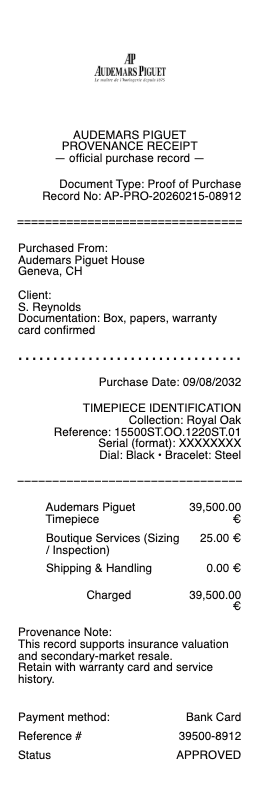
What’s on an Audemars Piguet Receipt
The AP boutique or AP House and purchase date
The model — Royal Oak, Royal Oak Offshore, Code 11.59 — and reference
The unique serial number of the watch
The price paid and applicable tax/VAT
Reference to the guarantee/warranty certificate issued with the watch
Payment method, and any allocation or client note
Servicing details, if it’s a service invoice
The Royal Oak and What You Bought
AP’s identity centers on the Royal Oak, designed by Gérald Genta in 1972 — the watch that created the luxury stainless-steel sports category, with its octagonal bezel secured by eight hexagonal screws, the textured “Tapisserie” dial, and an integrated bracelet. The sportier, larger Royal Oak Offshore and the more recent Code 11.59 round out the core lines. A receipt specifies the exact model and reference, which matters enormously because value varies drastically across AP’s range and configurations. As haute horlogerie from a family-owned maison in the Vallée de Joux, these are hand-finished movements, not mass-market watches — part of why a specific reference and its serial are what the receipt pins down. Knowing precisely which AP the receipt describes is the basis for insuring, valuing, or authenticating it, since a steel Royal Oak and a complicated or precious-metal piece are worlds apart in value.
Boutique-Only Distribution and Waitlists
What makes an AP receipt unusual is how the watches are sold. Audemars Piguet has moved to a boutique-controlled model — selling largely through its own AP boutiques and AP Houses rather than a wide network of third-party dealers — and its most in-demand pieces, especially steel Royal Oaks, are allocated to established clients through long waitlists. Demand runs far above supply, so buying a Royal Oak at retail is genuinely difficult, and secondary-market prices commonly run well above retail. That scarcity is exactly why an authorized-boutique receipt is valuable: it proves the watch entered ownership through official channels at retail, which matters for provenance in a market full of flipped and grey-market pieces. The receipt naming the AP boutique, the reference, and the serial is the documentary proof of an authorized purchase — a meaningful distinction for a brand this supply-constrained.
Provenance, Insurance, and Authentication
Because AP watches hold and often exceed their retail value, the receipt does serious work. For provenance and resale, a “full set” — watch, box, guarantee certificate, and receipt — commands a premium and reassures buyers in a market where documentation separates a clean piece from a questionable one. For insurance, scheduling an AP requires proof of value, and the receipt establishes purchase price alongside an appraisal reflecting current market value (which can be higher than retail). For authentication, the physical watch, its finishing, and its serial checked against AP’s records are what confirm a watch — a receipt is supporting evidence only, which is precisely why counterfeit and grey-market sellers try to supply fake paperwork. AP can service and verify pieces through its records. Treated properly, an AP’s documentation is stored as carefully as the watch, because here the paperwork genuinely protects a substantial asset.
Related luxury watch receipts: see also our Patek Philippe receipt guide and our Omega receipt guide.
Create an Audemars Piguet Receipt
Our generator reproduces an AP-style purchase receipt — boutique, model and reference, serial, price, and guarantee reference — as a clean PDF when you need a legible copy for insurance scheduling, a provenance file, or your own records.
Use it responsibly: recreate only a genuine watch you actually purchased, with its true details. Fabricating an AP receipt to authenticate a counterfeit, fake an authorized-purchase provenance, or inflate an insurance valuation is fraud — authenticity rests on the physical watch and its serial verified against Audemars Piguet’s records, not on a document, and AP’s scarcity makes forged paperwork a known problem. Audemars Piguet is a trademark of its owner; this tool is not affiliated with it and is for legitimate record-keeping only.
Frequently asked questions
Everything you need to know about the product and billing.
What does an Audemars Piguet receipt show?
The AP boutique or AP House and date, the model (Royal Oak, Royal Oak Offshore, Code 11.59) and reference, the watch’s unique serial number, the price and VAT, a reference to the guarantee certificate, the payment method and any allocation note, and any servicing details.
What is the Audemars Piguet Royal Oak?
AP’s defining watch, designed by Gérald Genta in 1972 — the first luxury stainless-steel sports watch, with an octagonal bezel secured by eight hexagonal screws, a textured Tapisserie dial, and an integrated bracelet. The Offshore and Code 11.59 round out the core lines.
Why is it so hard to buy an AP Royal Oak?
AP sells largely through its own boutiques and AP Houses rather than many third-party dealers, and allocates its most in-demand pieces — especially steel Royal Oaks — to established clients via long waitlists. Demand far exceeds supply, so secondary-market prices often run well above retail.
Why is an authorized AP receipt valuable?
Because AP is boutique-controlled and supply-constrained, an authorized-boutique receipt proves the watch entered ownership through official channels at retail — meaningful provenance in a market full of flipped and grey-market pieces. It names the boutique, reference, and serial.
Does an AP receipt prove the watch is authentic?
No. Authenticity rests on the physical watch, its finishing, and its serial checked against AP’s records; the receipt is supporting evidence only. AP’s scarcity makes forged paperwork a known problem, so counterfeit and grey-market sellers often try to supply fake receipts.
Do I need my AP receipt for insurance?
Yes — scheduling an AP on a policy requires proof of value. The receipt establishes purchase price, usually with an appraisal reflecting current market value, which for sought-after references can exceed retail. Keep it with the guarantee certificate and box as a full set.