A Patek Philippe receipt documents a purchase at the pinnacle of watchmaking — where a timepiece is treated as a heirloom, not an accessory. Patek’s own paperwork is unusually rich: a Certificate of Origin, and the ability to trace any watch it has ever made through an Extract from the Archives. This page explains what a Patek receipt shows, how its documentation works, and why provenance matters more here than almost anywhere in luxury.
Patek Philippe Receipt
Add custom logo
Edit line items
Choose payment method
Add/remove elements
Customize business information
Choose font
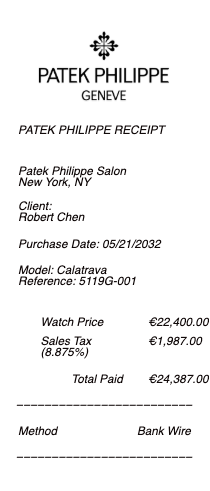
What’s on a Patek Philippe Receipt
The authorized dealer or salon and purchase date
The model reference — e.g. Calatrava, Nautilus, Aquanaut, a complication
The unique movement and case numbers
The price paid and applicable tax/VAT
Reference to the Certificate of Origin issued with the watch
Payment method, and any waitlist or allocation note
Servicing details, if it’s a service invoice
The Certificate of Origin and Extract from the Archives
Patek’s documentation is central to what you own. Every watch is delivered with a Certificate of Origin — the modern warranty and authenticity document, signed and stamped, recording the reference and the movement and case numbers. Beyond that, Patek maintains records of every watch it has produced since 1839, and for a fee will issue an Extract from the Archives confirming a specific watch’s original specification and production date. That’s an extraordinary provenance tool almost unique to Patek, and it’s the authoritative reference an owner or collector relies on — far more than a sales receipt. The receipt complements these: it establishes where and when the watch was bought and for how much, while the Certificate of Origin and any Archive Extract establish what the watch is. Together they form the documentary backbone of a Patek, which is part of why the brand’s pieces are trusted across generations.
"You Never Actually Own a Patek Philippe"
Patek’s famous line — that you merely look after it for the next generation — isn’t just marketing; it reflects how these watches are held and valued. They are built and documented to be serviced and passed down for decades, and Patek will service even very old references. This generational framing has a practical consequence for paperwork: the original receipt, Certificate of Origin, box, and any service records accumulate into a provenance file that follows the watch through inheritance and resale. Certain references — the Nautilus and Aquanaut especially — have had demand so far above supply that authorized dealers maintain long waitlists, and secondary-market prices have run well over retail. In that environment, complete original documentation is decisive: it distinguishes a watch with a clean, provable history from one without, and the receipt is the first link in that chain.
Provenance, Insurance, and Authentication
Because Patek watches hold and often grow in value, the receipt does serious work. For insurance, scheduling a Patek requires proof of value, and the receipt establishes purchase price alongside a professional appraisal that reflects current market value — which can exceed what was paid. For resale and provenance, a full documentation set (receipt, Certificate of Origin, box, service history) materially affects both price and buyer confidence, and an Archive Extract can confirm originality for significant pieces. For authentication, the physical watch and its movement and case numbers — checkable against Patek’s records — are what confirm a watch, not a receipt on its own; a receipt is supporting evidence only, which is why it’s a target for forgery around counterfeits. Treated properly, a Patek’s paperwork is stored as carefully as the watch, because here the documentation is genuinely part of the asset.
Related luxury watch receipts: see also our Audemars Piguet receipt guide and our Rolex receipt guide.
Create a Patek Philippe Receipt
Our generator reproduces a Patek Philippe-style purchase receipt — dealer, reference, movement and case numbers, price, and certificate reference — as a clean PDF when you need a legible copy for insurance scheduling, a provenance file, or your own records.
Use it responsibly: recreate only a genuine watch you actually purchased, with its true details. Fabricating a Patek receipt to authenticate a counterfeit, inflate an insurance valuation, or fake provenance for resale is fraud — authenticity rests on the physical watch and its movement and case numbers verified against Patek’s archives, not on any document, and the Extract from the Archives is the authoritative reference. Patek Philippe is a trademark of its owner; this tool is not affiliated with it and is for legitimate record-keeping only.
Frequently asked questions
Everything you need to know about the product and billing.
What does a Patek Philippe receipt show?
The authorized dealer or salon and date, the model reference (Calatrava, Nautilus, Aquanaut, or a complication), the unique movement and case numbers, the price and any VAT, a reference to the Certificate of Origin, the payment method, and any waitlist or servicing notes.
What is a Patek Philippe Certificate of Origin?
The signed, stamped document delivered with the watch that serves as its warranty and authenticity record, listing the reference and the movement and case numbers. It’s the primary authenticity document — the sales receipt complements it by proving where, when, and for how much the watch was bought.
What is an Extract from the Archives?
Patek keeps records of every watch it has made since 1839 and, for a fee, issues an Extract from the Archives confirming a specific watch’s original specification and production date. It’s an authoritative provenance tool almost unique to Patek, used to verify significant or vintage pieces.
Why is documentation so important for a Patek Philippe?
Because these watches are held and passed down for generations and often appreciate, a full set — receipt, Certificate of Origin, box, service records — proves a clean, verifiable history. For in-demand references like the Nautilus, complete documentation materially affects resale price and buyer confidence.
Does a Patek receipt prove authenticity?
No. Authenticity rests on the physical watch and its movement and case numbers checked against Patek’s records; the receipt is supporting evidence only. That’s why receipts are targeted by counterfeit sellers — and why an Archive Extract, not a document alone, is the authoritative confirmation.
Do I need my Patek receipt for insurance?
Yes — scheduling a Patek on a policy requires proof of value. The receipt establishes the purchase price, usually alongside a professional appraisal reflecting current market value, which for some references can exceed what was originally paid. Keep it with the Certificate of Origin.