A personal expense receipt documents a non-business purchase. It is commonly used for budgeting, refunds, and personal record keeping.
Personal Expense Receipt
Add custom logo
Edit line items
Choose payment method
Add/remove elements
Customize business information
Choose font
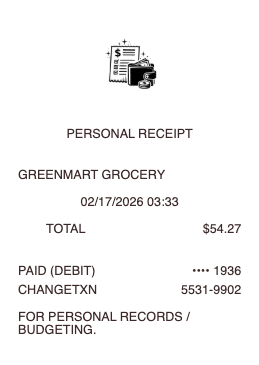
What's on a Personal Expense Receipt
A personal expense receipt is the proof you attach to an expense report or keep for your own budgeting, and whether it's a printed slip or a digital copy, a valid one carries the details a reviewer or the IRS looks for:
Vendor name and location — who you paid, so the expense can be identified and verified.
Date of the transaction — the day the money was spent, which must fall inside the reporting period.
Itemised goods or services — what was purchased, not just a lump sum, so meals, supplies or travel can be categorised.
Amount and tax — the subtotal, any sales tax, and the total actually paid.
Payment method — cash, or the card type and last four digits, tying the receipt to your statement.
Business purpose — often added to the report rather than the receipt itself, but essential for reimbursement and deductions.
IRS receipt requirements for business expenses
If you deduct or get reimbursed for business costs, the IRS receipt requirements for business expenses matter. As a rule of thumb, the IRS generally expects a receipt for any business expense of $75 or more, while smaller costs can often be supported by a log or other records — with one important exception: lodging always requires a receipt regardless of amount. A compliant receipt should show the amount, date, place and the nature of the expense, and for meals or travel you'll also want to note the business purpose (and, for meals, who attended). These are general guidelines drawn from IRS Publication 463; your employer's policy or your accountant may set a stricter threshold, so treat the receipt as the backbone of a defensible record either way.
Reimbursement and the expense report workflow
For a reimbursement expense receipt, the receipt is what turns an out-of-pocket cost into money back in your pocket. Most employers run an "accountable plan": you submit receipts with a short business purpose, and the reimbursement is paid back to you tax-free rather than counted as income. To keep the process smooth, group receipts by category (travel, meals, supplies), make sure each total is legible, and match every line on your expense report to a receipt. Missing or unreadable receipts are the most common reason a report gets sent back, so a clean, complete copy of each one — digital or paper — is the difference between same-cycle payment and a frustrating back-and-forth with finance.
Replacing a lost receipt for an expense report
Lost a slip you need for a claim? Start with the source: many vendors can reprint or email a copy if you have the date, amount and card used, and card or bank statements can corroborate the charge. When only a summary line exists and you need a clean, itemised copy to attach, reconstructing the receipt from the details you already have keeps your report complete and your records accurate. The goal is honest documentation of an expense that genuinely happened — a legible stand-in for a faded thermal slip or a receipt that was never issued — not the invention of a cost you didn't incur. Keep the reconstructed copy alongside any statement evidence so the paper trail holds up.
Related payment receipts: see also our Proof of Payment receipt guide and our Online Purchase receipt guide.
Free expense receipt maker and generator
Our expense receipt generator lets you produce a clean, itemised receipt for an expense report or your own records in under a minute. Add the vendor, date, line items, tax and total, then download a print-ready PDF, PNG or JPG — no account required — so it's easy to attach to a claim or file for the tax year. Use this expense receipt maker to replace a faded or lost slip, to itemise a payment that only came with a summary, or to practise bookkeeping and report formatting. Please use it responsibly and lawfully: create receipts only for expenses that actually happened, for legitimate documentation and reimbursement — never to fabricate costs, mislead an employer, or claim deductions you're not entitled to.
Frequently asked questions
Everything you need to know about the product and billing.
What needs to be on a valid expense receipt?
The vendor name, transaction date, an itemised list of what was bought, the amount and any tax, and the payment method. For reimbursement or a deduction, add the business purpose (and, for meals, who attended) on the expense report.
What are the IRS receipt requirements for business expenses?
As a general rule the IRS expects a receipt for expenses of $75 or more, with smaller costs supported by a log — except lodging, which always needs a receipt. The receipt should show the amount, date, place and nature of the expense (per IRS Publication 463). Your employer may require receipts for every amount.
Do I need a receipt for expenses under $75?
The IRS generally doesn't require one below $75 (lodging excepted), but a log or note of the date, amount and purpose is wise, and many employers require a receipt regardless. When in doubt, keep the receipt.
How do I handle a lost receipt on an expense report?
Ask the vendor to reprint or email a copy, use your card or bank statement as corroboration, and reconstruct a clean itemised copy from the details you have. Keep the statement evidence with it so the record is defensible.
What is an accountable plan for reimbursement?
It's an employer arrangement where you submit receipts with a business purpose and are reimbursed tax-free, rather than the payment being treated as taxable income. Timely, itemised receipts are what keep it compliant.
Can I use this expense receipt generator legitimately?
Yes — to replace a lost or faded receipt, itemise a payment that only came with a summary, or practise bookkeeping. It is for documenting expenses that actually happened, not for fabricating costs or claiming deductions you're not entitled to.