A phone bill receipt is proof you paid your wireless service — and the bill behind it is one of the more confusing monthly statements, because the plan price you were quoted is rarely the total. Between a device installment, taxes, and a stack of regulatory fees, the final number climbs. This page explains what a phone bill and its payment receipt show, why the total exceeds the plan, and the everyday jobs the receipt does.
Phone Bill Receipt
Add custom logo
Edit line items
Choose payment method
Add/remove elements
Customize business information
Choose font
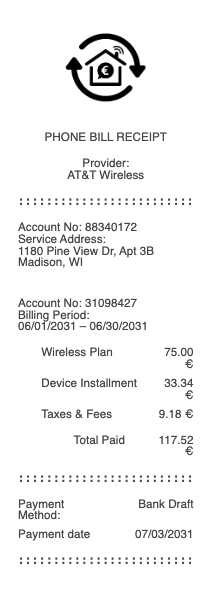
What’s on a Phone Bill and Payment Receipt
The carrier and account number, with the billing period
The plan charge per line — talk, text, and data
A device installment, if you’re financing a phone
Add-ons — device protection, international, or extra data
Taxes and regulatory fees — often several line items
Autopay/paperless discounts, if applied
The amount paid, date, and a confirmation on the payment receipt
Why the Total Is More Than the Plan Price
The single biggest source of phone-bill confusion is that the advertised plan price isn’t the bill. Several things push it up. A device installment — financing a phone over 24 or 36 months (an Equipment Installment Plan) — is a separate charge from service, so a “$X/month plan” plus a phone payment is a bigger total, and importantly the device balance is still owed if you leave the carrier. Then come taxes and regulatory fees: state and local taxes, a 911 fee, a Universal Service Fund (USF) charge, and carrier “regulatory recovery” or administrative fees — small individually but adding up. Carriers often advertise prices with an autopay/paperless discount already applied, so the bill is higher until those kick in. Reading the bill line by line — plan, device, add-ons, taxes/fees, discounts — is how you see where the money actually goes, and spot a charge worth questioning.
Device Installments, Autopay, and Add-Ons
A few recurring elements shape the bill. Device installments (EIP) spread a phone’s cost interest-free over a term; some carrier promotions apply monthly bill credits that offset the installment as long as you keep the line, so the device effectively becomes free over time — but leaving early forfeits the remaining credits and leaves the balance due. Autopay and paperless typically earn a per-line monthly discount, which the bill reflects once enrolled. Add-ons — device protection/insurance, an international plan, extra hotspot data — appear as their own lines and are worth reviewing periodically, since forgotten add-ons are a common source of bill creep. For a family or business account with multiple lines, the bill breaks charges out per line, which is how you allocate cost. The receipt for the payment confirms the total cleared; the bill is where the composition lives.
Proof of Address, Business Expenses, and Records
A phone bill does jobs beyond paying for service. It’s one of the most widely accepted forms of proof of address — for opening accounts, verifying identity, or official applications, a recent phone bill in your name showing your address is standard documentation. For business or self-employed use, the portion of a phone bill attributable to business is a deductible expense, and the itemized bill plus payment receipt is the substantiation (a dedicated business line is cleanest). For disputes, keeping bills lets you catch a rate change, an erroneous charge, or a promised discount that didn’t apply. Carriers keep billing history in your online account or app, so copies of bills and payment confirmations are downloadable, usually for a year or more. Whether you need proof of address, an expense record, or evidence for a billing dispute, the itemized phone bill with its payment receipt is the document to keep.
Related utility receipts: see also our Verizon receipt guide and our Utility Bill receipt guide.
Create a Phone Bill Receipt
Our generator produces a clean phone bill or payment receipt — carrier and account, plan and device charges, taxes and fees, and the amount paid — as a PDF when you need a legible copy for proof of address, a business expense, or your own records.
Use it responsibly: recreate only a real bill and payment, with true amounts. Fabricating a phone bill to fake proof of address or identity, support a false expense claim, or misrepresent a payment is fraud — and forging proof of address for identity verification can carry serious legal consequences. The carrier’s own billing records are the authoritative and verifiable source; this tool is for legitimate record-keeping only.
Frequently asked questions
Everything you need to know about the product and billing.
What’s on a phone bill and payment receipt?
The carrier and account with the billing period, the plan charge per line, any device installment, add-ons like protection or international, taxes and regulatory fees (often several lines), any autopay/paperless discounts, and — on the payment receipt — the amount paid, date, and a confirmation.
Why is my phone bill higher than the plan price?
Because the advertised plan isn’t the total. A device installment is a separate charge, taxes and regulatory fees (state/local tax, 911 fee, Universal Service Fund, carrier fees) add up, and carriers often advertise prices with an autopay/paperless discount already applied, so the bill is higher until those kick in.
What is a device installment on a phone bill?
Financing a phone over 24 or 36 months (an Equipment Installment Plan), billed separately from service. Some promotions apply monthly bill credits that offset it so the device becomes effectively free over time — but leaving the carrier early forfeits remaining credits and leaves the balance due.
What are the taxes and fees on a phone bill?
State and local taxes plus regulatory charges like a 911 fee, a Universal Service Fund (USF) charge, and carrier “regulatory recovery” or administrative fees. Individually small, they add up, which is a large part of why the total exceeds the advertised plan price.
Can I use a phone bill as proof of address?
Yes — a recent phone bill in your name showing your address is one of the most widely accepted forms of proof of address for opening accounts, verifying identity, or official applications. Carriers let you download bills from your online account for this purpose.
Is my phone bill tax-deductible?
The portion attributable to business or self-employed use is deductible, and the itemized bill plus payment receipt is the substantiation — a dedicated business line is cleanest. Personal phone use isn’t deductible, so you allocate the business share for a mixed-use line.