A utility bill receipt is proof you paid for electricity, gas, water, or another metered service — and beyond confirming payment, a utility bill is one of the most widely accepted documents for a completely different purpose: proving where you live. This page explains what a utility bill and its payment receipt show, how usage-based billing works, and why a utility bill in your name is such a valuable piece of paperwork.
Utility Bill Receipt
Add custom logo
Edit line items
Choose payment method
Add/remove elements
Customize business information
Choose font
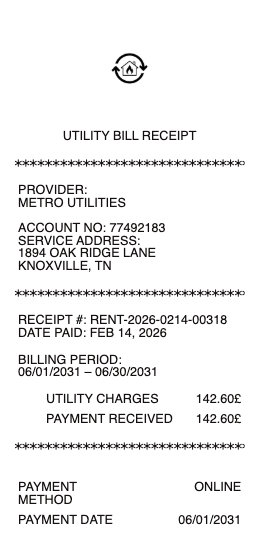
What’s on a Utility Bill and Payment Receipt
The utility provider and your account number
The service address and the name on the account
The billing period and meter reading / usage
Usage charges — the amount used times the rate — plus fixed service charges
Taxes and regulatory fees
The amount due, due date, and prior balance
On the payment receipt, the amount paid, date, and confirmation
Usage-Based Billing and the Bill vs the Receipt
Utility billing is metered: the provider reads how much you used — kilowatt-hours for electricity, therms or CCF for gas, gallons or cubic feet for water — and multiplies by a rate, then adds fixed service charges and taxes. That’s why bills swing with the seasons (heating, cooling) and why the usage line, not just the total, is worth reading. A key distinction: the bill tells you what you owe for the period; the payment receipt (or confirmation) proves you paid it — they’re two documents, and for proof of payment you want the receipt, while for proof of usage or address you want the bill. Providers show both in your online account. Understanding usage-based billing also helps you spot an anomaly — a sudden spike can mean a leak, a meter error, or a rate change, and the itemized bill is where you’d catch it before it becomes a much larger charge.
Why a Utility Bill Is Prime Proof of Address
This is a utility bill’s most valuable secondary use: it is among the strongest proof-of-address documents there is. Because a utility account ties a named person to a physical service address and is billed regularly, banks, the DMV, employers, landlords, and government agencies routinely accept a recent utility bill in your name to verify residence — for opening an account, getting a license, or completing an official application. The requirements are usually that it be recent (often within the last 90 days), show your full name and address, and come from a recognized provider. That’s why keeping a current utility bill accessible is genuinely useful admin, and why a utility bill is one of the few documents specifically named on “acceptable proof of address” lists. The payment receipt proves you paid; the bill itself, with your name and address, is what does the identity-verification job.
Budget Billing, Autopay, Business Use, and Copies
A few more practical points. Many utilities offer budget or level billing — averaging your annual usage into a flat monthly amount to smooth seasonal spikes, with a periodic true-up — so a budget-billed receipt shows the level amount rather than actual usage that month. Autopay is common, and new service often requires a deposit that appears on early bills. For a business or rental property, utilities are a deductible operating expense, and for a home office a portion of home utilities may be deductible — the itemized bill and payment receipt substantiate it, and landlord/tenant responsibility for utilities should match who’s named on the account. To get a copy, your provider’s online account stores bills and payment history, downloadable as PDFs — the standard way to retrieve a bill for proof of address or an expense record. Keep the most recent one handy; it’s the document you’ll be asked for most often.
Related utility receipts: see also our Phone Bill receipt guide and our Water Bill receipt guide.
Create a Utility Bill Receipt
Our generator produces a clean utility bill or payment receipt — provider and account, service address, usage and charges, and amount paid — as a PDF when you need a legible copy for your records, an expense claim, or a payment confirmation.
Use it responsibly: recreate only a real bill and payment for service you actually used, with true amounts. Fabricating a utility bill to fake proof of address or identity, support a false expense claim, or misrepresent residence is fraud — and forging proof of address for identity verification, benefits, or credit carries serious legal consequences. The provider’s own billing records are the authoritative and verifiable source; this tool is for legitimate record-keeping only.
Frequently asked questions
Everything you need to know about the product and billing.
What’s on a utility bill and payment receipt?
The provider and account number, the service address and account name, the billing period and meter reading/usage, usage charges (amount used times rate) plus fixed service charges, taxes and fees, the amount due and due date — and on the payment receipt, the amount paid, date, and confirmation.
How is a utility bill calculated?
It’s metered — the provider reads your usage (kilowatt-hours for electricity, therms or CCF for gas, gallons for water) and multiplies by a rate, then adds fixed service charges and taxes. That’s why bills swing with the seasons, and why reading the usage line, not just the total, matters.
Why is a utility bill good proof of address?
Because it ties a named person to a physical service address and is billed regularly, so banks, the DMV, employers, and agencies routinely accept a recent utility bill in your name to verify residence. It’s usually required to be recent (often within 90 days) with your full name and address.
What’s the difference between a utility bill and a payment receipt?
The bill tells you what you owe for the period; the payment receipt proves you paid it. They’re two documents — for proof of payment you want the receipt, and for proof of usage or address you want the bill. Providers show both in your online account.
What is budget or level billing?
A plan that averages your annual usage into a flat monthly amount to smooth seasonal spikes, with a periodic true-up to reconcile actual usage. A budget-billed receipt shows the level amount rather than the actual usage that month, making payments predictable.
How do I get a copy of a utility bill?
Your provider’s online account stores bills and payment history, downloadable as PDFs — the standard way to retrieve one for proof of address or an expense record. Keep the most recent bill accessible, since it’s the document you’ll be asked for most often.