A photography receipt records payment for a shoot — a portrait session, a wedding, a commercial job — and it carries details most service receipts don’t: a booking retainer that reserves your date, and the usage rights that decide how the images can be used. For photographers it’s an income record; for clients it’s proof of what they paid for and what they’re allowed to do with the photos. This page explains both sides.
Photography Receipt
Add custom logo
Edit line items
Choose payment method
Add/remove elements
Customize business information
Choose font
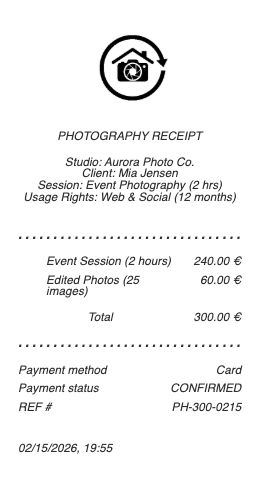
What’s on a Photography Receipt
Photographer/studio and the client, with the shoot date
The package or session — type, hours of coverage, number of edited images
The retainer/deposit paid to book, and the remaining balance
Deliverables — digital gallery, prints, albums — each priced
Usage or licensing rights granted, especially on commercial work
Sales tax, where prints or tangible goods are taxable
Payment method, amount paid, and receipt number
Retainers, Deposits, and Booking a Date
Photography runs on a booking model, and the receipt reflects it. To reserve a date — especially for weddings and events — clients pay a retainer (often non-refundable) that takes the date off the market; the balance is due before or on the shoot day. The receipt should show the retainer as a distinct line and track it against the total, so both sides know what’s paid and what remains. A non-refundable retainer is standard because the photographer turns away other bookings for that date, and stating it clearly on the receipt (and contract) prevents disputes if a client cancels. For multi-part jobs, each payment — retainer, balance, and any add-on prints ordered later — should get its own receipt, so the record shows exactly what each amount covered rather than one lump sum.
Usage Rights, Licensing, and Print Sales Tax
Two things make photography receipts unusual. First, usage rights: paying for a shoot doesn’t automatically transfer copyright. Photographers retain copyright by default and grant the client a license — personal use for portraits, or defined commercial usage (web, print, advertising, term, territory) for business work. The receipt or accompanying license should state what’s granted, because a commercial client paying for limited web use versus full buyout is paying for very different rights, and the document is where that scope lives. Second, sales tax: many states tax tangible goods like prints and albums, and some tax the whole session when prints are involved, while purely digital delivery may be treated differently — rules vary by state. The receipt itemizing prints separately from service is what lets tax be applied correctly.
For Photographers: Income Records and Contracts
As a business, your receipts are your income record. Photography is typically freelance or small-business income with no tax withheld, so the receipts you issue total what you report, and you’ll owe self-employment and income tax on the profit — the receipts you keep for gear, software, studio rent, and second shooters offset it as deductions. Because bookings involve retainers and cancellations, pairing each receipt with the signed contract protects you: together they prove what was agreed, what was paid, and what rights were licensed. Clients ordering prints later generate additional receipts you’ll want to track for sales tax. Keeping numbered receipts against each booking — retainer, balance, print orders — is what keeps a photography business’s books clean and its tax filing defensible if questioned.
Related creative service receipts: see also our Freelance receipt guide and our Graphic Design receipt guide.
Create a Photography Receipt
Our generator produces a clean photography receipt — photographer and client, the package, retainer and balance, deliverables, any licensed usage, and tax — as a PDF you can send a client or keep for your income records and bookkeeping.
Use it responsibly: recreate only real bookings and payments, with their true amounts. Fabricating photography receipts to misstate income, invent expenses, or claim rights that weren’t granted is fraud, and misrepresenting usage rights can create real legal exposure — the figures should match your return and the license should match your contract. This tool is for legitimate record-keeping only.
Frequently asked questions
Everything you need to know about the product and billing.
What does a photography receipt show?
The photographer and client with the shoot date, the package (type, coverage hours, edited images), the retainer paid and balance, deliverables like galleries, prints, and albums, any usage or licensing rights granted, sales tax where applicable, and the amount paid with a receipt number.
What is a photography retainer or deposit?
A payment — often non-refundable — that reserves your date and takes it off the market, especially for weddings and events. The balance is due before or on the shoot day. The receipt shows the retainer as a distinct line tracked against the total.
Do I own the copyright to photos I paid for?
Not automatically. Photographers retain copyright by default and grant you a license — personal use for portraits, or defined commercial usage for business work. The receipt or license states what’s granted, since limited web use and a full buyout are very different rights.
Is sales tax charged on photography?
Often on tangible goods like prints and albums, and some states tax the whole session when prints are involved, while purely digital delivery may be treated differently. Rules vary by state, so a receipt that itemizes prints separately from the service lets tax be applied correctly.
Why should a photographer keep receipts and contracts together?
Because bookings involve retainers, balances, and cancellations. Pairing each receipt with the signed contract proves what was agreed, what was paid, and what rights were licensed — protecting you in a dispute and keeping your income records clean for taxes.
Should each photography payment get its own receipt?
Yes — give the retainer, the balance, and any later print orders their own receipts. That way the record shows exactly what each amount covered, which matters for tracking a booking, applying sales tax to prints, and totaling your income accurately.