A Saks Fifth Avenue receipt shows proof of purchase from a luxury department store. It is commonly used for returns, resale documentation, and expense tracking.
Saks Fifth Avenue Receipt
Add custom logo
Edit line items
Choose payment method
Add/remove elements
Customize business information
Choose font
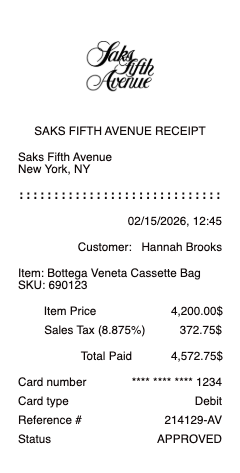
What's on a Saks Fifth Avenue Receipt
A Saks Fifth Avenue receipt documents a purchase from the luxury department store, whether bought in a location or through saks.com. Because Saks sells designer goods, the receipt is often kept for authentication, returns, gifting, or insurance. A Saks Fifth Avenue receipt typically shows:
Saks Fifth Avenue name and store location or “online”
Date and time of purchase
Itemized designer products with brand and description
SKU or item number for each product
Price per item and any discount applied
Subtotal, sales tax, and total
Payment method and card last four digits
Associate or store number and transaction / order number
Return-policy note or gift-receipt indicator
In-Store, Online, and Email (E-Receipt) Formats
Saks issues receipts in a few forms. An in-store receipt is printed at the register with the store location and associate number. A Saks Fifth Avenue online receipt — from a saks.com order — arrives as an order confirmation and summary with an order number. Increasingly, stores also send an email receipt (e-receipt) tied to the shopper's account. Each covers the same essentials — itemized designer goods, price, tax, and total — but people often need to recreate one when a paper receipt faded or was lost, an e-receipt never landed in the inbox, or an online order confirmation didn't itemize cleanly.
Gift Receipts and Returns at Saks
Luxury purchases are frequently gifts, so a gift receipt — which confirms the item and store without showing the price — is common at Saks. For returns and exchanges, the receipt is the proof of purchase that ties an item to its original order. Saks Fifth Avenue and Saks OFF 5TH each maintain their own return windows and conditions, and those policies change over time, so confirm the current terms on saks.com before relying on them. A clear, itemized receipt showing the item, date, and transaction number is what makes a return or exchange straightforward.
Designer returns also move on tighter clocks than the mall average — luxury goods commonly carry shorter return windows and stricter condition requirements (tags attached, unworn, original packaging), and the receipt's purchase date is what starts that clock. A Saks Fifth Avenue receipt template that mirrors the real layout will show exactly the fields the returns desk reads first: date, item, and form of payment.
Why People Need a Saks Fifth Avenue Receipt
A Saks receipt is more than proof of payment on a designer item. Shoppers keep it for authentication and resale — a documented purchase from an authorized retailer supports the provenance of a handbag, watch, or coat. Others need it for insurance on high-value pieces, for expense or gift records, or to reconstruct a purchase history after a paper receipt was lost. Because the amounts are large, a legible, itemized Saks Fifth Avenue receipt — with the brand, SKU, price, and transaction number — carries real weight where a vague note would not.
Related luxury retail receipts: see also our Neiman Marcus receipt guide and our Farfetch receipt guide.
One more use shoppers discover late: the price adjustment. When an item bought at full price is marked down shortly after, department stores will often refund the difference — but only against the original Saks Fifth Avenue receipt showing the date and price paid. Without it, there is nothing to adjust from, and the markdown you just missed stays missed.
Generate a Saks Fifth Avenue Receipt — Free, No Login
Our Saks Fifth Avenue receipt generator builds a clean, itemized receipt with every field in place: store or online source, date, itemized designer products with SKU, price and discount, subtotal, sales tax, total, payment method, and transaction number. Edit each field and download a formatted Saks receipt template in PDF, PNG, or JPG in under a minute — no account required. Use it to replace a lost or faded receipt, reconstruct an online order that didn't itemize, or keep a clean record of your own purchase. Only create receipts for transactions that actually took place.
Frequently asked questions
Everything you need to know about the product and billing.
What's on a Saks Fifth Avenue receipt?
It shows the Saks Fifth Avenue name and store or online source, the date, itemized designer products with SKU and price, any discount, subtotal, sales tax, total, payment method, and the transaction or order number.
How do I get a receipt from a Saks online order?
A saks.com order generates an email confirmation and order summary with an order number. If it never arrived or didn't itemize cleanly, you can recreate a Saks Fifth Avenue online receipt from your order details.
What is a Saks gift receipt?
A gift receipt confirms the item and store without showing the price paid, so a recipient can return or exchange it without seeing the amount. It's common on luxury gifts from Saks. The gift receipt matters more at a luxury counter than most — condition requirements are strict, and the gift receipt is what lets the recipient exchange without exposing the price.
Can I return to Saks without a receipt?
Saks Fifth Avenue and Saks OFF 5TH set their own return conditions and these change over time, so check the current policy on saks.com. A receipt or order number makes any return or exchange far simpler.
Why keep a Saks Fifth Avenue receipt?
For returns, authentication and resale of designer goods, insurance on high-value items, and expense or gift records. An itemized receipt with brand, SKU, and transaction number documents the purchase clearly. It is also the key to a price adjustment — if the item is marked down soon after purchase, the refund of the difference is calculated from the receipt's price and date.
Can I make a Saks receipt template?
Yes. The generator builds an itemized Saks Fifth Avenue receipt you can edit and download as a PDF, PNG, or JPG — useful for replacing a lost receipt or reconstructing an order, for legitimate record-keeping only.