A Farfetch receipt is the order confirmation from a global luxury marketplace — and it works unlike a normal store, because Farfetch doesn’t hold the stock. It connects you to boutiques and brands around the world, so your item ships directly from whichever boutique has it, often internationally with duties included. This page explains what a Farfetch order shows, why items ship from different places, and how returns and authenticity work.
Farfetch Receipt
Add custom logo
Edit line items
Choose payment method
Add/remove elements
Customize business information
Choose font
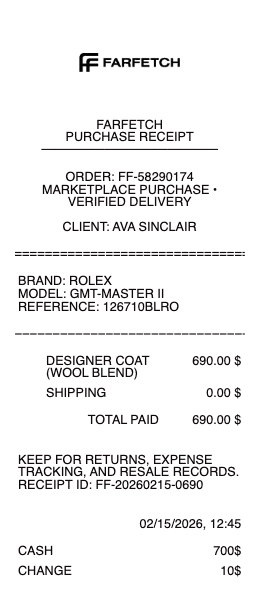
What’s on a Farfetch Receipt
An order number and order date
The item(s) — brand, description, size, and price
The selling boutique or brand, and where it ships from
Shipping method and destination, often international
Duties and taxes, frequently included (DDP) for cross-border orders
The total in your currency
Return window and instructions for that item
A Marketplace, Not a Warehouse
The key to a Farfetch order is that Farfetch is a marketplace: it aggregates hundreds of luxury boutiques and brands worldwide onto one platform, but it generally doesn’t own the inventory. When you order, the item ships directly from the boutique or brand that stocks it — which might be in Italy, London, or elsewhere — so the receipt names the seller and origin. Order two items and they may come from two different boutiques, in separate shipments with separate tracking. That model explains a lot about the experience: shipping times and return handling depend on the individual seller, and the same designer piece can appear from multiple boutiques at slightly different prices. Reading which boutique your item shipped from tells you where a return goes and why delivery works the way it does — it’s a global consignment network, not a single fulfillment center.
International Shipping, Duties, and Authenticity
Because items often cross borders, duties and taxes are central to a Farfetch receipt. Farfetch frequently ships DDP (Delivered Duty Paid), meaning import duties and taxes are calculated and included in the price you pay at checkout, so there’s no surprise customs bill on delivery — the receipt reflects that all-in total. On authenticity: Farfetch sells new luxury sourced from authorized boutiques and brands, so pieces are genuine current-season merchandise rather than resale — distinct from pre-owned platforms. (Farfetch has also offered pre-owned services for items like handbags, which are authenticated separately.) For a buyer, the receipt documenting the boutique, the item, and the duties-included total is the proof of a legitimate luxury purchase, useful for returns, warranty with the brand, or simply confirming what an international order actually cost once duties were folded in.
Returns, Records, and Getting a Copy
Returns on Farfetch follow the item’s and boutique’s terms, shown on the order — typically a set return window, with the item sent back (often to the originating boutique or a Farfetch hub) using provided instructions, after which the refund goes to your original payment. Some items, like final-sale or certain beauty pieces, may be non-returnable, which the receipt or product page states. Because orders can split across boutiques, each parcel may have its own return process, so keeping the order confirmation for each is useful. To get a copy, check the confirmation email or your Farfetch account order history, which stores your orders, tracking, and returns. For records or an expense claim, the itemized confirmation — brand, boutique, item, duties, and total — is the document to keep, and it’s the reference for any question about a cross-border luxury order.
Related luxury retail receipts: see also our Vestiaire Collective receipt guide and our Saks Fifth Avenue receipt guide.
Create a Farfetch Receipt
Our generator reproduces a Farfetch-style order receipt — order number, brand and item, selling boutique, shipping, duties, and total — as a clean PDF when you need a legible copy for your records, a return reference, or an expense file.
Use it responsibly: recreate only real orders you actually placed, with their true items and amounts. Fabricating a Farfetch receipt to fake a purchase, authenticate a counterfeit, or support a false return or expense claim is fraud — the authoritative record is Farfetch’s and the boutique’s own order data, which can be verified. Farfetch is a trademark of its owner; this tool is not affiliated with it and is for legitimate record-keeping only.
Frequently asked questions
Everything you need to know about the product and billing.
What does a Farfetch receipt show?
An order number and date, the item(s) with brand, description, size, and price, the selling boutique or brand and where it ships from, the shipping method and destination, duties and taxes (often included as DDP), the total in your currency, and the return window and instructions.
Why did my Farfetch items ship from different places?
Because Farfetch is a marketplace connecting hundreds of boutiques and brands worldwide, not a single warehouse. Each item ships directly from the boutique that stocks it, so a two-item order can arrive in separate shipments from different boutiques with separate tracking.
Are duties included in a Farfetch order?
Often yes — Farfetch frequently ships DDP (Delivered Duty Paid), so import duties and taxes are calculated and included in the checkout price, avoiding a surprise customs bill on delivery. The receipt reflects that all-in total for a cross-border order.
Is Farfetch authentic?
Farfetch sells new luxury sourced from authorized boutiques and brands, so items are genuine current-season merchandise rather than resale. It has also offered pre-owned services for items like handbags, which are authenticated separately. The receipt documents the boutique and item as proof of a legitimate purchase.
How do returns work on Farfetch?
Returns follow the item’s and boutique’s terms shown on the order — usually a set window, with the item returned via provided instructions and refunded to your original payment. Some final-sale items are non-returnable, and because orders can split across boutiques, each parcel may have its own return process.
How do I get a copy of my Farfetch receipt?
Check the confirmation email or your Farfetch account order history, which stores your orders, tracking, and returns. For records or an expense claim, keep the itemized confirmation showing the brand, boutique, item, duties, and total.