A stablecoin receipt records a transfer of a coin pegged to a currency — usually the US dollar — like USDT, USDC, or DAI. It looks like an ordinary crypto transaction, but the point of a stablecoin is that its value doesn’t move, which changes what the receipt means: it’s closer to a digital-dollar payment than a volatile trade. This page explains what a stablecoin transfer shows, how the peg is backed, and the tax nuance behind it.
Stablecoin Receipt (USDT / USDC)
Add custom logo
Edit line items
Choose payment method
Add/remove elements
Customize business information
Choose font
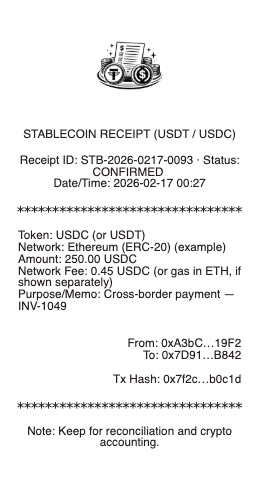
What’s on a Stablecoin Receipt
The stablecoin — USDT, USDC, DAI, or another — and the amount
The network used — Ethereum (ERC-20), Tron (TRC-20), Solana, and others
Sender and receiver wallet addresses
The transaction hash, verifiable on that chain’s explorer
The gas/network fee, paid in the chain’s native coin
Date, time, and confirmation status
The USD value — normally near 1:1 with the amount
The Peg and What Backs It
A stablecoin holds its value because it’s pegged — designed to stay worth about one dollar — but how the peg is maintained differs, and that’s the trust question behind the receipt. USDC (issued by Circle) is backed by cash and short-term US Treasuries, with regular published attestations of reserves. USDT (Tether) is the largest and publishes reserve breakdowns of its own. DAI takes a different route — it’s over-collateralized by other crypto rather than fiat in a bank. The backing matters because a stablecoin is only as reliable as its reserves: it’s a claim that one token can be redeemed for one dollar. When you receive a stablecoin, you’re trusting the issuer’s reserves, which is why the specific coin on the receipt — not just “a stablecoin” — is worth noting. Reserve quality is what separates them.
Payments, Networks, and Depeg Risk
Stablecoins are used like digital dollars — for trading (parking value without cashing out to a bank), cross-border payments and remittances (fast and cheap versus wires), and as the base currency of DeFi. The network you send on changes the cost dramatically: the same USDT sent over Ethereum can cost far more in gas than over Tron or Solana, and — critically — the sender and receiver must use the same network, or the funds can be lost. That network line on the receipt is not a detail; it’s essential. The peg also isn’t guaranteed: stablecoins can depeg — the algorithmic UST collapsed to near zero in 2022, and even USDC briefly slipped below a dollar during a 2023 banking scare before recovering. Most of the time the value tracks the dollar, but the receipt records a moment, and the coin and network are what make it verifiable.
Taxes, Records, and Verification
Here’s the tax nuance: stablecoins are still property for US tax, so technically every time you spend or convert one it’s a disposal with a gain or loss — but because the value stays near a dollar, that gain or loss is usually near zero. That doesn’t make it invisible: high-volume stablecoin activity still needs to be recorded, and if you bought a stablecoin below a dollar and redeemed at a dollar, there’s a small real gain. More often, stablecoins matter as the on- and off-ramp in your records — the leg between fiat and volatile crypto — so tracking them keeps your cost basis coherent across trades. Every transfer is verifiable on-chain by its hash, and exchanges and wallets export stablecoin activity with USD values. Keeping the record — coin, network, amount, and hash — is what lets tax software treat stablecoin movements correctly rather than as mystery transactions.
Related crypto receipts: see also our Ethereum receipt guide and our crypto exchange withdrawal receipt guide.
Create a Stablecoin Receipt
Our generator produces a clean stablecoin transfer receipt — coin (USDT, USDC, DAI), amount, network, sender and receiver, gas fee, and transaction hash — as a readable PDF for your records or a crypto tax file when you want a legible copy of a transfer.
Use it responsibly: recreate only real transfers that actually occurred, with their true amounts and addresses. Fabricating a stablecoin receipt to fake a payment, invent proof of funds, or misrepresent a transfer is fraud — the transaction is recorded on a public blockchain and can be verified in seconds by its hash. The on-chain record is the authoritative source; this tool is for legitimate record-keeping only.
Frequently asked questions
Everything you need to know about the product and billing.
What does a stablecoin receipt show?
The stablecoin (USDT, USDC, DAI) and amount, the network used (Ethereum, Tron, Solana, etc.), the sender and receiver addresses, the transaction hash, the gas fee paid in the chain’s native coin, the date and confirmation status, and the USD value — normally near 1:1.
What backs a stablecoin like USDC or USDT?
USDC (Circle) is backed by cash and short-term US Treasuries with regular reserve attestations. USDT (Tether) publishes its own reserve breakdowns. DAI is over-collateralized by other crypto rather than fiat. The backing matters because the coin is a claim to redeem one token for one dollar.
Why does the network matter when sending a stablecoin?
The same stablecoin exists on multiple networks, and the cost differs hugely — USDT over Ethereum can cost far more in gas than over Tron or Solana. Critically, sender and receiver must use the same network, or the funds can be lost, so the network line is essential.
Can a stablecoin lose its peg?
Yes. The peg isn’t guaranteed — the algorithmic UST collapsed in 2022, and even USDC briefly slipped below a dollar during a 2023 banking scare before recovering. Most of the time the value tracks the dollar, but depeg risk is real and depends on the backing.
Are stablecoin transactions taxable?
Technically yes — stablecoins are property, so spending or converting one is a disposal with a gain or loss. But because the value stays near a dollar, that gain or loss is usually near zero. High-volume activity still needs recording, and they matter as the on/off-ramp in your basis tracking.
How do I verify a stablecoin transfer?
Look up the transaction hash on the relevant chain’s block explorer, which permanently shows the coin, amount, addresses, and confirmations. Wallets and exchanges also export stablecoin activity with USD values for your records and tax software.