A taxi receipt is the record of a cab ride — the fare, distance, date, and taxi company details — that business travelers rely on for expense reports and reimbursement. This guide explains what's on a taxi receipt, how to get one from the driver or a taxi app, and how to use a template when a paper receipt is faded or was never offered.
Taxi Receipt
Add custom logo
Edit line items
Choose payment method
Add/remove elements
Customize business information
Choose font
What's on a taxi receipt
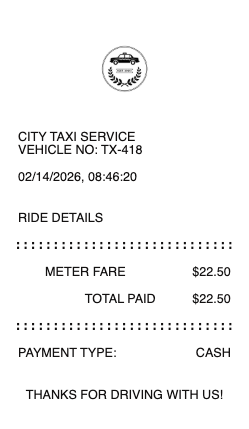
A taxi receipt, whether from the meter printer or an app, should capture the trip clearly enough for an expense claim:
Taxi company & vehicle/medallion number — the cab operator and the medallion or car number identifying the vehicle.
Date & time — when the ride took place.
Pickup & drop-off — the trip's start and end points, or at least the city.
Distance & fare — the miles traveled and the metered fare.
Extras & tip — airport surcharges, tolls, booking fees, and any gratuity.
Total & payment method — the final amount and whether it was cash or card.
How to get a taxi receipt
Getting a receipt is easiest if you ask before you pay. Metered cabs have a printer that produces a receipt with the fare and trip details — just ask the driver for it. In cities like New York, card payments print an itemized receipt automatically. If you booked through an app such as Curb (or a local dispatcher), the receipt is emailed and saved in the app's ride history, which is the cleanest version for expenses. For a cash ride with no printer, ask the driver to write one with the company name, date, and fare, or use a template to record the trip while the details are fresh.
Using a taxi receipt for expenses and reimbursement
Taxi rides are one of the most common business travel expenses, and finance teams want a receipt showing the date, route or city, and fare — not just a card charge. Airport transfers, client visits, and late-night work rides all typically qualify for reimbursement when documented. Because meter-printed receipts fade fast and cash rides may not come with one at all, travelers often reconstruct the trip: note the date, pickup and drop-off, and the fare you paid. Keeping a clear, itemized taxi receipt is what turns a legitimate ride into a claimable expense.
Taxi receipt templates and formats
When a receipt is missing or illegible, a taxi receipt template lets you record the ride in the standard format — company, date, route, distance, fare, extras, and total. Printable PDF and editable formats work for a single trip or a stack of blank forms for frequent travelers. App-based rides (Curb and similar) generate their own PDF receipts you can download. Whichever format you use, the goal is the same: a legible record with the company name, date, and fare that an expense system will accept.
Related rideshare & taxi receipts: see also our Uber receipt guide and our airport taxi receipt guide.
Related rideshare and taxi receipts: see also our Uber receipt guide and our airport taxi receipt guide.
Create a taxi receipt
Our taxi receipt template and generator produces a clean, itemized cab receipt — company and vehicle number, date, pickup and drop-off, distance, fare, extras, and total — in a printable format, so you can document a ride you actually took when the original is faded or missing.
For legitimate record-keeping only. A taxi receipt should reflect a real trip you paid for; creating one for a ride that didn't happen, or inflating a fare to pad an expense claim, is fraud. Use this only to reproduce or organize your own genuine taxi rides.
To see how a metered fare is built, from the initial charge to distance units and surcharges, read the cab receipt example.
Frequently asked questions
Everything you need to know about the product and billing.
How do I get a receipt from a taxi?
Ask the driver before you pay — metered cabs have a printer that produces a receipt, and card payments in many cities print an itemized one automatically. App rides (like Curb) email the receipt and store it in ride history. For a cash ride with no printer, ask the driver to write the company, date, and fare.
What should a taxi receipt include?
The taxi company and vehicle or medallion number, the date and time, pickup and drop-off (or at least the city), the distance and metered fare, any surcharges, tolls, or tip, and the total with the payment method.
Do I need an itemized taxi receipt for an expense report?
Usually yes. Finance teams want a receipt showing the date, route or city, and fare, not just a card charge. Airport transfers, client trips, and work rides typically qualify when documented this way.
How do I get a taxi receipt if I paid cash and got nothing?
Ask the driver to write one with the company name, date, and fare, or record the trip yourself using a taxi receipt template while the details are fresh — noting the date, pickup and drop-off, and the amount you paid.
Can I get a receipt from a taxi app?
Yes. Apps such as Curb email a receipt after the ride and keep it in your ride history as a downloadable PDF, which is the cleanest itemized version to submit for reimbursement.
What is the medallion number on a taxi receipt?
It's the number identifying the licensed cab (prominent on New York taxis, for example). Along with the company name, it helps identify the specific vehicle if you need to follow up on a ride or a lost item.