A Toast POS receipt comes from a restaurant running Toast. This guide explains how to look up a past Toast check, what the receipt shows about tips and checks, the printer setup restaurants use, and how to get a copy after you have left.
Toast POS Receipt
Add custom logo
Edit line items
Choose payment method
Add/remove elements
Customize business information
Choose font
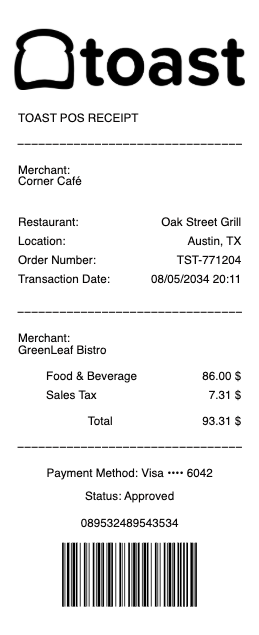
Toast is a restaurant POS, and its receipts show it
Toast is built specifically for restaurants, and that shapes what its receipts look like. Where a retail POS prints a simple list of items, a Toast receipt reflects the way restaurant service actually works: a check opened at a table, items fired to the kitchen over time, a tip added after the card is authorized, and a check that may be split between several guests.
Understanding that flow explains the two things diners most often puzzle over — why the receipt shows an amount that differs from what posts to the card, and why there are two slips at the end of a meal.
The two-slip mystery, and why your card shows a different amount
At a full-service restaurant on Toast, paying by card typically produces a merchant copy (which you sign, with the tip line filled in) and a customer copy for you to keep. The card is first authorized for the pre-tip total, and the tip is added afterwards when the server closes the check.
This is why your banking app may briefly show a pending charge for the meal without the tip, then settle a day or two later at the full amount. Nothing has gone wrong — the pending authorization and the final settled charge are two stages of the same transaction. The receipt in your hand shows the intended total; the settled charge is what actually leaves your account.
Getting a copy of a Toast receipt after you leave
Restaurants running Toast keep a complete record of every check, and staff can look up a past transaction from the Toast back office by date, amount, card last four digits, or check number. If you need a copy for an expense report, calling the restaurant with the date and approximate amount is usually enough for them to find and resend it.
Toast can also deliver receipts digitally by email or text at the point of payment, and many restaurants prompt for this on the payment screen or on a handheld device at the table. Taking the digital copy is the simplest way to avoid needing a lookup at all — particularly for business meals, where the itemized receipt matters far more than the card slip.
Itemized receipt vs card slip — the one that matters for expenses
For a business meal, the credit-card slip alone is often not sufficient documentation. It shows a total and a tip, but not what was purchased, and expense policies (and tax rules on meal deductions) frequently require the itemized detail:
The itemized receipt lists each dish and drink, subtotal, tax, and the check number.
The card slip shows only the total, the tip line, the card's last four digits, and the authorization.
Keep both if you can, and if you can only keep one, keep the itemized receipt. Alcohol lines matter too — some employers reimburse food but not alcohol, and only the itemized version distinguishes them.
What restaurants print on, and why receipts fade
Toast restaurants typically run thermal receipt printers at the point of sale and impact or thermal printers in the kitchen for tickets. Thermal paper produces no-ink, fast, quiet printing — but it fades with heat, light, and time, which is precisely why a receipt kept for a quarterly expense claim can arrive at the accountant unreadable.
Photograph or email the receipt the day you get it. If an original is already lost and the meal genuinely happened, you can reconstruct a clear record of your own transaction from your card statement, which pins down the date, amount, and restaurant — a record for your files documenting a real payment, matching the underlying charge exactly, and never a replacement for the restaurant's own transaction record.
Frequently asked questions
Everything you need to know about the product and billing.
How do I get a copy of a Toast receipt?
Ask the restaurant — staff can look the check up in the Toast back office by date, amount, card last four digits, or check number and resend it. Many Toast restaurants can also email or text you the receipt at the time of payment.
Why does my card show a different amount than my Toast receipt?
The card is authorized for the pre-tip total and settles later with the tip included. The pending charge and the final settled charge are two stages of the same transaction, which is why the amounts can differ for a day or two.
Why did I get two receipts at the restaurant?
One is the merchant copy, which you sign and which carries the tip line, and one is the customer copy for your records. The merchant copy stays with the restaurant as its record of the authorized tip.
Is a credit card slip enough for a business meal expense?
Often not. The card slip shows only the total and tip; the itemized receipt shows what was actually purchased. Most expense policies — and meal deduction rules — want the itemized version, which also distinguishes alcohol from food.
What is a check number on a Toast receipt?
It is the restaurant's identifier for that table's order. It is the fastest reference for staff to look up your transaction later.
Why do restaurant receipts fade?
They are printed on thermal paper, which darkens under heat rather than ink and fades over time with light and warmth. Photographing or emailing the receipt the same day is the reliable fix.