A Trader Joe’s receipt looks plainer than most grocery slips, and that is by design: the chain runs no loyalty card, prints no survey code, and sells mostly its own private-label products, so the receipt is a clean list of items and a total. This page covers what it shows, why there are no points to chase, and how the store’s famously generous return policy works with and without it.
Trader Joe’s Receipt
Add custom logo
Edit line items
Choose payment method
Add/remove elements
Customize business information
Choose font
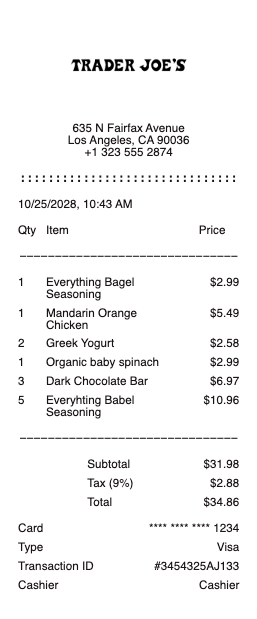
What’s on a Trader Joe’s Receipt
Store location and number
Date, time, and a short transaction number
Each item — overwhelmingly Trader Joe’s own private-label products, listed by their in-store name
Price per item, with the chain’s flat, everyday pricing rather than sale tags
Subtotal, tax, and total
Payment method — card last four or cash with change
Crew and register line at the bottom — but no loyalty number and no survey invitation
Why There Are No Points or Survey Codes
Nearly every grocery receipt in this guide carries a loyalty program or a satisfaction survey. Trader Joe’s deliberately has neither. There is no rewards card, no points, and no members-only pricing — the company’s stated approach is one low price for everyone, so there is nothing on the receipt to scan into an app later and no code to enter for a discount. That also means there is no digital receipt archive tied to an account: the paper slip is the record, full stop. If you need the purchase documented — for an expense, a gift reconciliation, or a warranty on a non-food item — capture the paper receipt at the register, because Trader Joe’s has no online order history to fall back on and (with rare exceptions) does not do delivery or pickup that would email you a copy.
Trader Joe’s Returns — With or Without the Receipt
Trader Joe’s built its reputation on a no-questions return policy, and the receipt is helpful but not strictly required. The store will generally refund or replace any product a customer is unhappy with, including food that has been opened and tasted — the “try it, and if you don’t love it bring it back” promise is real and central to the brand. With a receipt, the refund goes to the original payment method cleanly. Without one, returns are handled at the crew’s discretion and typically resolved as store credit or a cash refund for smaller amounts. Because there is no loyalty account tracking your purchases, the receipt is the only proof you bought the item there, so it is worth keeping for anything you might bring back.
Expenses, Reimbursements, and the Private-Label Quirk
For work — office snacks, event catering runs, a client gift basket — the Trader Joe’s receipt is your reimbursement document, and here the private-label model creates a small quirk: item names on the receipt are the chain’s own product names, which an approver unfamiliar with the store may not recognize. Keeping the itemized slip (rather than a card-statement line that only shows “TRADER JOE’S”) matters more here than at a mainstream grocer, because the receipt is the only place the actual items appear. Photograph it promptly — Trader Joe’s thermal receipts fade like any other, and there is no reprint-from-account safety net.
Related grocery receipts: see also our Whole Foods receipt guide and our Aldi receipt guide.
Create a Trader Joe’s-Style Receipt
Our generator rebuilds a clean grocery receipt in the Trader Joe’s style — store header, itemized private-label lines, flat pricing, tax, and payment — as a downloadable PDF for records when the original has faded or gone missing.
Use it responsibly: recreate only purchases you actually made, with real items and amounts. Fabricating receipts for returns, reimbursements, or disputes is fraud — and with no loyalty account behind the purchase, an honest paper trail matters all the more. Trader Joe’s is a trademark of its owner; this tool is not affiliated with the company.
Frequently asked questions
Everything you need to know about the product and billing.
Does Trader Joe’s have a loyalty card or rewards program?
No — Trader Joe’s deliberately runs no rewards card, points, or member pricing. It offers one price for everyone, so there is nothing on the receipt to scan for points and no digital receipt archive tied to an account.
Is there a survey code on a Trader Joe’s receipt?
No. Unlike most grocery chains, Trader Joe’s does not print a satisfaction-survey invitation or validation code. The receipt is simply an itemized list and total.
Can I return something to Trader Joe’s without a receipt?
Usually yes — the store’s generous policy refunds or replaces products customers are unhappy with, including opened food. Without a receipt it is at crew discretion, often as store credit; with one, the refund goes to your original payment.
Can I get a copy of a lost Trader Joe’s receipt?
Generally no — there is no loyalty account or online order history to reprint from, since the chain does not run rewards accounts or standard delivery. The paper slip is the record, so photograph it when purchases matter.
Why don’t I recognize the item names on my Trader Joe’s receipt?
Most products are Trader Joe’s own private-label brands, so the receipt shows the chain’s in-house product names. Keep the itemized slip for expenses, since those names appear nowhere on a card statement.
Does Trader Joe’s email receipts or offer digital copies?
No — with no loyalty program and no standard online ordering, there is no emailed or in-app receipt. Every purchase is documented only by the printed register slip.