A train ticket receipt is a distinct document from the ticket itself: the ticket gets you through the barrier, the receipt proves what you paid — and rail travelers reach for it constantly, because commuting and business trips both run on reimbursement. This page covers what the receipt shows, how it differs from the ticket, and how fare types and refunds work on it.
Train Ticket Receipt
Add custom logo
Edit line items
Choose payment method
Add/remove elements
Customize business information
Choose font
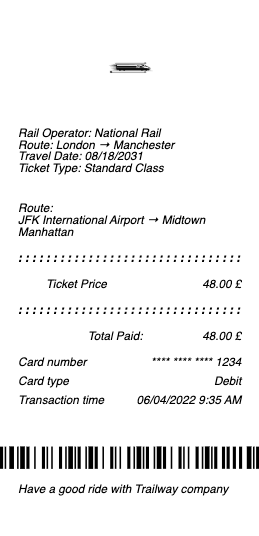
What’s on a Train Ticket Receipt
Rail operator and the booking or transaction reference
Journey — origin and destination stations, date, and time
Fare type — advance, off-peak, anytime, or a saver fare, which governs flexibility
Class and any seat/coach reservation
Price, with any railcard or discount applied
Booking fees where the seller adds them, plus total and payment method
The Ticket vs. the Receipt
These are two different things, and expense claims need the second. The ticket — a paper stub, a barcode in an app, or a smartcard tap — is your right to travel and to pass the gate. The receipt is the proof of purchase showing the price paid, the journey, and the reference, which is what a reimbursement or company travel policy requires. Mobile and e-tickets often separate them cleanly: the ticket lives in the rail app or wallet, while the receipt is a downloadable confirmation or a “tax receipt” you request. For a ticket bought from a station machine, the receipt is a separate slip the machine offers — take it, because the ticket alone usually isn’t accepted as an expense document.
Fare Types, Railcards, and Reading the Price
The price on a rail receipt makes sense only alongside the fare type, which is the rail world’s equivalent of an airline fare class. Advance fares are cheapest but tied to a specific train and barely refundable; off-peak and anytime cost more and flex more. The receipt records which you bought, and that determines what a change or refund will cost. Railcard or pass discounts show as a reduction on the receipt, which matters if you need to prove the discounted amount you actually paid. On high-speed and long-distance services a compulsory seat reservation may appear as its own line. Reading the fare type off the receipt is how you know your rights before you try to change the trip.
Refunds, Season Tickets, and Expenses
Refund rules follow the fare: flexible tickets refund with a small admin fee, advance tickets generally do not, and the receipt is what any refund is processed against. Season tickets and passes — weekly, monthly, annual commuter tickets — deserve their own receipt kept safe, since they are high-value and often partially refundable on a pro-rata basis if you stop commuting, and employers running season-ticket loan schemes require the receipt. For expenses, submit the itemized receipt showing the journey and price, not a bare ticket stub or a card line; business travel policies want the route and fare visible. Retrieve a lost receipt from the rail operator’s or ticket seller’s account order history, where e-ticket purchases are stored.
Related transport receipts: see also our high-speed train receipt guide and our bus ticket receipt guide.
Create a Train Ticket-Style Receipt
Our generator rebuilds a rail receipt — operator and reference, journey with date and time, fare type and class, any railcard discount, and total — as a clean PDF for a records or expense file when the original is gone.
Use it responsibly: recreate only journeys you actually paid for, at their real amounts and fare types. Fabricating train receipts for reimbursement or refunds is fraud — the rail operator’s account keeps the genuine receipt, which is the correct document for any claim.
Frequently asked questions
Everything you need to know about the product and billing.
What is the difference between a train ticket and a train receipt?
The ticket — a stub, app barcode, or smartcard — is your right to travel. The receipt is proof of purchase showing the price, journey, and reference, which is what expense claims and company travel policies require.
How do I get a receipt for a train ticket?
For e-tickets, download the confirmation or request a tax receipt from the rail app or seller account. For a station-machine ticket, take the separate receipt slip the machine offers — the ticket alone usually isn’t accepted as an expense document.
What do fare types mean on a train receipt?
They set flexibility: advance fares are cheapest but tied to a specific train and barely refundable; off-peak and anytime cost more and flex more. The receipt records which you bought, determining change and refund costs.
Can I get a refund on a train ticket?
It depends on the fare — flexible tickets refund with a small admin fee, advance tickets generally don’t. The refund is processed against the receipt, so keep it until any change or refund is settled.
How do railcard or pass discounts appear on the receipt?
As a reduction against the standard fare, showing the discounted amount you actually paid — useful proof if a claim or refund references the real price.
Do I need a receipt for a season ticket?
Yes — season and commuter passes are high-value, often partially refundable pro-rata, and required by employer season-ticket loan schemes. Keep the receipt safe separately from the pass itself.