A tuition receipt is proof that school or college tuition was paid — used for education tax credits, employer reimbursement, and financial or visa documentation. This guide explains what's on a tuition receipt, how it relates to the IRS Form 1098-T, and how students, parents, and schools can get or issue one.
Tuition Receipt
Add custom logo
Edit line items
Choose payment method
Add/remove elements
Customize business information
Choose font
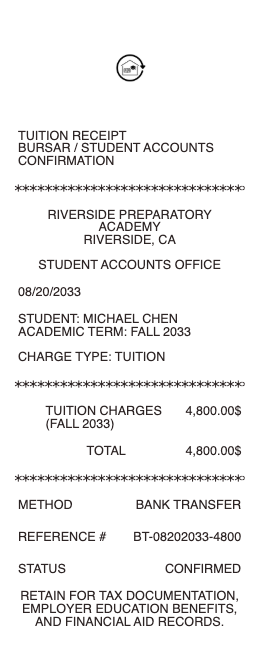
What's on a tuition receipt
A tuition receipt should clearly document the payment:
School / institution name — the college, university, or school, with its address.
Student name & ID — who the tuition is for.
Term or period — the semester, quarter, or academic year covered.
Amount paid & what for — tuition, and separately any fees, room and board, or materials.
Payment date & method — when and how it was paid, with a "paid" status or balance.
Receipt or transaction number — a reference for the school's records and yours.
Tuition receipts and the IRS Form 1098-T
For taxes, two documents work together. Your school issues a Form 1098-T (Tuition Statement) each year, reporting tuition billed or paid — it's the official form for claiming education tax credits like the American Opportunity Tax Credit or the Lifetime Learning Credit. A tuition receipt is the proof of the actual payments you made, which supports the 1098-T and documents amounts (like a spring payment) you're claiming. Keep both: the 1098-T for the credit, and receipts to substantiate what you paid if the IRS asks.
When you need a tuition receipt
Beyond taxes, tuition receipts prove payment for several purposes. Employer tuition assistance programs reimburse you after you submit a receipt showing the course and amount. Scholarships, 529 plan withdrawals, and financial aid may require proof that tuition was paid. Students on a visa, or applying for one, often need receipts as evidence of enrollment and payment. And for personal budgeting or a support arrangement, a tuition receipt documents who paid what. In each case, the itemized receipt — not just a bank charge — is what's accepted.
How to get a tuition receipt (and how schools issue them)
Most colleges post payment receipts in the student account or bursar portal — log in, open billing or payment history, and download the receipt for a term. If it's not there, contact the bursar or student accounts office and request an itemized paid receipt. Schools and tutors issuing tuition receipts should include the institution and student, the term, the amount and what it covers, and a paid status — a reusable template keeps this consistent for every family, whether it's a university bursar or an independent tutor billing for lessons.
At tax time, tuition receipts meet a form: the 1098-T, which US schools issue each January reporting the year’s payments received for qualified tuition (Box 1). The education credits — the American Opportunity Credit and Lifetime Learning Credit — are claimed against those figures, and your own tuition receipts are the detail behind the summary: they show exactly what was paid, when, and for which term, which matters when a payment straddles calendar years or the 1098-T needs questioning. Keep the receipts and the 1098-T together; the form claims the credit, the receipts defend it.
Related childcare and education receipts: see also our Daycare receipt guide and our Tutoring receipt guide.
Create a tuition receipt
Our tuition receipt template and generator lays out every field — school and student, term, amount and what it covers, payment date, and a paid status — in a clean printable format for schools, tutors, and families keeping records for taxes or reimbursement.
For genuine payments only. A tuition receipt should reflect tuition actually paid; creating one for a payment that didn't happen, or to claim a credit or reimbursement you're not entitled to, is fraud. Use these templates to document real education payments.
Frequently asked questions
Everything you need to know about the product and billing.
What is a tuition receipt?
It's proof that school or college tuition was paid, showing the institution, student, term, amount, and payment date. It's used for education tax credits, employer reimbursement, and financial or visa documentation.
What's the difference between a tuition receipt and a 1098-T?
The Form 1098-T is the official annual statement your school issues for claiming education tax credits. A tuition receipt is proof of the actual payments you made, which supports the 1098-T and documents specific amounts you paid.
How do I get a tuition receipt from my college?
Log in to your student account or bursar portal and download the receipt from billing or payment history. If it's not there, contact the bursar or student accounts office and request an itemized paid receipt.
Do I need a tuition receipt for a tax credit?
The 1098-T is the form used to claim the American Opportunity or Lifetime Learning credit, but keep tuition receipts to substantiate the amounts you actually paid if the IRS asks — especially for payments spanning terms.
Can I use a tuition receipt for employer reimbursement?
Yes. Employer tuition-assistance programs typically reimburse after you submit a receipt showing the course and amount paid. The itemized receipt, not just a bank charge, is what's usually required.
What should a tuition receipt include?
The school and student names, the term or period, the amount paid and what it covers (tuition versus fees or room and board), the payment date and method, a paid status, and a receipt number.