A tutoring receipt records payment for academic help — a single session, a package of sessions, or a monthly plan — and it does double duty: it’s the tutor’s income record and the family’s proof of what they paid. It also touches a tax question people often get wrong: most tutoring isn’t deductible, but a specific kind is. This page explains what a tutoring receipt shows, how sessions are billed, and where the tax lines actually fall.
Tutoring Receipt
Add custom logo
Edit line items
Choose payment method
Add/remove elements
Customize business information
Choose font
What’s on a Tutoring Receipt
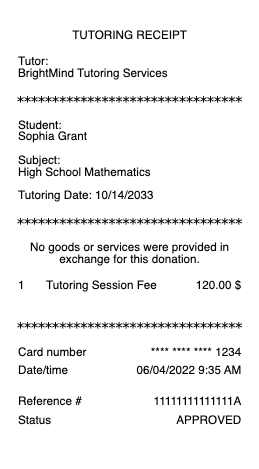
The tutor or center and the student’s name
The subject and level — and whether it’s tutoring or test prep
Session details — date(s), duration, and number of sessions
The rate — per hour or per session — and any package price
The amount paid and payment method
Any platform or center reference (e.g. an online tutoring service)
A receipt or invoice number for records
How Tutoring Is Billed
Tutoring is usually billed by time — an hourly or per-session rate — and the receipt reflects that, whether it’s a one-off session or a recurring weekly arrangement. Many tutors and centers sell packages (a block of sessions at a discount) or monthly plans, so a receipt may cover several sessions at once, and prepaid packages should show what’s been used and what remains. Rates vary widely by subject, level, and format: specialized test prep (SAT, ACT, MCAT) and advanced subjects command more than general homework help, and one-on-one costs more than small-group. Tutoring centers like the well-known national chains bill differently from an independent tutor or an online platform, which may charge through the site. Reading whether you paid per session, into a package, or on a monthly plan tells you exactly what a given charge covered — useful for tracking a child’s ongoing tutoring cost across a semester.
The Tax Question: When Tutoring Is (and Isn’t) Deductible
Here’s where families get it wrong. For a typical student, tutoring is a personal expense and not tax-deductible — general academic help doesn’t qualify. But there are specific exceptions worth knowing. Tutoring for a child with a diagnosed learning disability (such as dyslexia), when recommended by a doctor as treatment, can qualify as a medical expense deduction — a genuine, established provision, but one that requires the medical basis and documentation. Separately, care for a child under 13 that enables parents to work may fall under the Child and Dependent Care Credit or a Dependent Care FSA, though pure academic tutoring generally doesn’t count as “care” the way after-school programs might. Because these turn on specifics, the receipt — showing the provider, student, dates, and amounts — is the substantiation you’d need if a deduction applies. When in doubt, the itemized receipt plus a tax professional’s guidance is the right combination.
For Tutors: Income Records; For Families: Reimbursement
Tutoring receipts matter on both sides. For an independent tutor, the receipts issued are self-employment income with no tax withheld — you report it, and if you tutor through a platform (or are paid $600+ by one client), you may receive a 1099 to reconcile against your own records. Clean per-session records also support deducting your own tutoring-business expenses. For families, a receipt may be needed for an employer or program reimbursement, a scholarship or education-fund disbursement, or simply budgeting a child’s support. Online platforms and centers keep payment history in your account, so a copy is usually a download or reprint, while an independent tutor should provide a receipt on request. Whether the purpose is the tutor’s bookkeeping, a possible deduction, or a reimbursement, the itemized receipt naming the student, sessions, and amount is the record that does the job.
Related childcare and education receipts: see also our Tuition receipt guide and our Childcare receipt guide.
Create a Tutoring Receipt
Our generator produces a clean tutoring receipt — tutor or center, student, subject, session details, rate, and total — as a PDF you can give a family or keep for your own income records, or that a family can keep for reimbursement or tax substantiation.
Use it responsibly: recreate only real sessions that actually took place, with their true amounts. Fabricating a tutoring receipt to misstate income, claim a deduction or reimbursement you’re not entitled to, or invent services is fraud — and a medical-expense deduction for tutoring requires a genuine diagnosis and recommendation the IRS can examine. The provider’s own records are the authoritative source; this tool is for legitimate record-keeping only.
Frequently asked questions
Everything you need to know about the product and billing.
What does a tutoring receipt show?
The tutor or center and student, the subject and level (tutoring or test prep), session dates, duration, and count, the hourly or per-session rate and any package price, the amount paid and method, any platform or center reference, and a receipt or invoice number.
How is tutoring usually billed?
By time — an hourly or per-session rate — for one-off or recurring sessions, and often as discounted packages or monthly plans, so a receipt may cover several sessions. Rates vary by subject, level, and format: test prep and one-on-one cost more than general or small-group help.
Is tutoring tax-deductible?
For a typical student, no — general tutoring is a non-deductible personal expense. The main exception is tutoring for a child with a diagnosed learning disability, recommended by a doctor as treatment, which can qualify as a medical expense deduction with the proper documentation.
Can tutoring count for the Child and Dependent Care Credit?
Generally not — pure academic tutoring usually isn’t “care” the way an after-school program that enables parents to work might be. The credit and a Dependent Care FSA turn on specific rules, so keep the itemized receipt and check with a tax professional about your situation.
I’m a tutor — how should I handle receipts for taxes?
The receipts you issue are self-employment income with no tax withheld, so you report it; tutoring through a platform or being paid $600+ by a client may generate a 1099 to reconcile. Clean per-session records also support deducting your own tutoring-business expenses.
How do I get a copy of a tutoring receipt?
Online platforms and tutoring centers keep payment history in your account, so a copy is usually a download or reprint, and an independent tutor should provide one on request. Keep the itemized receipt if you need it for reimbursement, a scholarship fund, or tax substantiation.