A USD receipt documents a payment in US dollars, often across borders. This guide explains correspondent banking fees on international dollar wires, why the amount received can be less than sent, and what the receipt should show.
USD Receipt
Add custom logo
Edit line items
Choose payment method
Add/remove elements
Customize business information
Choose font
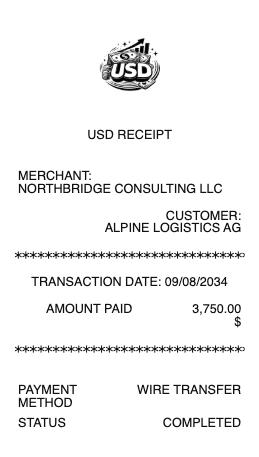
The dollar is the world's settlement currency — and that has costs
A very large share of international trade is invoiced and settled in US dollars, including between two parties in countries that use neither the dollar nor each other's currency. That is why a USD receipt so often documents a cross-border payment rather than a domestic one — and why it carries complications a domestic receipt never does.
The central complication is that dollars moving between countries do not travel directly. They pass through the correspondent banking network — intermediary banks that hold dollar accounts and pass the payment along — and each intermediary can take a fee.
Why the amount received is less than the amount sent
This is the most common and most infuriating surprise in international payments. You send $5,000 and your counterparty receives $4,955. Nobody has stolen anything — an intermediary bank has deducted its fee in transit.
Who bears these charges is a term of the payment, and it is usually set by a code on the instruction:
OUR — the sender pays all charges, and the beneficiary receives the full amount.
BEN — the beneficiary bears all charges, deducted from the amount.
SHA — shared: the sender pays their own bank's fee, and the beneficiary absorbs intermediary and receiving fees. This is the common default, and it is why the shortfall usually lands on the recipient.
If a supplier must receive an exact sum, the payment has to be sent OUR — otherwise a $50 deduction becomes a $50 dispute, invoice-by-invoice, forever.
What a USD payment receipt should show
The amount sent and, where known, the amount received — the difference is the story.
The charge code (OUR / BEN / SHA), which explains who was meant to absorb fees.
Your bank's own fee, stated separately.
The reference or trace identifier, which is what any investigation into a missing payment will start from.
The beneficiary details and the date sent.
Tracing a dollar payment that has not arrived
Because the payment hops between institutions, "it left our account" and "it has not arrived" can both be true for days without anything being wrong. What resolves it is the reference number — the identifier assigned as the payment entered the system — which lets a bank trace where it currently sits.
Without that reference, a trace request is effectively a request to search for an unidentified payment, and banks are not able to do much with it. This is the single most practical reason to keep the sending receipt: it is not a formality, it is the key to the payment.
Dollar receipts, tax, and record-keeping
For a business outside the US invoicing in dollars, the receipt is also an accounting input: the transaction is recorded in the functional currency at the rate on the transaction date, and the difference at settlement becomes an exchange gain or loss. The receipt's date and dollar amount are what that calculation is built on.
Keep the sending receipt, the reference, and the bank's fee advice together — they are three parts of one record, and a dispute over a missing $45 needs all three.
If a record is lost while the payment genuinely occurred, your bank statement establishes the amount, date, and beneficiary, and a clear reconstructed record documents that real payment for your files, matching the statement exactly. For a trace or an investigation, though, only the bank's own reference will do — so request a reissue rather than relying on a reconstruction.
Frequently asked questions
Everything you need to know about the product and billing.
Why did my recipient get less than I sent?
An intermediary bank almost certainly deducted a fee in transit. International dollar payments pass through correspondent banks, and each can take a charge — the shortfall is a fee, not an error.
What do OUR, BEN, and SHA mean?
They set who bears the charges. OUR means the sender pays everything and the beneficiary receives the full amount. BEN means the beneficiary bears all charges. SHA — the common default — splits them, which is why the recipient usually absorbs the shortfall.
How do I make sure a supplier receives the exact amount?
Send the payment with the OUR charge code, so you bear all charges including intermediary fees. Otherwise deductions in transit will short the invoice.
What is correspondent banking?
The network of intermediary banks that hold dollar accounts and pass international payments along. Dollars do not travel directly between countries — they hop through this network, and each hop can carry a fee.
How do I trace a missing dollar payment?
With the reference or trace identifier from the sending receipt. Without it, a bank cannot meaningfully search for the payment — which is the practical reason to keep the receipt.
What should a USD payment receipt show?
The amount sent and, where known, the amount received; the charge code (OUR/BEN/SHA); your bank's own fee separately; the reference or trace identifier; and the beneficiary details and date.