A water bill receipt is the record that a utility payment actually cleared — a different document from the bill itself, and one that gets asked for in surprisingly many places: proof-of-address checks, landlord–tenant utility splits, assistance applications, and moving-out reconciliations. This page covers what a valid one shows and how to get a copy when the utility has it and you don’t.
Water Bill Receipt
Add custom logo
Edit line items
Choose payment method
Add/remove elements
Customize business information
Choose font
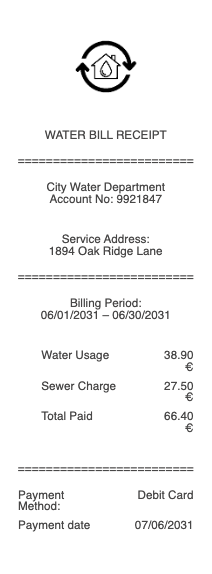
What’s on a Water Bill Receipt
The utility’s name — a city water department or a private water company
Account number and service address — the address served, which is what address-verification checks care about
Billing period and the usage it covered, metered in gallons or CCF (hundred cubic feet)
Amount billed and amount paid, with the payment date and method
Confirmation number for online or phone payments
Balance — zero after payment in full, or the remainder on a payment plan
Water Bill vs. Water Bill Receipt
The bill and the receipt answer different questions. The bill is the utility asking: here is the period, the meter readings, the tiers, the amount due. The receipt is the proof you answered: the payment date, the method, the confirmation number, the balance after. The distinction matters because most “show us your water bill” requests — a school enrollment office, a bank, the DMV — are really address checks that a recent bill satisfies, while disputes, ledgers, and assistance programs need the payment side: evidence the account is current, which only the receipt or a payment history provides.
Tenancy setups split the two documents between parties: where the landlord holds the account and the tenant reimburses, the tenant's record is a payment to the landlord while the utility's receipt names someone else. The clean fix is the pairing — the landlord's utility receipt plus the tenant's reimbursement receipt — because either alone documents half a transaction.
Where a Paid Water Receipt Gets Used
Three situations produce nearly all requests. Proof of address: utility documents are on almost every acceptable-documents list; a recent water bill or payment receipt showing your name and service address routinely satisfies it. Rentals: where tenants pay water directly or split it, receipts settle who paid what — landlords keep them for make-ready records, tenants keep them to reclaim deposits and prove the account was left current. Assistance and hardship programs: applications for utility assistance typically want the recent bill plus evidence of payments, and a clean receipt trail is what keeps a payment-plan agreement provable.
One more requester worth expecting: home closings — checklists sometimes ask for evidence utility accounts are settled, and the final water receipt is what ends the prorated bill argument between buyer and seller.
Related utility receipts: see also our Utility Bill receipt guide and our Spectrum Internet & Cable receipt guide.
A fourth use appears the month something breaks: the leak adjustment. When a hidden leak inflates a bill, most utilities will adjust it — but only against evidence: the repair receipt from the plumber, the abnormal usage on the bill, and your payment record in good standing. A water bill receipt sample from a normal month is part of that case too, because the adjustment is calculated against your typical usage.
Getting a Copy: Sample Layout and Utility Portals
Almost every water utility now runs an online account portal where past bills and payment history can be downloaded — the fastest fix for a lost receipt is logging in and printing the payment record or requesting a statement of account. Autopay users can pair the utility’s billing history with the bank statement line. For cash payments at an office or kiosk, the printed slip is the only record, so photograph it. A typical water bill receipt sample layout mirrors the anatomy above: utility block at top, account and service address, period and usage, then the payment line — which is exactly the layout our generator reproduces below.
Create a Water Bill Receipt
Our generator rebuilds a utility-style water receipt — utility and account blocks, service address, billing period with usage, amount paid, method, and confirmation line — as a clean PDF for your records file.
Use it responsibly: recreate only payments that actually happened, with real amounts. For anything official — address verification, assistance applications, disputes — the right document is the utility’s own bill, receipt, or account statement, reissued free from your portal or their office.
Frequently asked questions
Everything you need to know about the product and billing.
What should a water bill receipt show?
The utility’s name, your account number and service address, the billing period and usage, the amount paid with date and method, a confirmation number for electronic payments, and the balance remaining.
Is a water bill receipt the same as the water bill?
No — the bill requests payment and shows usage; the receipt proves the payment happened. Address checks usually accept the bill; disputes and assistance programs want the payment side.
Can I use a water bill receipt as proof of address?
Utility documents are accepted on most proof-of-address lists. A recent bill or payment receipt showing your name and the service address typically qualifies — check the specific office’s document list for recency rules.
How do I get a copy of a paid water bill receipt?
Log in to your utility’s account portal and download the payment history or a statement of account — utilities keep the records and reissue them free. For counter or kiosk cash payments, the printed slip is the record, so keep or photograph it. Normal-month copies matter too — leak adjustments are calculated against typical usage, so a paid receipt from an ordinary month is part of the evidence.
What is CCF on my water receipt?
Hundred cubic feet — a standard water-metering unit equal to about 748 gallons. Utilities bill in CCF or gallons; the receipt reflects whichever unit your meter uses.
Do landlords or tenants need water payment receipts?
Both. Where tenants pay or split water, receipts settle who paid what, support deposit reconciliations, and prove the account was left current at move-out. Where the tenant reimburses a landlord-held account, keep the pair — the utility's receipt and the reimbursement receipt — since either alone is half the transaction.