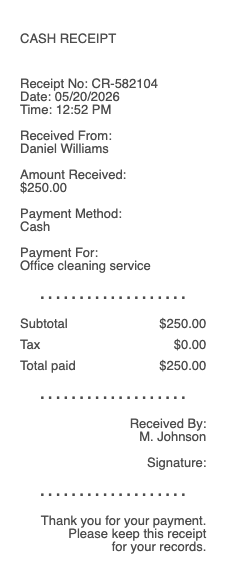
A cash receipt documents a transaction completed with physical currency — bills and coins — rather than card, check, or electronic transfer. Cash receipts have unique importance because cash leaves no automatic paper trail: there's no card statement, no bank record, no email confirmation. Without a properly-issued cash receipt, the transaction effectively doesn't exist for accounting, tax, or legal purposes. With 2,600 monthly US searches for "cash receipt" alone (6,000+ across the full keyword cluster) and an extraordinarily low KD of 3, this is the highest-value template anyreceiptgenerator.com can offer. Generate a clean, professional cash receipt in seconds with our tool above — works for landlords, freelancers, small business owners, nonprofits, garage sales, and any cash transaction that needs documentation.
Cash Receipt
Why Cash Receipts Matter More Than Other Receipts
Every non-cash payment leaves a digital trail. Card payments appear on bank statements, checks have routing numbers and clearing dates, wire transfers have confirmation codes, Venmo/Zelle/PayPal create transaction records. Cash payments leave nothing — unless you create a receipt. This makes cash receipts the single most important documentation method for any cash transaction, and the reason landlord-tenant law in many US states legally requires landlords to provide cash receipts to tenants.
Three practical scenarios where the absence of a cash receipt creates real legal and financial risk:
Disputed rent payments. Tenant pays $1,500 cash, landlord later claims it wasn't paid. Without a receipt, the tenant cannot prove the payment occurred. Eviction proceedings can follow.
Cash purchase tax deductions. Self-employed buyer purchases $400 in supplies with cash, no receipt issued. IRS audit later disallows the deduction because the taxpayer can't prove the expense.
Small business cash sales. Restaurant takes $50 cash from a customer, doesn't ring it through the register or issue a receipt. The transaction is effectively invisible — to the customer (no warranty record), to the business (no inventory deduction), and to the tax authority (which treats unreported cash as fraud).
What Belongs on a Cash Receipt
A legally durable cash receipt should include every element below:
Receipt number — a unique sequential ID (e.g. CR-2026-0184). Sequential numbering is important for audit purposes and matches the pattern used by IRS-compliant POS systems.
Date of cash payment — when the cash physically changed hands
Recipient's full name and business address (the person or business receiving the cash)
Payer's name (the person or business paying)
Amount received in cash — written in both digits and words: "$1,500.00 — One thousand five hundred dollars and 00/100"
"Cash" explicitly stated as the payment method — never assume; specify
Purpose of payment — "rent for May 2026," "invoice #1234 paid in full," "garage sale items: dining table, two chairs," "donation to St. Mary's Food Bank," etc.
Outstanding balance if this is a partial payment
Signature of the recipient — required for legal weight, especially for amounts over $500
Optional: tax ID for tax-deductible transactions
Cash Receipts for Rent — The Most Common Use Case
Landlord-tenant law in many US states explicitly requires landlords to issue receipts for cash rent payments. States with this requirement include California (Civil Code §1499), Maryland (Real Property §8-208), Massachusetts (Mass Gen Laws c. 186 §15B), New York City (NYC Admin Code 26-517.1), and several others. Some states require receipts only when the tenant requests one; others require them automatically for every cash payment. Even in states where receipts aren't legally required, providing one prevents the most common landlord-tenant dispute: "I paid rent already."
For rent specifically, the receipt should clearly identify: the rental property address, the month being paid (or partial period), the lease holder name as payer, the landlord or property manager as recipient, the amount, and any late fees or partial payment status. Most experienced landlords use a sequentially-numbered receipt book so each receipt has a unique ID, and they keep the carbon copy as their own record.
Cash Receipts for Small Business and Freelance Work
When a freelancer collects cash for services rendered, the cash receipt closes the financial loop on the project. The receipt should reference the original invoice number (if one was issued), describe the services, and specify cash as the payment method. For self-employed taxpayers filing Schedule C, cash receipts are required documentation for any cash income — without them, the IRS may challenge the reported income figures.
For small businesses (restaurants, retail, services), cash receipts should match the daily cash deposit. If $1,200 in cash was rung through the register on a given day, $1,200 in receipts should exist and the deposit should match. Discrepancies trigger audits.
Cash Receipts for Donations
Charitable donations of cash to qualified 501(c)(3) organizations are tax-deductible, but the IRS has specific documentation requirements:
Donations under $250: A bank record (canceled check, bank statement) OR a written receipt from the charity is sufficient. Cash donations under $250 require the receipt — no bank record exists.
Donations of $250 or more: A written acknowledgment from the charity is required, including the amount, a description of any goods or services provided in exchange, and a statement that the organization is tax-exempt.
Donations of $500 or more: Additional reporting on IRS Form 8283 may be required.
For nonprofits issuing cash donation receipts, the receipt must include the organization's EIN (Employer Identification Number) and 501(c)(3) tax-exempt status confirmation.
Cash Receipts for Private Sales (Craigslist, Facebook Marketplace, Garage Sales)
When you sell something to a stranger for cash — used furniture, a car, electronics, anything — issuing a cash receipt protects both parties. The seller has proof of sale (important if the buyer later claims the item was defective or stolen). The buyer has proof of ownership (important for registration, warranty, or resale).
For vehicle sales, the cash receipt must accompany the title transfer and bill of sale. Many state DMVs require a separately-issued cash receipt or bill of sale showing the purchase price for tax assessment purposes. For higher-value sales (over $10,000 in cash), the IRS requires the recipient to file Form 8300 within 15 days — the cash receipt is critical supporting documentation.
The IRS Reporting Threshold — Why $10,000 in Cash Matters
Federal law requires any trade or business receiving more than $10,000 in cash in a single transaction (or related transactions) to file IRS Form 8300 within 15 days. The form requires details about the payer, the transaction, and the cash amount. Maintaining a clean cash receipt for any single large cash transaction is essential — both for the business's own records and to provide to the payer if requested. Splitting a large cash payment into smaller payments to avoid Form 8300 filing ("structuring") is itself a federal crime under 31 U.S.C. §5324.
Generate a Cash Receipt in Seconds
Use the generator above to create a professional, legally-durable cash receipt for any transaction. Specify the recipient, payer, amount (in digits and words for legal weight), purpose, and receipt number. Download as PDF or PNG instantly. Works for cash rent payments, cash sales of any kind, freelance and contractor cash collections, charitable cash donations, garage sales, private sales of vehicles or property, and any other cash transaction that needs proper documentation.
Sequential Numbering — Why Every Cash Receipt Needs a Unique ID
Tax auditors look closely at sequential numbering on cash receipt books. A landlord who issues receipts #001 through #047 over six months, then jumps to receipt #050 without explanation, raises immediate red flags — missing receipts #048 and #049 suggest unreported income. Always number receipts consecutively, use a single receipt book (or sequential digital numbering scheme) per business or rental property, and account for voided receipts by marking them "VOID" rather than skipping the number entirely. The same principle applies to small business POS systems — gaps in transaction numbers are the single most common audit trigger.
Cash Receipts vs Bank Cash Deposits — Reconciliation Matters
If you're running a cash business, your cash receipts should reconcile to your bank deposits. If you issued $4,200 in cash receipts on a given day, your end-of-day bank deposit should be $4,200 (minus any cash kept for next-day operations like change for register). Discrepancies — even minor ones — accumulate over a tax year and create audit risk. Best practice: count cash at end of day, match against receipts issued, deposit the matching amount, retain receipts and deposit slip together. This three-document reconciliation is what professional auditors look for first.
Cash Receipt Books vs Generated Receipts — Both Are Valid
Traditional carbon-copy cash receipt books (sold at office supply stores under brands like Adams, TOPS, Rediform) remain perfectly valid for legal and tax purposes. They have advantages: tamper-evident (carbon copies can't be modified after the fact), sequential numbering built in, no electronics required. They have disadvantages: not backed up, can be lost or stolen, hard to search, hard to share with accountants. Generated digital cash receipts (PDF or PNG) are equally valid in all US states and most international jurisdictions provided they include the required fields. For maximum durability, many businesses use both: hand-write the carbon-copy receipt for the customer, generate the digital version for their own records and accountant.
What to Do If You Lose a Cash Receipt
If you lost the cash receipt from a transaction you need to document (typically for tax purposes), the IRS accepts reconstructed receipts in good faith, particularly when supported by other evidence: bank withdrawal slips showing the cash was withdrawn before the transaction, contemporaneous calendar entries, emails or text messages referencing the payment, witness statements, or photographs of the goods purchased. Use our generator to recreate the cash receipt with the original transaction details. Document your reconstruction process — note the date you created the replacement and why the original is unavailable. Auditors expect reconstructed receipts in cases of theft, fire, or loss — they're not automatically rejected, just scrutinized more carefully.
Generate a Cash Receipt Online — Free, No Login
Our cash receipt generator creates a professional, legally-durable cash receipt in under a minute. Add the recipient's full business name and address, payer name, transaction date, cash amount (with dollar-and-words notation), purpose of payment, receipt number for sequential tracking, and optional outstanding balance. Download as PDF or PNG instantly — no login required. Works for landlords issuing legally-required rent receipts (California, Maryland, Massachusetts, New York, and other states), small business owners documenting daily cash sales for end-of-day reconciliation, freelancers and contractors collecting cash from clients, nonprofits issuing tax-deductible cash donation acknowledgments, private sellers documenting garage sales, vehicle sales, and Craigslist/Facebook Marketplace transactions, and any individual reconstructing lost cash receipts for IRS audit support. Sequential receipt numbering, written-words amount notation, and signature field included — built to withstand IRS audit and small claims court scrutiny.
Frequently
asked questions
Everything you need to know about the product and billing.