A deposit receipt documents money paid upfront and held against a future obligation — a down payment on a purchase, earnest money on a home, a security deposit, a layaway payment, a vendor deposit for a service, or an escrow contribution. It confirms how much was paid, what it's being held against, and whether it's refundable. With "deposit receipt" at 600 monthly US searches plus "deposit receipt template" at 250 (KD 1–3), this is a heavily-used financial document across real estate, retail, services, and rentals. Generate a clean deposit receipt in seconds with our tool above.
Deposit Receipt
Add custom logo
Edit line items
Choose payment method
Add/remove elements
Customize business information
Choose font
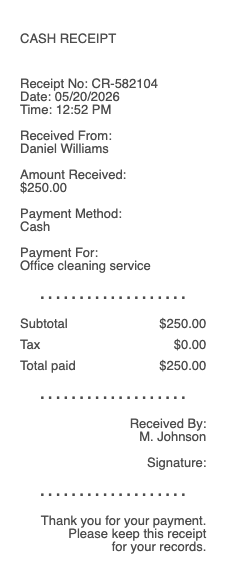
What a Deposit Receipt Documents
A deposit is money paid before the full transaction completes — it secures an item, a service, or an agreement. The deposit receipt is critical because deposits are frequently disputed: "Was it refundable?" "How much did I pay?" "What was it for?" A clear receipt answers all three.
Standard fields on a deposit receipt:
Recipient name and address (the party receiving the deposit)
Payer name (the party paying)
Receipt number and date
Deposit amount in digits and words
What the deposit is for — the underlying transaction (e.g. "Deposit toward purchase of 2019 Honda CR-V" or "Security deposit for 123 Main St lease")
Total transaction amount and remaining balance after this deposit
Refundability terms — refundable, non-refundable, or conditional, with the conditions stated
Payment method
Expected completion or balance-due date
Signatures of both parties
Types of Deposits — Each Needs a Receipt
Earnest money (real estate). When making an offer on a home, buyers put down earnest money (typically 1–3% of the price) to show good faith. Held in escrow, it's applied to the purchase at closing or forfeited if the buyer backs out without a contingency. The earnest money deposit receipt is a critical document in the transaction — it proves the buyer's commitment and the amount held.
Security deposit. Rentals (housing, equipment, venues) collect a refundable deposit against damage. The receipt documents the amount and refund conditions. (For housing specifically, see our security deposit receipt page.)
Down payment. On vehicles, appliances, furniture, or any large purchase, a down payment reduces the financed amount. The deposit receipt shows the down payment against the total purchase price and the remaining balance.
Vendor / service deposit. Photographers, caterers, contractors, wedding venues, and event planners require a deposit (often 25–50%) to book. The receipt documents the booking commitment and what remains due.
Layaway. Retail layaway plans take incremental deposits toward an item held by the store. Each payment generates a deposit receipt showing the running balance.
Pet / breeder deposit. Reserving a puppy, kitten, or animal from a breeder typically requires a deposit. The receipt documents the reservation.
Refundable vs Non-Refundable — The Critical Distinction
The single most important field on a deposit receipt is the refundability term. Disputes almost always center on whether a deposit should be returned. The receipt must state clearly:
Fully refundable — returned in full if the transaction doesn't complete (state conditions)
Non-refundable — kept by the recipient regardless (common for vendor booking deposits)
Conditionally refundable — returned only under specific conditions (e.g. cancellation more than 30 days out, no damage, contingency met)
For the payer's protection, get the refundability terms in writing on the receipt at the moment of payment. Verbal "don't worry, it's refundable" promises are nearly impossible to enforce later. A deposit receipt with clear terms is admissible evidence in small claims court.
Deposit Receipts and the Running Balance
A good deposit receipt always shows the full transaction amount and remaining balance, not just the deposit in isolation. For example: a $2,000 furniture purchase with a $500 deposit should show "Deposit: $500, Total: $2,000, Balance due: $1,500." This running-balance format matters because:
It documents the deposit as part of a larger agreed transaction (not a standalone payment)
It prevents disputes about the total price agreed
It creates a clear paper trail for the final payment and receipt
Generate a Deposit Receipt
Use the generator above to create a clean deposit receipt with all fields: recipient and payer names, receipt number and date, deposit amount in digits and words, what the deposit is for, total transaction amount, remaining balance, refundability terms, payment method, balance-due date, and signature lines. Download as PDF or PNG instantly.
Earnest Money Deposit Receipts in Real Estate
Earnest money is the deposit a homebuyer pays when making an offer — typically 1–3% of the purchase price, held in an escrow account by the title company, broker, or attorney. The earnest money receipt is a legally significant document: it proves the buyer's good-faith commitment and specifies the amount held. At closing, the earnest money is credited toward the down payment or closing costs. If the deal falls through, who keeps it depends on the contingencies in the purchase agreement. Always get a written earnest money receipt from the escrow holder — it's referenced throughout the transaction and at closing.
Vendor Booking Deposits — Weddings, Events, Contractors
Service vendors require deposits to secure a booking: wedding photographers (often 50%), caterers (25–50%), event venues, contractors, and DJs. These deposits are usually non-refundable because they compensate the vendor for blocking the date and turning away other clients. The deposit receipt should state this clearly. For the client's records, the deposit receipt documents the booking commitment, the total contract value, and the balance due before or on the event date. Disputes over forfeited deposits are common — the written receipt with refundability terms is the deciding evidence.
Down Payment Deposits on Major Purchases
For vehicles, appliances, furniture, and other large purchases, a down payment (deposit) reduces the financed or remaining amount. The deposit receipt must show the down payment against the full purchase price with the remaining balance clearly stated. This protects both parties: the buyer has proof of partial payment, the seller has documentation of the agreed total. For financed purchases, the down payment receipt is also needed for loan paperwork — lenders require proof of the down payment amount before finalizing financing.
Protecting Yourself: Always Get the Refund Terms in Writing
The most common deposit dispute is refundability. To protect yourself as the payer: never hand over a deposit without a written receipt stating the amount, what it's for, and the exact refund conditions. Photograph or scan the receipt immediately. If the recipient says "it's refundable" verbally but the receipt says otherwise (or is silent), the written terms win in a dispute. For large deposits (earnest money, vehicle down payments), consider whether the deposit is held in escrow vs directly by the seller — escrow provides more protection. A clear deposit receipt is your primary recourse in small claims court or a credit-card chargeback.
Generate a Deposit Receipt — Free, No Login
Our deposit receipt generator creates a clean receipt for any deposit type: recipient and payer names, receipt number and date, deposit amount in digits and words, what the deposit secures, total transaction amount, remaining balance, refundability terms (refundable / non-refundable / conditional), payment method, balance-due date, and signature lines. Works for earnest money on a home purchase, security deposits, vehicle and appliance down payments, vendor booking deposits (photographers, caterers, venues, contractors), retail layaway payments, breeder/pet reservation deposits, and escrow contributions. The refundability terms and running-balance format protect both parties in any dispute. Download as PDF or PNG instantly.
Frequently
asked questions
Everything you need to know about the product and billing.
What is a deposit receipt?
A deposit receipt documents money paid upfront and held against a future obligation — a down payment, earnest money on a home, a security deposit, a layaway payment, a vendor booking deposit, or an escrow contribution. It confirms the amount paid, what it secures, the total transaction value, the remaining balance, and critically, whether the deposit is refundable. It protects both parties in the common event of a deposit dispute.
What's the most important field on a deposit receipt?
The refundability term. Deposit disputes almost always center on whether the money should be returned. The receipt must clearly state: fully refundable (with conditions), non-refundable, or conditionally refundable (e.g. returned if cancelled 30+ days out). Get this in writing at the moment of payment — verbal 'it's refundable' promises are nearly impossible to enforce. A deposit receipt with clear refund terms is admissible evidence in small claims court.
What is earnest money and do I need a receipt for it?
Earnest money is the good-faith deposit a homebuyer pays when making an offer — typically 1-3% of the purchase price, held in escrow by the title company, broker, or attorney. Yes, always get a written receipt: it's a legally significant document proving your commitment and the amount held. At closing, earnest money credits toward your down payment or closing costs. If the deal falls through, whether you get it back depends on the purchase agreement's contingencies — the receipt is referenced throughout.
Are vendor booking deposits refundable?
Usually not. Service vendors (wedding photographers, caterers, venues, contractors, DJs) typically require non-refundable deposits because they compensate for blocking your date and turning away other clients. The deposit receipt should state this clearly. For your records, it documents the booking commitment, total contract value, and balance due. Disputes over forfeited vendor deposits are common — the written receipt with refundability terms is the deciding evidence.
Should a deposit receipt show the total price and remaining balance?
Yes. A good deposit receipt always shows the full transaction amount and remaining balance, not just the deposit in isolation. For example: '$500 deposit, $2,000 total, $1,500 balance due.' This documents the deposit as part of a larger agreed transaction, prevents disputes about the total price, and creates a clear paper trail for the final payment. A deposit shown without the running balance is weaker documentation.
How do I protect myself when paying a deposit?
Never hand over a deposit without a written receipt stating the amount, what it's for, and the exact refund conditions. Photograph or scan the receipt immediately. If the recipient says 'it's refundable' verbally but the receipt is silent or says otherwise, the written terms win in a dispute. For large deposits (earnest money, vehicle down payments), confirm whether the money is held in escrow (more protection) or directly by the seller. The receipt is your primary recourse for a small-claims case or credit-card chargeback.