A generic receipt is the unbranded, universal-format receipt you create when no store-specific template fits — for cash sales between individuals, freelance work, garage sales, private services, or any transaction where you need clean documentation without a corporate logo. With 300 monthly US searches for "generic receipt" and "simple receipt template" at 700 monthly searches, this is one of the most-requested neutral receipt formats. Generate a clean generic receipt in seconds with our tool above — no logos, no branding, just professional documentation.
Generic Receipt
Add custom logo
Edit line items
Choose payment method
Add/remove elements
Customize business information
Choose font
When You Need a Generic Receipt (Not a Brand-Specific One)
Most receipt searches are for specific brands — Walmart, Amazon, CVS. But thousands of daily transactions happen outside any chain store, and those need a generic format:
Private sales — selling a used car, furniture, electronics to another individual
Garage sales — documenting cash received for buyer/seller records
Freelance services — graphic design, consulting, writing, photography, tutoring
Independent contractors — handyman, plumber, cleaner, lawn care without a chain affiliation
Cash payments between individuals — paying back a loan, settling shared expenses, rent in cash to a private landlord
Donations to small organizations — community groups, sports teams, religious groups without their own forms
Babysitter or pet-sitter payments — documentation for FSA, taxes, or shared expense tracking
For all of these, a branded receipt would be wrong (no store name applies) but the documentation is still needed. Generic format is the answer.
What Makes a Receipt "Generic"
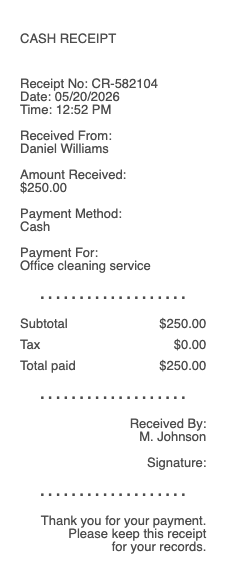
A generic receipt has the standard elements of any receipt — without the chain-store branding, logo, or specific industry conventions:
"Receipt" title at top (instead of a brand logo)
Receipt number — sequential ID you assign
Date of transaction
Recipient (you, the seller/service provider): name, address, optional contact info
Payer: name and contact
Description of what was sold or what service was provided
Amount in digits and words ("$500.00 — Five hundred dollars and 00/100")
Payment method: cash, check #, transfer ref, etc.
Signature of the recipient (sometimes both parties)
What it doesn't have: a corporate logo, register number, SKU codes, store policies. Just clean documentation of the transaction.
Common Use Cases in Detail
Selling a car privately. When you sell a used car to a stranger (Craigslist, Facebook Marketplace), both parties need a record. The buyer needs it for DMV registration (to prove purchase price for taxes). The seller needs it to prove the car is no longer their liability. A generic receipt with both names, the car details (VIN, year, make, model), purchase price, and date covers both needs.
Garage and estate sales. For higher-value items at garage sales (over $100), both parties may want a receipt. Useful if the item is later questioned (was it stolen?), if the buyer wants to resell and document provenance, or if you're claiming the donation to charity equivalent.
Freelance payments. A photographer paid $800 cash for a wedding shoot, a tutor paid $40 for an hour, a freelance graphic designer paid $200 for a logo — all need receipts for tax records (both sides). The freelancer documents income (Schedule C); the client documents expense.
Babysitter and household worker payments. For Dependent Care FSA reimbursement, payments to babysitters, nannies, and household workers require receipts. Most informal caregivers don't have receipt books — you generate one for them, they sign, both keep copies.
Repayment of personal loans. When a friend or family member pays you back, a generic receipt protects both: you have proof the loan was repaid (no future dispute), they have proof of payment (no future false claim).
Legal Standing of Generic Receipts
A handwritten or generated generic receipt has the same legal weight as a chain-store receipt when it contains the required information: who paid, who received, what for, how much, when, and ideally both signatures.
Small claims courts accept generic receipts as evidence. The IRS accepts them for tax documentation. State DMVs accept them for vehicle sales (alongside bill of sale forms). Insurance adjusters accept them for personal property claims.
The key requirements for legal durability:
Amount written in both digits AND words (prevents alteration)
Date that matches the actual transaction (no backdating)
Sequential numbering if you issue multiple receipts (audit trail)
Signature of at least the recipient (ideally both parties for high-value)
Generic Receipt vs Specific Templates
When should you use a generic receipt vs a specific template? Use specific (Walmart, restaurant, hotel, etc.) when:
The transaction was at that specific business
Returning, exchanging, or claiming warranty at that business
The finance team or insurance adjuster needs to verify the merchant
Use generic when:
The transaction was between individuals, not at a chain
The service or product doesn't fit a standard retail category
You're documenting something the original "merchant" can't or won't provide
Generate a Generic Receipt
Use the generator above to create a clean, unbranded receipt for any transaction. Add the date, your name and contact info as recipient, the payer's name, a description of what the payment was for, the amount in digits and words, payment method, and optional reference number. Download as PDF or PNG instantly.
Generic Receipt Numbering — Why Sequential Matters
If you're issuing multiple generic receipts (regular freelance client, monthly cash rent, recurring donations), use sequential numbering: R-001, R-002, R-003... This isn't just bookkeeping aesthetics — tax auditors check receipt sequences for gaps that suggest hidden income. A landlord whose generic receipt book jumps from R-047 to R-049 raises a flag (where's R-048?). For one-off generic receipts, use a date-based ID: 2026-05-25-001. For recurring payments, build a consistent system from the first receipt forward.
Two Signatures or One? Depends on Stakes
A receipt is legally binding with just the recipient's signature (the person receiving money confirms receipt). But for higher-stakes transactions — vehicle sales, large cash payments, services where the work could be later disputed — get both signatures. Two signatures convert the receipt into a mini-contract: both parties acknowledge the terms, amount, and date. Threshold rule: under $500 = one signature is fine; $500-$5,000 = consider both; over $5,000 = always both signatures plus optional witness or notary.
Generic Receipt for Self-Employed Income Documentation
If you're self-employed and accepting cash, generic receipts serve a dual purpose: documentation for the client (they need it for their own deductions) AND your own record of income (required for Schedule C). The IRS expects self-employed taxpayers to maintain receipt records of all income, not just expenses. Generic receipts you issue to clients should be sequentially numbered and saved (carbon copy or PDF). At year-end, the sum of all issued receipts should reconcile with your reported gross income on Schedule C — discrepancies are an audit trigger.
Digital vs Paper Generic Receipts
Both formats are legally equivalent in the US, UK, EU, Canada, and most jurisdictions. Paper has advantages for in-person cash transactions (no devices needed, signed in front of both parties). Digital (PDF emailed or generated and downloaded) has advantages for long-term storage (no fading, searchable), remote transactions, and audit trail (timestamps, IP addresses if using electronic signature services like DocuSign). For freelancers, the modern standard is: generate digital receipt at the moment of payment, email PDF to the client, save copy in your accounting system. Skip the paper version entirely.
Generate a Generic Receipt — Free, No Login
Our generic receipt generator creates a clean, unbranded receipt for any transaction that doesn't fit a chain-store template: private vehicle sales, garage sales, freelance services, independent contractor payments, cash repayments between individuals, donations to small organizations, babysitter and household worker payments, and any peer-to-peer transaction. Add sequential receipt number, date, recipient name and contact, payer name, description of what was sold or provided, amount in digits and words for legal durability, payment method (cash, check, transfer), and optional signature lines. Download as PDF or PNG instantly. Legally accepted in small claims court, IRS audits, state DMV vehicle registration, insurance claims, and corporate expense systems.
Frequently
asked questions
Everything you need to know about the product and billing.
What is a generic receipt?
A generic receipt is an unbranded, universal-format receipt used when no store-specific template applies. It contains the standard elements of any receipt (date, parties involved, amount, payment method) without a corporate logo or industry-specific conventions. Used for private sales, garage sales, freelance services, independent contractor work, cash repayments, donations to small organizations, babysitter payments, and any peer-to-peer transaction.
Is a handwritten generic receipt legally valid?
Yes. A handwritten or generated generic receipt has the same legal weight as a chain-store receipt when it contains the required information: who paid, who received, what for, how much, when, and a signature. Small claims courts accept them as evidence, the IRS accepts them for tax documentation, and state DMVs accept them alongside bill of sale forms for vehicle transactions. For maximum durability: write the amount in both digits AND words, never backdate, and get both signatures for higher-value transactions.
When should I use a generic receipt instead of a brand-specific template?
Use generic when the transaction is between individuals (not at a chain store), when the service or product doesn't fit a standard retail category, or when you're documenting a payment the original 'merchant' can't or won't provide formally. Use brand-specific (Walmart, restaurant, hotel) when the transaction was at that business, for warranty/return claims, or when finance teams need to verify a specific merchant.
How should I number my generic receipts?
Use sequential numbering: R-001, R-002, R-003... for receipt books, or date-based IDs (2026-05-25-001) for one-off receipts. The sequence matters for tax purposes — auditors check for gaps that might suggest hidden income. If you void a receipt, mark it 'VOID' rather than skipping the number entirely. For freelancers and small business owners issuing recurring receipts, maintain a consistent system from the first receipt forward.
Do I need both parties to sign a generic receipt?
Required: the recipient's signature (the person receiving money confirms receipt). Recommended for higher-value transactions: both signatures. Threshold rule: under $500 = recipient's signature is enough; $500-$5,000 = consider both; over $5,000 = always both signatures, plus optional witness or notary for added legal weight. For vehicle sales, both signatures plus the buyer's printed name are standard. For freelance services, having the client countersign confirms scope/satisfaction.
What's the legal way to document a private cash transaction with a generic receipt?
Include: today's actual date (never backdate), recipient (you) name and address, payer name and contact, clear description of what the payment is for ('Sale of 2018 Honda Civic VIN 1HG...' or 'Photography services for 2026-05-15 wedding'), the amount in both digits AND words ($500.00 - Five hundred dollars and 00/100 — this prevents alteration), payment method (cash, check #, Zelle ref, etc.), and both signatures for any amount over $500. Keep your copy in a secure location; give the original to the payer.