A Goodwill donation receipt is the document Goodwill Industries issues when you drop off donated items at one of their 4,000+ donation centers across the United States. With 1,600 monthly US searches for "goodwill donation receipt" alone and 2,500+ across the full cluster, it's one of the most-searched donation receipts on the internet — and for good reason: every item you donate to Goodwill is tax-deductible, but only if you have proper documentation. The receipt Goodwill hands you at drop-off is essentially blank — you are responsible for valuing and itemizing what you donated. Generate a clean, IRS-compliant Goodwill donation receipt in seconds using our tool above.
Goodwill Donation Receipt
Add custom logo
Edit line items
Choose payment method
Add/remove elements
Customize business information
Choose font
Why Goodwill Donation Receipts Are Different From Other Charitable Receipts
Most charitable donations work like this: you give the charity money or property, the charity calculates the value, the charity issues a receipt for that exact amount. Goodwill doesn't work that way. When you drop off a bag of clothes or a piece of furniture at a Goodwill donation center, the attendant hands you a small slip of paper that says, in essence: "We received donated items from you on this date. You are responsible for determining the fair market value."
This shift in responsibility — from the charity to the donor — is what makes Goodwill receipts unique and why so many donors search for help filling them out. The IRS requires the donor to:
List each donated item
Estimate the fair market value of each (typically thrift-store resale value, not original retail price)
Maintain the receipt and itemization for at least 3 years (7 for major items)
Attach a separate statement for donations totaling $500+ in a tax year
Obtain a formal appraisal for any single item valued at $5,000+
The result: most donors leave Goodwill with a blank receipt slip and no idea what to do next. This page shows you what to do.
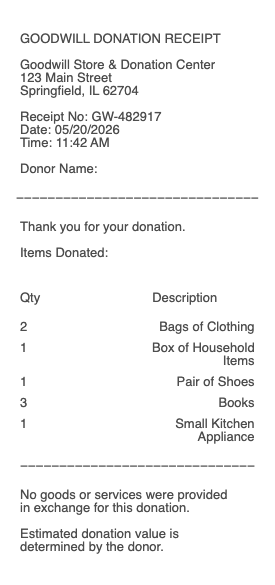
What's on the Goodwill Receipt You're Given at Drop-Off
The slip Goodwill hands you at the donation center is intentionally minimal:
Goodwill organization name — the specific regional Goodwill (e.g., "Goodwill of Central and Coastal Virginia" — there are 156 independent regional Goodwills in the US)
Address of the donation center
EIN (Employer Identification Number) — Goodwill's federal tax ID for 501(c)(3) status verification
Date of donation
"Thank you for your donation" language
A blank section where you write what you donated and the estimated value
Attendant's signature (sometimes) confirming items were dropped off
What's not there: a specific list of items received, item-by-item values, or the total dollar amount. That's your job to fill in.
How to Fill Out a Goodwill Donation Receipt for Tax Purposes
"how to fill out goodwill donation receipt" gets 150 monthly searches. The correct process:
Make a list of every item you donated — before you leave the parking lot. Photos help. If you're donating 30 shirts, write "30 women's shirts." If you're donating a couch, write "leather sectional couch, brown, 2010 model."
Look up fair market value for each item — Goodwill publishes a valuation guide at goodwill.org/donate/donor-form with thrift-store typical prices. The Salvation Army publishes a similar guide. Both are IRS-accepted reference values.
Use the thrift-store resale price, not the original retail price. A shirt that cost $40 new might be valued at $4–$8 at Goodwill — that's the tax-deductible value, not the $40 original.
Write your itemization on the Goodwill receipt itself or on a separate attached sheet. Reference the receipt number on any attached sheet.
Keep both documents together for at least 3 years (per IRS Pub 526).
For donations totaling $500 or more in a tax year, complete IRS Form 8283 (Noncash Charitable Contributions) when you file your taxes.
For single items valued at $5,000 or more, obtain a written appraisal from a qualified appraiser within 60 days before the donation.
Goodwill Valuation Guide — What Common Items Are Actually Worth
The most-referenced part of any Goodwill receipt help: how much can you claim per item? Goodwill's published 2026 valuation guide ranges (averaged across regional Goodwills):
Adult clothing (typical): shirts $3–$8, pants $4–$12, dresses $6–$20, suits $10–$60, coats $10–$50
Children's clothing: roughly half of adult prices
Shoes: $3–$25 depending on condition and brand
Furniture: couches $50–$200, tables $20–$100, chairs $5–$50, beds $50–$200
Electronics: highly condition-dependent — TVs $20–$200, laptops $50–$300, small appliances $5–$30
Books, DVDs, CDs: $0.50–$3 each
Kitchenware: dishes $0.50–$3 each, small appliances $5–$30, cookware sets $10–$30
Toys: $1–$10 each, more for unopened or premium items
Bedding & linens: sheets $4–$10, blankets $5–$15, comforters $10–$30
These ranges are conservative — auditors expect them. Inflating values invites IRS scrutiny.
Goodwill Industries — 156 Independent Organizations
Important context: "Goodwill" isn't a single national charity. It's a federation of 156 independent regional Goodwill organizations in the US, each with its own EIN, leadership, and donation acceptance policies. They share branding, the donation business model, and the Goodwill Industries International umbrella organization, but each is a separate 501(c)(3). This matters for your receipt because:
The EIN on your receipt is specific to your regional Goodwill, not a national organization
Donation acceptance policies vary by region (some accept electronics, some don't; some accept furniture, some don't)
Each regional Goodwill files its own 990 with the IRS — your donation appears on their books, not a national consolidated report
For your tax records, the regional EIN is sufficient — the IRS recognizes each as a qualified 501(c)(3).
Common Goodwill Receipt Mistakes That Trigger IRS Audits
Three patterns auditors flag:
Inflated values — claiming $30 for a shirt that's worth $5 thrift-store. This is the most common audit trigger for charitable deduction abuse.
No itemized list — claiming "$2,000 in donations to Goodwill" without listing what was donated. The IRS wants the breakdown.
Backdating — claiming a donation on December 30 for items dropped off in January. The donation date is the date Goodwill received the items, not when you decided to donate them.
The good news: legitimate Goodwill donations are rarely challenged when properly documented. The IRS looks for outliers — donations far above the expected range for a household income level.
Generate a Goodwill Donation Receipt
Use the generator above to create a clean, IRS-compliant Goodwill donation receipt with: regional Goodwill name and EIN, donation center address, date of donation, complete itemized list of donated items with quantities and descriptions, fair market value per item (referencing Goodwill's valuation guide), total donation value, and donor information. Download as PDF or PNG. Especially useful for reconstructing lost Goodwill receipts, properly itemizing the blank slip Goodwill gave you, and creating Form 8283-ready documentation for donations over $500.
Goodwill vs Salvation Army Receipts — Functionally Similar But Different EINs
Goodwill and Salvation Army are the two largest US thrift-store charities, and both work the same way: you drop off items, they hand you a blank receipt, you itemize and value the donation yourself. The key difference for tax records is the EIN and organization name on the receipt. Goodwill's EIN varies by region (one of 156). Salvation Army's EIN is 13-5562351 (the national organization). Both are 501(c)(3) qualified for charitable deductions. If you donate to both in the same tax year, keep separate documentation for each — combining them on one receipt creates audit risk.
What Goodwill Does and Doesn't Accept
Acceptance policies vary by regional Goodwill, but most accept: clean clothing (no stains/tears), shoes, books, household items (dishes, kitchenware, decor), small furniture, electronics (TVs, computers, small appliances in working condition), toys, bedding. Most do not accept: mattresses (health code issues), large appliances (refrigerators, washers, dryers — too costly to refurbish at scale), cribs or car seats (safety recall liability), unsafe toys, hazardous materials (paint, chemicals), exercise equipment over a certain size, opened/used personal hygiene items, or anything broken. Check your regional Goodwill's website for the specific list before driving there — getting turned away with a truckload of mattresses is a real frustration.
Goodwill Online Donations and Pickup Services
Beyond drop-offs, some regional Goodwills offer home pickup for large items (typically furniture) via partnerships with services like ReSupply, Pickup Please, or local moving companies. Online donations via Goodwill's online store (shopgoodwill.com) are not charitable donations — those are purchases, not gifts. Goodwill also accepts vehicle donations at most regional locations — these require a separate receipt process including IRS Form 1098-C if the vehicle is valued at $500+. Vehicle donation receipts have stricter documentation requirements than typical item donations.
Goodwill Receipt for Cryptocurrency, Stock, or Cash Donations
Most "Goodwill donation receipt" searches refer to physical item donations, but Goodwill also accepts cash, stock, and cryptocurrency. The receipt format is different: cash donations get a standard 501(c)(3) acknowledgment letter showing the dollar amount. Stock donations are valued at the average of high/low trading price on the donation date. Cryptocurrency donations are valued at fair market value on the donation date and require IRS Form 8283 for any donation worth $500+. For these non-item donations, the receipt comes from the regional Goodwill's development office, not the donation center attendant.
Generate a Goodwill Donation Receipt — Free, No Login
Our Goodwill donation receipt generator creates a clean, IRS-compliant donation receipt for items dropped off at any Goodwill donation center. Add the regional Goodwill name (e.g., "Goodwill of Southern California"), EIN, donation center address, donation date, complete itemized list of donated items with quantity and brief description, fair market value per item (use Goodwill's valuation guide ranges), total donation value, and donor name and address. Download as PDF or PNG instantly. Especially useful for reconstructing lost Goodwill receipts from past donations (Goodwill retains very limited records), properly itemizing the blank slip Goodwill hands you at drop-off, creating IRS Form 8283-ready documentation for donations totaling $500 or more in a tax year, and supporting Schedule A charitable deduction claims with the level of itemization the IRS expects.
Frequently
asked questions
Everything you need to know about the product and billing.
Why is the Goodwill receipt I got at drop-off blank?
Goodwill issues 'self-itemized' receipts — they confirm you donated something on a specific date, but they leave the item list and value blank. The IRS requires the donor (you), not the charity, to determine fair market value for noncash donations. The blank receipt is standard practice and IRS-acceptable, but you must fill it in or attach a separate itemization sheet for the donation to be tax-deductible. The receipt without itemization is not enough to support a deduction during an audit.
How do I know what my donated items are worth?
Use Goodwill's official donation valuation guide (published at goodwill.org/donate/donor-form) or the Salvation Army's similar guide. Both list typical thrift-store resale prices, which are what the IRS considers fair market value for donations. Adult shirts are typically $3–$8, pants $4–$12, couches $50–$200, etc. Use the thrift-store resale price (not the original retail price you paid). Inflating values above thrift-store ranges is the #1 IRS audit trigger for charitable deductions.
Do I need a separate receipt for each Goodwill donation?
Yes. Each visit generates its own receipt because each donation is a separate tax event. If you make 6 separate trips to Goodwill in a year, you'll have 6 separate receipts. For your tax return, you'll combine the values for the Schedule A deduction, but the individual receipts are what the IRS expects to see if audited. Keep all receipts for at least 3 years (7 if the deduction is large or part of a partial business loss).
What if I lost my Goodwill donation receipt?
Goodwill retains very limited records of individual drop-off receipts — most regional Goodwills can't reproduce a receipt from a past date. Your options: check email archives if you've used Goodwill's digital donation tracker, contact the specific donation center to see if they have records, or generate a reconstructed receipt with the original donation date, location, and itemized list. The IRS accepts good-faith reconstruction when supported by other evidence (photos of donated items, receipts from the items' original purchase, or witness statements).
What's the difference between Goodwill receipts from different regions?
Goodwill is a federation of 156 independent regional 501(c)(3) organizations. Each has its own EIN, its own leadership, and slightly different donation acceptance policies. The receipt you get from Goodwill of Central Virginia has a different EIN than the receipt from Goodwill Industries of Southern California. For tax purposes, the regional EIN is what the IRS recognizes — both are qualified 501(c)(3) charities for the donor's deduction.
When do I need to file IRS Form 8283 for Goodwill donations?
If your total noncash charitable donations (Goodwill plus any other charities) exceed $500 in a tax year, you must file IRS Form 8283 (Noncash Charitable Contributions) with your tax return. The form requires details about the donated property, the donee organization, the date acquired, the original cost, and the fair market value. For any single item valued at $5,000 or more, you also need a written appraisal from a qualified appraiser dated within 60 days before the donation. Keep all Goodwill receipts as supporting documentation.