A receipt book is the analog originals of small-business documentation — a bound, carbon-copy pad of pre-numbered blank receipts that landlords, freelancers, food trucks, and side-hustle operators have used for over a century to track cash transactions. With 11,000 monthly US searches for "receipt book" (KD 0) and another 1,100 for "receipt book near me," it's one of the highest-volume, lowest-competition queries in the entire receipt ecosystem. Most searchers are looking to buy a paper book, but increasingly they're realizing a digital receipt generator does the same job better — sequentially numbered, archived automatically, never running out of pages. Generate digital "receipt book"-style receipts with our tool above, or read below for everything you need to know about both formats.
Receipt Book
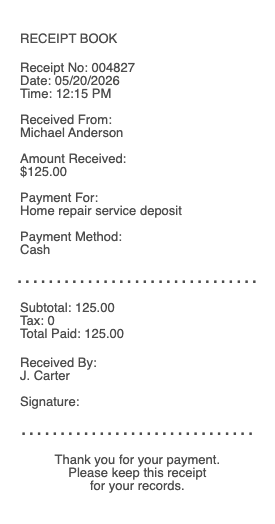
What a Receipt Book Is — And Why It Still Exists in 2026
A traditional receipt book is a physical pad — usually 50 to 100 pages of pre-printed blank receipt forms — sold under brands like Adams, TOPS, Rediform, Pukka, and Skilcraft. Each page is sequentially numbered (e.g., 001 through 100) and includes carbon paper or carbonless duplicating sheets so that writing on the top page automatically creates an identical copy underneath. The original goes to the customer; the carbon copy stays in the book for the seller's records.
Despite the universal availability of digital alternatives, receipt books remain a $50+ million annual market in the US because they have practical advantages:
No electronics needed — works at farmers' markets, garage sales, food trucks, in rural areas without reliable internet, and during power outages
Tamper-evident — carbon copies physically prove the receipt wasn't altered after the fact
Sequential numbering built in — the book itself enforces audit-friendly numbering
Legal weight — accepted as evidence in small claims court and tax audits without question
No subscription, no login, no battery — once bought, the book costs nothing to use
Where to Buy a Receipt Book (And Why Some People Stop)
Physical receipt books are available at:
Office supply stores — Staples, Office Depot, OfficeMax (typically $4–$12 per book)
Big-box retailers — Walmart, Target, Costco (often cheapest)
Amazon — widest selection of brands and formats
Drugstores — CVS, Walgreens, Rite Aid (limited selection)
Specialty office suppliers — Quill, Uline (bulk pricing for business buyers)
The "receipt book near me" search (1,100 monthly searches) reflects this physical-retail intent. Many buyers eventually switch to digital generation after experiencing the receipt book's downsides:
You run out — books fill up, especially for active rental properties or busy food trucks
Lost books — losing the receipt book means losing months of records
Fade and water damage — carbon copies and ink can degrade
No search — finding the receipt for a specific date in a stack of books is painful
No backup — fire, flood, or theft destroys irreplaceable records
Hard to share — sending a carbon copy to your accountant requires scanning
How to Fill Out a Receipt Book Correctly
"how to fill out a receipt book" gets 900 monthly searches — a strong signal that even people who own one aren't always sure of the convention. The proper format:
Receipt number — already pre-printed on most books; if not, write the next sequential number
Date — current date (never backdate)
Received from — the payer's name and contact info
Amount in figures — e.g., $500.00
Amount in words — "Five hundred dollars and 00/100" (this protects against tampering)
For (purpose) — what the payment was for ("Rent for May 2026" or "Invoice #1234 paid in full")
Payment method — cash, check #1234, Zelle ref XYZ, etc.
Account amount before this payment (if applicable) and balance remaining after
Signature — recipient signs both copies (or initials)
Press firmly enough that the carbon copy clearly transfers. For receipts over $500, two signatures (recipient + witness) strengthen the legal weight further.
Rent Receipt Book — The Single Biggest Use Case
"rent receipt book" gets 800 monthly searches. Landlords are the largest single category of receipt-book buyers because many US states (California, Maryland, Massachusetts, New York, and others) legally require landlords to issue receipts for cash rent payments. A dedicated rent receipt book serves several purposes:
Legal compliance — satisfies state-mandated cash receipt rules
Dispute prevention — eliminates "I paid rent already" arguments
Tax records — required for landlord Schedule E income reporting
Eviction defense documentation — receipt sequence proves payment history
Modern landlords often use a digital alternative — generating PDF rent receipts at the time of payment and emailing them to tenants while keeping a copy in their accounting system. This achieves the same legal and practical goals with better long-term durability.
Receipt Book Format Variants
Receipt books come in several formats — the right one depends on your business type:
2-part carbonless — original + 1 copy. Standard for small businesses.
3-part carbonless — original + 2 copies (e.g., customer, business, accountant). Better for businesses with formal accounting.
Cash receipt book — specifically labeled for cash transactions. The "format of cash receipt book" search gets 350 monthly searches.
Rent receipt book — pre-formatted with fields for property address, lease holder, period covered
Sales receipt book — itemized lines for goods or services, designed for retail or service businesses
Money receipt book — generic, can be used for any transaction type
Numbered duplicate book — generic two-part format usable as receipt or any other dual-copy document
Digital Receipt Generator vs Paper Receipt Book — Which Wins for Your Use Case
The honest comparison:
Factor | Paper receipt book | Digital generator |
|---|---|---|
Cost | $4–$12 per book (lasts ~50–100 transactions) | Free |
Setup time | Buy at store | 30 seconds online |
Sequential numbering | Built in | Manual or automatic |
Long-term storage | Books take physical space; fade over years | Cloud backup, searchable forever |
Audit weight | Strong (tamper-evident carbon copies) | Strong (PDF timestamps, IP records) |
Sharing with accountant | Scan first | Email PDF directly |
Works without internet | Yes | No (generation requires connection) |
Customization | Limited to pre-printed format | Fully customizable |
For most modern small businesses, digital wins on cost, durability, searchability, and customization. Paper still wins for off-grid use cases (food trucks at festivals, garage sales, rural markets) and for anyone who genuinely prefers handwritten documentation.
Generate a Digital Receipt — The "Receipt Book" Alternative
Use the generator above to create a single receipt in seconds — sequential numbering, carbonless-style two-copy layout, printable on standard paper if you want a physical version. Download as PDF or PNG. For high-volume use (landlords with multiple tenants, freelancers with recurring clients), the digital approach replaces the receipt book entirely while giving you searchable history, automatic backup, and no risk of running out of pages.
How to Spot a Fake Receipt Book Receipt
Counterfeit or altered receipt-book receipts are a common form of small-claims fraud, especially in landlord-tenant disputes. Genuine receipts show: matching ink color and pressure across both copies, sequential numbering that aligns with the issuer's other receipts, amount in both digits and words with no whitespace where alterations could be inserted, same handwriting throughout (or all-typed if from a digital book), and complete fields (no blank "purpose" or "received from" lines). Receipts where the amount appears to have been changed (different ink, smudges, gaps in writing), where the receipt number doesn't match the book's expected sequence, or where the carbon copy is missing should be challenged.
Receipt Book Tax Records — Retention Requirements
The IRS requires US businesses to keep receipt records for at least 3 years, but extends to 7 years for major items, partial business losses, or any year with carryover deductions. State tax authorities sometimes require longer (California: 4 years for sales tax records). For business audit purposes, this means keeping receipt-book duplicate copies — not just original receipts — for the full retention period. Paper receipt books take significant physical space if you're a busy small business; many operators scan completed books into PDF at the end of each year for digital archive, then discard the physical books. This is legally acceptable in all US states.
Receipt Book vs Receipt Generator for Rent Income (Schedule E)
Landlords filing Schedule E (Supplemental Income and Loss for Rental Properties) on their federal tax return need detailed records of all rental income received during the tax year. The IRS specifically requests payment dates, amounts, and proof of payment for any audit. A receipt book provides this naturally — the sequence of stubs IS the payment history. A digital receipt generator provides the same but with the added benefit of searchability ("find all April rent payments across all properties") and automatic backup. For landlords with multiple properties, digital wins decisively on bookkeeping efficiency.
Receipt Book Pricing and Bulk Options
Office supply pricing for receipt books in 2026: Adams 2-part carbonless (50 sets) typically $5–$8 at Staples or on Amazon. Adams 3-part carbonless (50 sets) usually $7–$10. TOPS sales receipt book around $6–$9. Skilcraft government-spec receipt books bulk-priced for government and military buyers via GSA contracts. For businesses going through 5+ books per year, bulk packs (10 books for $40–$50) save money. For comparison, a digital generator producing the equivalent volume of receipts is free.
Generate Receipts Online — The Digital Receipt Book Alternative
Our online receipt generator serves the same function as a traditional carbonless receipt book — but with sequential numbering, searchable history, automatic backup, and no risk of running out of pages. Fill in payer name, amount in digits and words, payment method, purpose, and receipt number. Download as PDF or PNG instantly, print on standard paper for physical handoff, or email directly to the payer. Works for landlords issuing legally-required cash rent receipts (replaces dedicated rent receipt books), small business owners tracking cash sales, freelancers collecting payment at the point of service, nonprofits issuing donation acknowledgments, food trucks and festival vendors who need physical receipts for buyers who pay cash (print at home, take to event), and anyone reconstructing lost receipts from older books. Sequential numbering, written-words amount notation, and digital signature support included — built to provide the same legal weight as a traditional Adams or TOPS carbonless receipt book.
Frequently
asked questions
Everything you need to know about the product and billing.