A rental receipt documents the rental of equipment, vehicles, tools, party supplies, venues, or any item rented for a fixed period — confirming what was rented, the rental dates, the rate, deposit, and return condition. This is distinct from a monthly housing rent receipt; it covers the broad world of short-term rentals: a moving truck, a power tool from the hardware store, a tuxedo, a bounce house, an event hall, camera gear, or construction equipment. With "rental receipt" and "rental receipt template" together hitting ~2,400 monthly US searches (KD 1–3), this is a high-value, low-competition format. Generate a clean rental receipt in seconds with our tool above.
Rental Receipt
Add custom logo
Edit line items
Choose payment method
Add/remove elements
Customize business information
Choose font
Rental Receipt vs Rent Receipt — Two Different Documents
It's a common confusion. A rent receipt documents a monthly housing payment from a tenant to a landlord. A rental receipt documents renting an item or space for a fixed period — equipment, vehicles, tools, venues, supplies. Different transactions, different fields.
This page covers the second type — item and equipment rentals. If you're looking for a housing rent receipt, use our dedicated rent receipt template instead.
What's on a Rental Receipt
Rental company or owner name and address
Renter (customer) name and contact
Rental agreement / receipt number
Description of the rented item(s) — make, model, serial number, or item identifier (e.g. "DeWalt 20V Drill, SN# 4827" or "16-ft Box Truck, plate ABC123")
Rental period: pickup date/time and return date/time
Rate: hourly, daily, weekly, or flat — with the calculation shown
Quantity (for multiple items)
Security deposit collected (and whether refundable)
Damage waiver / insurance if added
Cleaning, fuel, or restocking fees if applicable
Late return / overage charges
Subtotal, tax, and total
Payment method
Return condition note and signatures
Common Rental Receipt Use Cases
Equipment and tool rental. Home Depot Tool Rental, Sunbelt Rentals, United Rentals, local hardware stores. Contractors and DIYers rent drills, saws, scaffolding, generators, pressure washers. The receipt documents the rental for job-cost accounting or expense reimbursement.
Moving truck rental. U-Haul, Budget Truck, Penske, Home Depot truck rental. The receipt (with mileage and fuel charges) is needed for relocation expense documentation or business moving deductions.
Party and event rental. Tables, chairs, tents, linens, bounce houses, sound systems, photo booths. Event planners and individuals need receipts for budgeting and client billing.
Venue and space rental. Event halls, meeting rooms, studios, co-working day passes, storage units rented short-term. Businesses expense these; individuals document them for shared-cost events.
Specialty rentals. Camera/photography gear, formalwear (tuxedos, gowns), medical equipment (wheelchairs, crutches), sporting equipment (skis, kayaks, bikes), musical instruments.
Car and vehicle rental. While we have dedicated pages for Hertz, Enterprise, Avis, and Budget, a generic rental receipt covers independent and local car rental agencies.
Security Deposits and Damage Waivers on Rental Receipts
Most rentals involve a refundable security deposit held against damage or late return. The rental receipt should clearly show: the deposit amount, whether it's refundable, the conditions for return, and (on the final receipt) whether it was returned or applied to charges. For disputes — "they kept my deposit unfairly" — the original rental receipt showing the item's condition and the deposit terms is the key evidence.
Damage waivers (optional insurance, typically 10–15% of the rental cost) appear as a separate line. As with car rentals, your own insurance or credit card may already cover rented equipment — making the waiver redundant. Document it separately so you can evaluate or dispute it.
Rental Receipts for Business and Taxes
Equipment and tool rentals are fully deductible business expenses (Schedule C line 20a — "Rent or lease: vehicles, machinery, and equipment"). Unlike purchases that must be depreciated, rentals are expensed in full in the year paid. The rental receipt is the documentation — it must show the item rented, the business purpose, the rental period, and the amount. For contractors billing clients, the rental receipt is passed through as a reimbursable job cost.
Generate a Rental Receipt
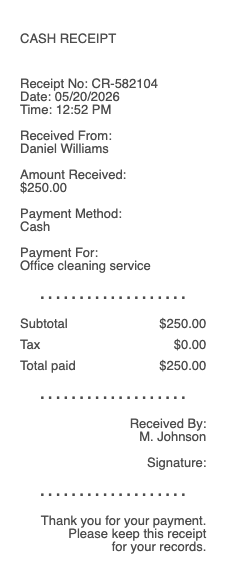
Use the generator above to create a clean rental receipt with all line items: rental company name, renter name, item description with serial/identifier, rental period (pickup and return), rate and calculation, security deposit, damage waiver, fees, subtotal, tax, total, and payment method. Download as PDF or PNG instantly.
Tool & Equipment Rental — Home Depot, Sunbelt, United Rentals
The equipment rental market has distinct receipt conventions. Home Depot Tool Rental charges by 4-hour, daily, weekly, or monthly blocks and the receipt shows the rate tier used plus a refundable deposit. Sunbelt Rentals and United Rentals (the two largest commercial equipment renters) issue detailed receipts with equipment ID numbers, delivery/pickup charges, environmental fees, and rental protection plans. For contractors, these receipts are job-cost documentation — they must tie to a specific project for accurate billing and tax treatment. Generate a clean replacement if the original was lost on the job site.
Moving Truck Rental Receipts — U-Haul, Penske, Budget Truck
Moving truck rentals have the most complex rental receipts because they combine: base daily rate, per-mile charge (or unlimited miles for one-way), fuel (returned full or charged), environmental fee, optional SafeMove/damage coverage, dolly and pad rentals, and one-way drop fees. U-Haul, Penske, and Budget Truck each format these differently. For relocation expense reports (especially employer-reimbursed moves or military PCS moves), the itemized truck rental receipt is required. Note: as of the 2017 TCJA, most personal moving expenses are no longer federally deductible except for active-duty military — but employers reimbursing moves still require the receipt.
Party & Event Rental Receipts
Event rentals — tables, chairs, tents, linens, dinnerware, bounce houses, AV equipment — generate receipts that event planners use for client billing and individuals use for budgeting. These receipts typically show: per-item rental rate, quantity, rental period (often a single event day plus setup/teardown), delivery and pickup charges, a damage/cleaning deposit, and replacement-cost values for each item (in case of damage). For wedding and large-event planning, the rental receipt is one of the biggest single line items and essential for the event budget reconciliation.
Rental Deposit Disputes — Why the Receipt Matters
The most common rental conflict is the security deposit: the renter believes they returned the item in good condition; the rental company claims damage and withholds the deposit. The original rental receipt is the primary evidence in this dispute — it documents the deposit amount, the agreed return condition, and the rental terms. Best practice for any rental: photograph the item at pickup and return, keep the rental receipt, and get the return condition noted in writing. If a company unfairly withholds a deposit, the receipt plus photos support a small-claims case or credit-card dispute.
Generate a Rental Receipt — Free, No Login
Our rental receipt generator creates a clean receipt for any equipment, vehicle, tool, venue, or supply rental: rental company name, renter name, item description with make/model/serial, rental period (pickup and return dates), rate (hourly/daily/weekly with calculation), quantity, security deposit, damage waiver, delivery/cleaning/late fees, subtotal, tax, total, and payment method. Works for tool and equipment rentals (Home Depot, Sunbelt, United Rentals), moving truck rentals (U-Haul, Penske, Budget Truck), party and event rentals (tables, tents, AV), venue and studio bookings, specialty rentals (camera gear, formalwear, medical equipment, instruments), and security-deposit dispute documentation. For monthly housing rent, use our dedicated rent receipt template instead. Download as PDF or PNG instantly.
Frequently
asked questions
Everything you need to know about the product and billing.
What's the difference between a rental receipt and a rent receipt?
A rent receipt documents a monthly housing payment from a tenant to a landlord. A rental receipt documents renting an item or space for a fixed period — equipment, vehicles, tools, venues, party supplies, camera gear, formalwear. They're different transactions with different fields. This page covers item/equipment rentals; for housing payments, use a dedicated rent receipt template.
What should a rental receipt include?
A complete rental receipt shows: rental company and renter names, rental agreement number, description of the rented item (make, model, serial number), rental period (pickup and return date/time), the rate and how it was calculated (hourly/daily/weekly), security deposit and whether it's refundable, any damage waiver or insurance, delivery/cleaning/late fees, subtotal, tax, total, payment method, and return-condition notes with signatures.
Are equipment rentals tax-deductible?
Yes — equipment, tool, and vehicle rentals are fully deductible business expenses (Schedule C line 20a, 'Rent or lease: vehicles, machinery, and equipment'). Unlike purchases that must be depreciated over years, rentals are expensed in full in the year paid. The rental receipt is the required documentation — it must show the item rented, business purpose, rental period, and amount. Contractors pass rental receipts through to clients as reimbursable job costs.
How do I dispute a withheld rental security deposit?
The original rental receipt is your primary evidence — it documents the deposit amount, agreed return condition, and rental terms. Best practice: photograph the item at pickup and return, keep the receipt, and get the return condition noted in writing. If the company unfairly withholds the deposit, the receipt plus dated photos support a small-claims case or a credit-card chargeback. If you lost the receipt, generate a replacement showing the original rental terms and deposit amount.
Do I need a rental receipt for a moving truck?
Yes, especially for employer-reimbursed moves or military PCS relocations. Moving truck rental receipts (U-Haul, Penske, Budget Truck) are complex — base daily rate, per-mile or unlimited-mile charge, fuel, environmental fee, damage coverage, dolly/pad rentals, and one-way drop fees. Note that since the 2017 TCJA, most personal moving expenses are no longer federally deductible except for active-duty military, but employers reimbursing moves still require the itemized receipt.
Does my insurance cover rented equipment, or do I need the damage waiver?
Often your existing coverage applies. Homeowner's or renter's insurance may cover rented equipment, and some credit cards extend protection to rentals. The rental company's damage waiver (typically 10-15% of the rental cost) may be redundant. Document the waiver as a separate line on the receipt so you can evaluate whether it's necessary or dispute it later. For high-value or commercial equipment rentals, verify your coverage limits before declining the waiver.