A sales receipt is the document issued at the moment of a sale — proof that a buyer paid for goods or services and the transaction is complete. Unlike an invoice (which requests future payment) or a receipt of payment (which confirms a separate payment was received), a sales receipt is a single document combining both: it lists what was sold, when, for how much, and confirms the buyer paid. Every retail purchase, restaurant meal, gas-station fill-up, and small-business sale generates one. With 2,000 monthly US searches for "sales receipt" alone (3,000+ across the cluster) and a remarkably low KD of 6, this is one of the highest-value templates for small business owners, retail operators, freelancers, and service providers. Generate a clean sales receipt in seconds with our tool above.
Sales Receipt
Sales Receipt vs Invoice vs Receipt of Payment — Why the Distinction Matters
These three documents handle different points in the transaction cycle:
Invoice — issued before payment. Says "you owe us $X by [date]." Common for B2B services, contractor work, and any sale where payment is delayed.
Sales receipt — issued at the moment of payment. Says "you paid $X today for these items." Common for retail, restaurants, gas stations, point-of-sale transactions.
Receipt of payment — issued after a separately-invoiced payment is received. Says "we received your $X payment for invoice #1234." Closes an open invoice.
The sales receipt is the most common of the three because it covers the most common transaction pattern: instant payment for instant delivery. A coffee at Starbucks, a tank of gas at Shell, a sweater at Target, a haircut at the barber — all generate sales receipts, not invoices.
What Belongs on a Sales Receipt
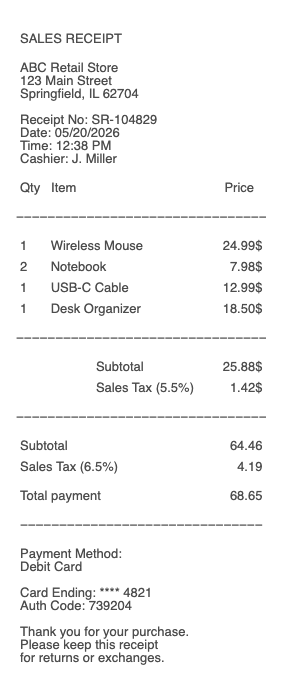
For a sales receipt to be legally valid and accounting-ready, it should include:
Seller name and business address — the legal name of the business and its physical or registered address
Seller's tax identification — EIN (US), VAT number (UK/EU), GST number (Canada/Australia/India), as required by jurisdiction
Receipt or transaction number — unique sequential ID
Date and time of sale
Itemized list of goods or services sold — each line with product/service description, quantity, unit price, and line total
Subtotal before tax
Sales tax applied — broken out by jurisdiction if multiple apply
Total amount — the final amount paid
Payment method — cash, check, card (last four digits), gift card, store credit, mobile payment, etc.
Buyer name — required for B2B sales and many tax-exempt transactions; optional for retail consumer sales
Return policy — most retailers include the return window and conditions on the receipt itself
Tip or gratuity — separately noted for restaurants and service businesses
Sales Receipt Requirements by Business Type
Retail stores. Sales receipts are essentially universal — most state laws require them for any taxable sale. The receipt must include the seller's name, sale date, items purchased, and total. Sales tax must be itemized separately from the subtotal in most states.
Restaurants and bars. Sales receipts at restaurants include itemized food and beverage orders, sales tax, and a clearly-marked tip line for gratuity. Many states require the tip to be itemized separately so it doesn't impact sales tax calculations. For business expense reports, the tip amount must be visible on the receipt.
Service businesses. Hairstylists, mechanics, lawn services, cleaning services, plumbers, electricians — all should issue sales receipts at the point of service completion. The receipt should describe the service performed (not just "service rendered"), the time spent or work performed, parts or materials used, labor charges, and total. For automotive and home repair specifically, detailed receipts are often required for warranty claims.
Online retail. E-commerce sales receipts must include the same elements as physical-store receipts, plus shipping charges, shipping address, billing address, and order tracking information. Most states require electronic delivery (email) of the receipt at the time of sale.
Freelance and consulting. When a freelancer collects payment at the point of service delivery (rather than billing later via invoice), they issue a sales receipt — itemizing services rendered, hours billed, hourly or project rate, and total. For 1099 contractors, sales receipts are the primary source documentation for year-end income reporting.
Sales Tax Requirements — Why the Tax Line Matters
For any taxable sale in the US, the sales receipt must itemize sales tax separately from the subtotal. State laws vary:
Most states require the tax to be shown as a separate line item, not bundled into the item price.
Some local jurisdictions add additional layers: city sales tax, county tax, district tax, tourism taxes. Each may need to be itemized on the receipt depending on state law.
Five states have no statewide sales tax (Alaska, Delaware, Montana, New Hampshire, Oregon) — but local taxes still apply in some Alaska and Montana jurisdictions.
Tax-exempt sales (nonprofits, government, resale) must show the tax line as $0 with an explicit notation explaining the exemption.
For business buyers claiming the sale as a deductible expense, the broken-out tax line on the receipt is essential — without it, the deduction is harder to substantiate during an audit.
Returns and Refunds — Why Sales Receipts Are Critical
Most retailers require the original sales receipt for returns or refunds, especially within standard return windows (typically 30–90 days). Without the receipt, the buyer's options are:
No return possible — most stores' default policy without receipt
Store credit at lowest selling price — common compromise at department stores and big-box retailers
Card lookup — some stores can look up the transaction using the original credit card if used
Manager approval — case-by-case
For high-value purchases (electronics, jewelry, furniture), the sales receipt is also required for warranty claims. Manufacturers typically require proof of purchase before honoring warranty service, and the sales receipt is the standard proof.
Generate a Sales Receipt in Seconds
Use the generator above to create a professional sales receipt with all required line items: seller business name and tax ID, transaction number, date, itemized goods and services, subtotal, sales tax broken out by jurisdiction, total, payment method, and return policy. Download as PDF or PNG instantly — no login required. Works for retail stores, restaurants, service businesses, online sellers, freelancers, and consultants.
Sales Receipt Numbering — Sequential Is Non-Negotiable for Small Businesses
The single most important administrative practice for any small business issuing sales receipts: sequential receipt numbering. A retail store issuing receipts SR-001, SR-002, SR-003... should never skip a number. If a receipt is voided, mark it "VOID" and keep the slot. Tax auditors examine receipt sequence for anomalies — gaps suggest unreported sales (cash income that bypassed the POS system). For digital systems, this happens automatically. For handwritten receipt books, it requires discipline. The IRS pattern-matches against the expected revenue-to-receipts ratio for your business category — gaps trigger closer review.
Sales Receipts for Restaurants and Tip Tracking
Restaurants face a unique sales receipt requirement: the tip line must be separately recorded for both employee tip income reporting and sales tax calculation. Most US states do not charge sales tax on gratuity, so the receipt must clearly show subtotal, sales tax, and tip as three distinct lines. For tipped employees, the receipt is the source document for the federal "tip credit" calculation that affects minimum wage compliance. For corporate diners expensing meals, the tip amount must be visible — finance teams typically reimburse meals up to 18–20% tip, but only with a receipt showing the tip explicitly.
Sales Receipts for Online and Marketplace Sellers
If you sell on Etsy, Amazon, eBay, Shopify, Facebook Marketplace, or similar platforms, the marketplace typically issues an automated sales receipt to the buyer — but the receipt is in the marketplace's format, not yours. For brand-building and customer relationship purposes, many serious online sellers issue their own supplemental sales receipt on letterhead or with branded design, sent via email alongside the marketplace's automated receipt. The supplemental receipt covers the same fields but adds the seller's branding, return instructions, and any custom messaging. It's not legally required but improves perceived professionalism.
What to Do When a Sales Receipt Is Lost or Faded
Lost sales receipts create real problems: no warranty claims, no returns, no tax deduction support, no proof of purchase. Most retailers can reproduce a receipt from a card transaction up to 12 months after sale — contact the store with the date and approximate transaction amount. For cash purchases with no card record, the receipt is essentially unrecoverable through official channels. For tax purposes, generate a clean replacement receipt with the original transaction details — the IRS accepts reconstructed receipts in good faith when supported by other evidence (bank withdrawals, calendar entries, witness statements). For warranty claims specifically, contact the manufacturer directly with the product serial number — some honor warranty service even without the original purchase receipt.
Generate a Sales Receipt Online — Free, No Login
Our sales receipt generator creates a professional, properly-formatted sales receipt for any retail, restaurant, service, or online transaction. Add your business name and tax ID (EIN, VAT, or GST number), sequential transaction number, sale date and time, itemized goods or services with quantity and unit price, subtotal, sales tax broken out by jurisdiction (state, county, city, or district), total amount, payment method, customer name (optional for retail), tip line (for restaurants), and return policy. Download as PDF or PNG instantly. Works for retail stores documenting daily POS sales, restaurants and bars with itemized food and gratuity tracking, service businesses (hairstylists, mechanics, lawn services, cleaning, plumbers, electricians) issuing point-of-service receipts, online sellers needing supplemental branded receipts beyond marketplace defaults, freelancers and consultants billing at the point of service delivery, and small businesses maintaining sequential receipt numbering for IRS audit compliance.
Frequently
asked questions
Everything you need to know about the product and billing.