A simple receipt is the minimalist receipt format — exactly the fields you need, nothing extra. For freelancers, sole proprietors, garage-sale sellers, and anyone who needs to document a transaction quickly without complex itemization, the simple format works. With 700 monthly US searches for "simple receipt template" and broader cluster across "simple receipt," "easy receipt template," "basic receipt," this is one of the most-requested receipt designs. Generate a clean simple receipt in seconds with our tool above.
Simple Receipt
Add custom logo
Edit line items
Choose payment method
Add/remove elements
Customize business information
Choose font
What Makes a Receipt "Simple"
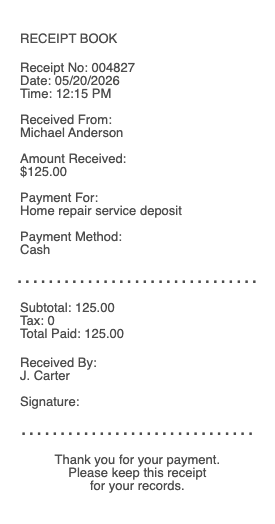
A simple receipt has only the essential elements — no logos, no SKU codes, no multi-jurisdiction tax lines, no "thank you for shopping" footer. Just the facts:
"Receipt" title at the top
Receipt number (sequential or date-based)
Date
Received from (the payer's name)
The amount in digits and (ideally) words
For (what the payment was for — one short line)
Received by (your name)
Signature
That's it. The format fits on a single half-page slip and contains all the legally required information.
When the Simple Format Is the Right Choice
Simple receipts are best for:
Cash payments between individuals — friends settling shared expenses, paying back a personal loan, splitting a bill
Garage sales — quick documentation of any item over $25
Tip jar payments at small businesses without a POS system
Babysitter and household worker payments — straightforward, no itemization needed
Tutoring sessions — date, hour, amount, parent name
Repaying a loan or shared expense
Small donations to community groups without formal 501(c)(3) forms
Renting personal items (tools, equipment, supplies)
For these scenarios, a complex itemized receipt would be overkill. The simple format provides legal documentation without unnecessary complexity.
What's NOT on a Simple Receipt (And Why)
Things the simple format intentionally leaves out:
Sales tax — for personal transactions, there's no merchant sales tax to collect
SKU codes — no inventory system tracking individual items
Loyalty program info — no rewards points to track
Return policy — for personal sales, returns are governed by mutual agreement, not store policy
Multi-jurisdiction tax breakdown — not applicable to private transactions
Cashier ID, register number — no POS system
The trade-off is intentional: simpler format = faster to write/generate, but less suitable for complex business transactions.
Simple Receipt vs Detailed Receipt — When Each Wins
Use a simple receipt when:
The transaction is between individuals (not a business)
The amount is small to moderate (under $1,000)
There's no complex itemization needed
You want a quick, legible record
Use a detailed/itemized receipt when:
It's a business transaction requiring expense report submission
The IRS or tax authority may audit
Insurance or FSA/HSA reimbursement is involved
The transaction has multiple items needing breakdown
You need to provide proof of specific items purchased
Generate a Simple Receipt
Use the generator above to create a clean, minimalist receipt with just the essentials: receipt number, date, payer name, amount in digits and words, brief description of purpose, your name as recipient, and signature line. Download as PDF or PNG in seconds.
Why Simple Is Often Better Than Detailed for Personal Transactions
For non-business transactions between individuals, an overly-complex receipt can look suspicious — like you're inventing a paper trail. A simple, clean receipt with the essential fields (date, parties, amount, purpose, signature) carries more credibility because it matches the actual nature of the transaction. A handwritten note on lined paper saying "Received $200 from John on 5/25/26 for selling my used bicycle. — Sarah" is more honest-looking and legally durable than a fancy itemized invoice with phantom SKU codes for a personal sale.
Simple Receipt Books — Still a Thing
Paper "simple receipt" books are sold at office supply stores under the same brands as full receipt books (Adams, TOPS, Rediform) but with a stripped-down field layout. They're popular for: tradespeople accepting cash for small jobs (lawn care, handyman), farmers markets and craft fair vendors, tutoring and music teachers, and any side-hustle operator who needs a quick on-the-spot receipt. The carbon-copy structure provides immediate buyer and seller copies. For one-off transactions, the paper book is overkill; for recurring small transactions, it's convenient. Digital alternatives work equally well — generate the simple format on demand.
Simple Receipt for Bill Payment Confirmation
If you pay a service bill in person (cash to a utility, lawn service, monthly rent in cash to a private landlord), the recipient should give you a simple receipt confirming the payment. A simple format here serves a specific purpose: dispute prevention. If the recipient later claims you didn't pay, the signed receipt is your defense. Best practice: insist on the receipt at the moment of payment, before you hand over the cash. For monthly recurring payments, save all simple receipts in a labeled folder for the tax year — they're admissible evidence in any dispute.
Simple Receipt Variations by State
Some US states have specific simple-receipt requirements: California (Civil Code §1499) requires landlords to provide receipts for cash rent that show the payer, date, amount, property address, and period covered. Maryland (Real Property §8-208) requires similar. Even where state law doesn't mandate the receipt, having it provides legal protection. The "simple receipt" format satisfies all of these state-mandated requirements when complete. For tenants paying cash rent: never accept "I'll give you a receipt later" — get the receipt at the moment of payment.
Generate a Simple Receipt — Free, No Login
Our simple receipt generator creates a clean, minimalist receipt with only the essential fields: receipt number, date, payer name, amount in digits and (recommended) words, brief description of what the payment was for, recipient name, and signature line. No logos, no SKU codes, no multi-jurisdiction tax breakdowns, no return policies — just the legally required information for personal or small-business transactions. Works for cash payments between individuals, garage sales, babysitter and tutor payments, freelance work, repaying personal loans, rent paid in cash to a private landlord, and any peer-to-peer transaction where complex itemization would be overkill. Download as PDF or PNG instantly.
Frequently
asked questions
Everything you need to know about the product and billing.
What is a simple receipt?
A simple receipt is the minimalist receipt format — only the essential fields needed for legal documentation, without complex itemization, multi-jurisdiction taxes, or merchant branding. It contains: receipt number, date, payer name, amount (digits and words), brief description of the payment purpose, recipient name, and signature. Used for personal transactions, peer-to-peer payments, garage sales, freelance work, and any small-scale transaction where a complex retail receipt would be overkill.
When should I use a simple receipt instead of an itemized one?
Use a simple receipt when the transaction is between individuals (not at a business), the amount is small to moderate (under $1,000), there's no complex itemization needed, and you want a quick, legible record. Use itemized/detailed receipts for business transactions requiring expense report submission, IRS-audited deductions, FSA/HSA reimbursement, insurance claims, or any time multiple items need to be broken down separately.
Is a simple receipt legally valid?
Yes. A simple receipt has the same legal weight as a complex retail receipt when it contains the required information: parties involved (payer and recipient), date, amount, payment method (or 'Cash'), and signature. Small claims courts accept simple receipts as evidence. The IRS accepts them for tax documentation. Many US states actually require landlords to provide simple receipts for cash rent payments — the format satisfies state-mandated requirements when complete.
Why use a simple receipt instead of a more detailed one?
Three reasons: speed (faster to write or generate), credibility (matches the actual nature of personal transactions — overly complex receipts can look suspicious), and clarity (the essential information is more visible without distraction). For non-business transactions between individuals, a stripped-down format is often more appropriate and more legally defensible than an inflated itemized version with phantom details.
What's required to make a simple receipt legally durable?
Four elements: amount written in BOTH digits and words ('$500.00 — Five hundred dollars and 00/100' — prevents alteration), accurate date (no backdating), clear identification of both parties (payer and recipient names), and at least the recipient's signature. For higher-value transactions over $500, get both signatures. Save your copy in a secure location; give the original to the payer.
Can I use a simple receipt for tax purposes?
Yes. The IRS accepts simple receipts as evidence of payments for tax-deductible expenses (charitable donations, medical expenses, business expenses on Schedule C). The receipt must include date, amount, recipient, and payment method. For Schedule A medical deductions, the simple receipt works for under-$250 expenses; for $250+ donations, the IRS requires a more detailed acknowledgment from the receiving 501(c)(3) organization. Keep all simple receipts for at least 3 years (7 for major items) per IRS recommendations.