An airdrop receipt records crypto tokens distributed to your wallet for free — usually to reward early users of a protocol or to decentralize its governance. “Free,” though, is misleading in one important way: the IRS treats airdropped tokens as taxable income the moment you control them. This page explains what an airdrop record shows, how eligibility and claiming work, the tax rule, and the scam airdrops you should never touch.
Airdrop Receipt
Add custom logo
Edit line items
Choose payment method
Add/remove elements
Customize business information
Choose font
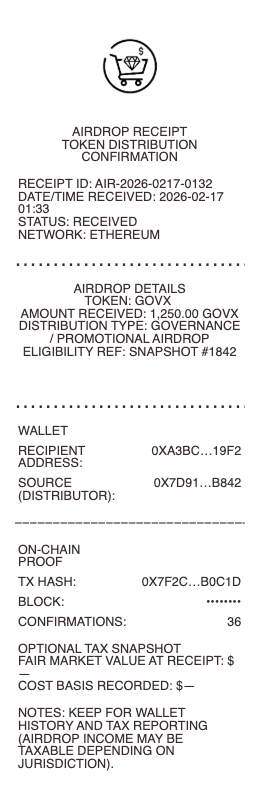
What’s on an Airdrop Record
The token received and the amount
The project/protocol that distributed it
The date received or claimed
The fair-market USD value at that time
The transaction hash and any gas paid to claim
The receiving wallet address
Whether it was a direct drop or a claim you initiated
How Airdrops Work — Snapshots and Claiming
Airdrops reward specific wallets, and eligibility is usually decided by a snapshot: at some past date, the project records which addresses met a criterion — used the protocol, held a token, bridged funds — and those wallets qualify. Some airdrops arrive directly in your wallet; others require you to claim them on the project’s official site, which is an on-chain transaction that costs gas. Famous examples decentralized major protocols — the UNI airdrop to early Uniswap users, ENS to name-holders, ARB to Arbitrum users. The distinction between a direct drop and a claim matters for your records: a claim has a clear transaction and date, while a direct drop’s timing is when it landed. Either way, the moment you can access and use the tokens is the moment that counts — which, as the next section explains, is exactly when the tax clock starts.
Airdrops Are Taxable Income
This is the rule that surprises people: an airdrop is ordinary income. Under IRS guidance (Revenue Ruling 2019-24), tokens received in an airdrop are taxed at their fair-market value when you gain dominion and control — essentially when they hit your wallet and you can transfer or sell them. So a “free” airdrop creates a reportable income event valued in USD at receipt, which is exactly what your record should capture. Then, as with other crypto, selling those tokens later is a separate capital gain or loss, with cost basis equal to the value you already reported as income. This can get awkward: if you’re taxed on an airdrop’s value at receipt and the token then crashes before you sell, you can owe income tax on value you no longer have. Documenting the FMV at receipt is what keeps both the income and the later gain/loss correct.
Scam Airdrops — What Not to Touch
Not every airdrop is a gift. Wallets frequently receive unsolicited “dust” tokens — worthless tokens sent to random addresses as bait. Interacting with them is dangerous: the token’s name may point to a phishing site, and approving or swapping it can trigger a wallet-draining contract that steals your real assets. The safe rule is simple: never interact with a token you didn’t expect, don’t visit a URL embedded in a mystery token, and only ever claim legitimate airdrops from the project’s official, verified channels. A real airdrop never requires you to connect to an unknown site, pay to “unlock” tokens, or share your seed phrase. Keeping records of the legitimate airdrops you actually claimed — and ignoring the rest — protects both your taxes and your wallet. When in doubt, a mystery token is a scam, not a windfall.
Related crypto receipts: see also our staking reward receipt guide and our Ethereum receipt guide.
Create an Airdrop Receipt
Our generator produces a clean airdrop record — token, amount, project, date, fair-market USD value at receipt, and transaction hash — as a readable PDF for your income records or a crypto tax file when you want a legible summary of a legitimate airdrop.
Use it responsibly: recreate only real airdrops you actually received, with their true amounts and values. Fabricating airdrop receipts to misstate crypto income or manufacture a cost basis is tax fraud — airdrops are recorded on a public blockchain and can be verified. And never use any receipt to lend credibility to a fake or scam airdrop. The on-chain record is authoritative; this tool is for legitimate record-keeping only.
Frequently asked questions
Everything you need to know about the product and billing.
What does an airdrop record show?
The token received and amount, the project that distributed it, the date received or claimed, the fair-market USD value at that time, the transaction hash and any gas paid to claim, the receiving wallet, and whether it was a direct drop or a claim you initiated.
How do airdrop eligibility and claiming work?
Eligibility is usually set by a snapshot — a past date when the project recorded which wallets met a criterion (used the protocol, held a token, bridged funds). Some airdrops arrive directly; others require you to claim them on the official site, an on-chain transaction that costs gas.
Are airdrops taxable?
Yes. Under IRS Revenue Ruling 2019-24, airdropped tokens are ordinary income at their fair-market value when you gain dominion and control — when they hit your wallet and you can use them. Selling them later is a separate capital gain or loss against that value.
What happens if an airdrop crashes after I’m taxed on it?
You can end up owing income tax on the value at receipt even if the token then falls before you sell — an awkward outcome of the receipt-date rule. Documenting the FMV at receipt keeps both the income and the later capital loss correct so you can claim the loss.
How do I spot a scam airdrop?
Unsolicited “dust” tokens appear in wallets as bait — their name may point to a phishing site, and interacting can trigger a wallet-draining contract. Never interact with a token you didn’t expect, never visit its embedded URL, and only claim real airdrops from official, verified channels.
Should I claim every airdrop I receive?
No. Only claim legitimate airdrops from a project’s official channels. A real airdrop never asks you to connect to an unknown site, pay to “unlock” tokens, or share your seed phrase. When in doubt, a mystery token is a scam, not a windfall — leave it alone.