A wheel alignment receipt documents a service that adjusts your suspension angles — not the tires or brakes, but the geometry that decides how the wheels meet the road. It’s a receipt worth keeping for two reasons: alignments carry warranties (sometimes years long), and one is often done alongside new tires to protect them. This page explains what the receipt shows, including the before-and-after angle printout that sets it apart.
Alignment Receipt
Add custom logo
Edit line items
Choose payment method
Add/remove elements
Customize business information
Choose font
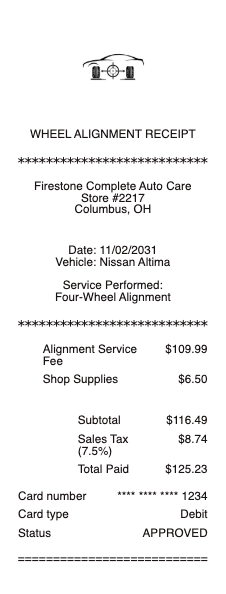
What’s on a Wheel Alignment Receipt
Shop and vehicle — make, model, and mileage
The alignment type — two-wheel (front) or four-wheel
Before and after readings — the toe, camber, and caster angles
Labor, and any parts if worn components were replaced
Whether it’s a one-time service or a warranty/lifetime alignment plan
Related work — often paired with new tires or suspension repair
Total, tax, and payment method
Toe, Camber, Caster — and the Before/After Printout
What makes an alignment receipt distinctive is the angle printout. An alignment adjusts three measurements: toe (whether the wheels point in or out), camber (their inward or outward tilt), and caster (the steering-axis angle). The machine prints each one before and after, usually with a green/red “in spec” indicator, and that readout is attached to or printed on the receipt. It’s genuinely useful: it proves the wheels were out of spec and are now corrected, which justifies the service and documents the vehicle’s condition. If you brought the car in for a pull to one side or uneven tire wear, the before column shows the culprit. Keep that printout — it’s the technical evidence behind the charge and a baseline if the problem returns.
Two-Wheel vs Four-Wheel, and Alignment With New Tires
Alignments come in two scopes, and the receipt names which you got. A two-wheel (front-end) alignment adjusts the front axle only; a four-wheel alignment squares all four and is standard for most modern cars, AWD vehicles, and anything with adjustable rear suspension. Four-wheel costs more because there’s more to set. The single most common time to buy one is with a new set of tires — a misaligned car chews through fresh tires quickly, so shops recommend an alignment at installation to protect the investment, and the receipt often shows both on one ticket. Alignment is also needed after suspension work, hitting a bad pothole or curb, or lowering a vehicle. Reading whether you paid for two- or four-wheel — and whether it was bundled with tires — tells you exactly what the service covered.
Warranties, Tire Protection, and Getting a Copy
Alignment is one of the few services frequently sold as a warranty or lifetime plan: chains and tire retailers offer a package where you prepay and get unlimited alignments for as long as you own the car, which pays off if you drive rough roads or replace tires often. The receipt is your proof of that plan — you present it for each free follow-up alignment, so losing it can mean losing the benefit. Alignments also tie into tire warranties: some tire road-hazard or tread-life warranties require you to show alignments were done, since neglecting them voids the wear coverage. That makes the alignment receipt part of your tire-warranty paper trail too. Shops keep service history under your account or plate, so a copy is usually a quick reprint — but for a lifetime plan, hold onto the original that states the plan terms.
Related auto service receipts: see also our brake service receipt guide and our tire shop receipt guide.
Create a Wheel Alignment Receipt
Our generator reproduces a wheel alignment receipt — shop and vehicle, alignment type, the angle readings, labor, any plan, and total — as a clean PDF when you need a legible copy for a warranty plan, a tire-warranty record, or a business vehicle expense file.
Use it responsibly: recreate only a real alignment that was actually performed, with its true readings and amount. Fabricating an alignment receipt to claim a lifetime plan you didn’t buy, support a false tire-warranty claim, or invent a business expense is fraud — the shop’s records and its alignment machine’s data are the authoritative source, and they can be verified. This tool is for legitimate record-keeping only.
Frequently asked questions
Everything you need to know about the product and billing.
What does a wheel alignment receipt show?
The shop and vehicle with mileage, the alignment type (two- or four-wheel), the before and after toe, camber, and caster readings, labor and any parts, whether it’s a one-time service or a warranty plan, related work like new tires, and the total.
What are toe, camber, and caster on an alignment printout?
The three suspension angles an alignment adjusts: toe is whether the wheels point in or out, camber is their inward or outward tilt, and caster is the steering-axis angle. The machine prints each before and after with an in-spec indicator, attached to the receipt as proof.
What’s the difference between a two-wheel and four-wheel alignment?
A two-wheel (front-end) alignment adjusts only the front axle; a four-wheel alignment squares all four and is standard for modern cars, AWD vehicles, and those with adjustable rear suspension. Four-wheel costs more because there’s more to set, and the receipt names which you got.
Why do I need an alignment with new tires?
A misaligned car wears fresh tires quickly, so shops recommend an alignment when installing new tires to protect them — the receipt often shows both on one ticket. Alignment is also needed after suspension work or hitting a bad pothole or curb.
What is a lifetime alignment plan?
A prepaid package from many chains and tire retailers giving unlimited alignments for as long as you own the car. The receipt is your proof of the plan — you present it for each free follow-up, so keep it, since losing it can mean losing the benefit.
Does an alignment affect my tire warranty?
It can. Some tire road-hazard or tread-life warranties require proof that alignments were done, since neglecting them voids the wear coverage. That makes the alignment receipt part of your tire-warranty paper trail, not just a standalone service record.